







Last updated: September 2026 · Prices & availability verified for the 2026/2027 season
Last updated: September 16, 2026
Today, the phinisi is instantly recognizable as the vessel of choice for sailing Komodo National Park and Raja Ampat, its tall twin masts framing sunset photos across countless travel feeds and honeymoon itineraries. But how did a wooden sailing ship, built by hand in a small Sulawesi village, end up here? The answer lies in a legend rooted in Southern Sulawesi’s ancestral tradition, where this vessel was used for commercial trade for centuries, carrying goods across the Indonesian archipelago long before it became the icon it is today.
This article traces that journey in full, from the ship’s earliest ancestors carved into the walls of Borobudur Temple, through the Majapahit Empire’s naval power, to the 19th-century Konjo shipbuilders of Bulukumba who gave the phinisi its name and rig.
Key Takeaways
- Phinisi’s design lineage traces back to relief carvings at Borobudur Temple from the 8th to 9th centuries, not 1412 as often miscited, showing Indonesia’s outrigger sailing tradition is over a thousand years old.
- The Majapahit Empire relied on massive jong ships as its naval backbone between the 13th and 16th centuries, some reaching nearly 80 meters and carrying up to 2,000 tons of cargo.
- The modern phinisi rig itself developed among the Konjo tribe of Bulukumba, South Sulawesi, in the 19th century, blending traditional Bugis boatbuilding with Western schooner sail design.
- In 2017, phinisi boatbuilding craftsmanship was officially recognized as UNESCO Intangible Cultural Heritage, cementing its status as a living maritime tradition rather than just a historical relic.
- Today’s phinisi vessels have evolved from cargo and fishing boats into fully modernized luxury charter yachts, complete with soundproof suites, wellness decks, and updated engineering, while still honoring their traditional Bugis hull design.
The Combination of Timeless Design and 21st-Century Engineering
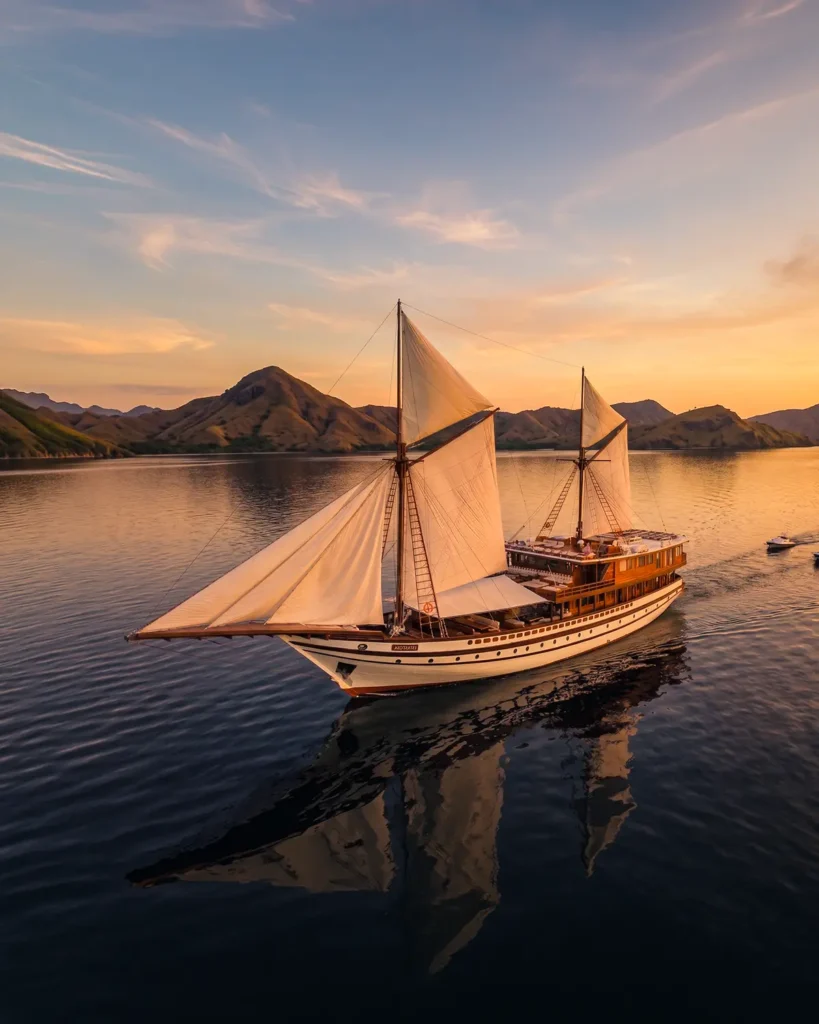
In the past, wooden phinisi from Indonesia were used to carry spices, textiles, and sandalwood. In Sulawesi, boat builders traditionally take years to complete each vessel by hand.
Today, people use modern phinisi yachts for diving, cruising, and recreation. The materials remain much the same, fine teak and ironwood sourced from Indonesia, but you can now select from different designs and finishes to meet the needs of today’s travelers. For example, some vessels offer ultra-wide areas for relaxing or yoga, while others feature luxurious soundproof suites perfect for a good night’s sleep. Newer builds also feature updated technological systems designed for maximum efficiency, sustainability, comfort, and quality.
For a look at how those choices translate into finished boats, the eight vessels in the shipbuilding portfolio are documented with published specifications and cabin mix, from the Bulukumba-built Naturalia to the mastless Komodo Signature.
The Story of Phinisi
When it comes to the story of phinisi in Indonesia, its roots trace back much further than the boat itself.
Borobudur – 8th to 9th Century
Traditional sails and vessels from Indonesia first appeared in relief carvings at Borobudur Temple, built between roughly 780 and the 840s CE. If you walk around the temple and pay attention to the relief panels, you’ll see depictions of ships that once crossed the seas to Indonesia, carrying followers of the Buddha in search of enlightenment. In 2003, a full-size replica built from one of these panels successfully sailed the historic “Cinnamon Route” from Java to Ghana, proving that these ancient outrigger vessels were capable of genuine ocean crossings.
Majapahit – 13th to 16th Century
The Majapahit Empire, which ruled from 1293 to around 1527, relied on the jong (also spelled djong or junk) as its primary naval vessel, alongside other wooden ships influenced by earlier outrigger designs like those depicted at Borobudur. These massive ships could carry anywhere from 100 to 2,000 tons of cargo and hundreds of people, with the largest reaching nearly 80 meters in length, making them some of the largest wooden vessels built anywhere in the world at the time. The jong, junk, or djong is a type of ancient ship that originated in Java, widely used by Malay and Javanese sailors for both trade and naval power.
Early 20th Century
The clearest historical record of the term “pinisi” referring specifically to a Sulawesi sailing ship appears in a 1917 Dutch magazine article, which described a “ship with a European schooner-style sail system.” Phinisi was an engineless trading ship built and sailed by South Sulawesi’s seafaring cultures, featuring a topsail-ketch rig that was tall and powerful, along with a gaff that stood permanently.
Read more: 7 Interesting Facts About Komodo National Park You Need to Know Before Visiting
History of Phinisi: Sulawesi’s Traditional Vessel
Talking about the history of the phinisi, this vessel came from South Sulawesi. The people of the Konjo tribe, who lived in Bulukumba regency, are widely credited as those who first developed this boat in the 19th century.
The sailors from that tribe had a remarkable idea: they combined Western schooner rigs with their own traditional sail design, and called the result the pinisi rig. According to one popular account, the name pinisi comes from two words: picuru and binisi. “Picuru” means “good example,” while “binisi” means “a small and agile fish.” As the story goes, it was a king who gave this name to honor the sailors’ invention, though other accounts trace the name to the Bugis word for the caulking technique used to seal the hull, so this origin story should be read as tradition rather than settled fact.
The Konjo tribe used this boat for both transportation and fishing. Phinisi featured a specific hull design (palari) with enough room for large cargo loads. In the stern, there was only a small cabin for the captain, so the crew slept on deck or in the cargo room. They used a sail called nade, inspired by the design of Western ships of the era.
The Phinisi Boat’s Design
Originally, phinisi in Indonesia featured two masts and 7 to 8 sails, differing from Western ships that typically used three masts. Its foremast is slightly taller than the stern mast, with the sails lined up symmetrically along the center. Every mast carries a small triangular sail as well as a large rectangular sail at the bottom.
Additional sails, usually three or four small triangular sails, are tied tightly from the foremast to the bowsprit. A standard phinisi ship measures about 20 to 35 meters long, though smaller variants of around 10 meters exist, typically built for fishing. Newer models can reach up to 50 meters and accommodate around 30 people, though only a handful of these larger vessels exist, most of them built for luxury cruise experiences.
Modern Evolution of Phinisi Boats
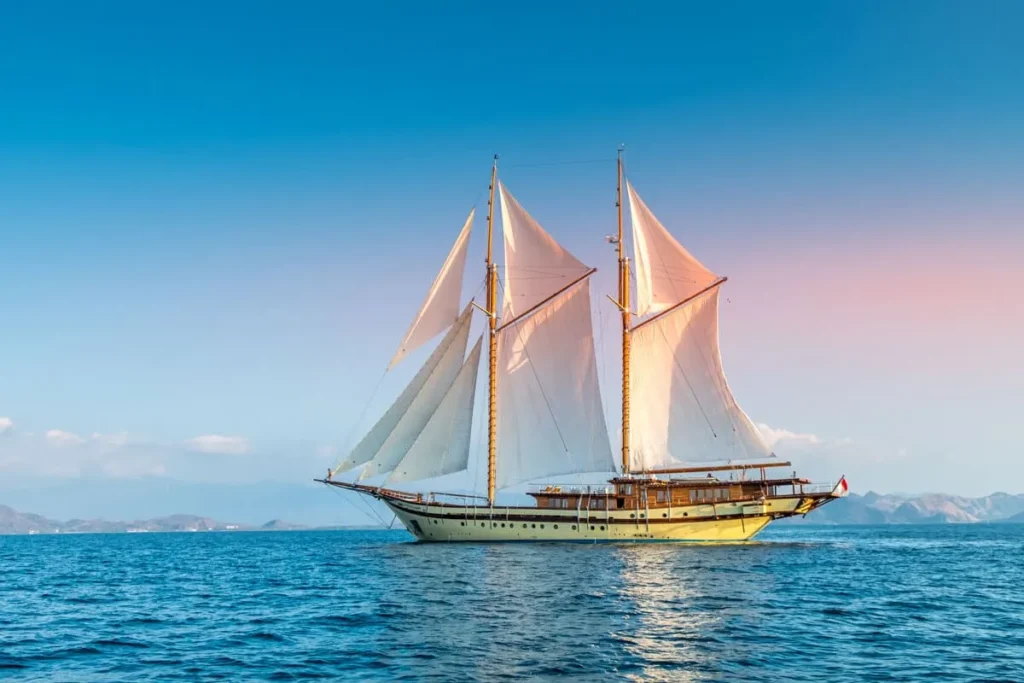
Phinisi’s design has changed considerably over the decades to fit each era’s needs. Around 1970, the boat’s primary function was mass transportation and cargo hauling. Builders then began implementing a hull type called lambo, which allowed for more cabin space.
Motorized versions followed shortly after, known as Perahu Layar Motor. Even though the sails became functionally redundant on these motorized boats, some older phinisi vessels kept their masts purely for aesthetic purposes. Later, many new phinisi builds reintroduced masts and sails so the vessels would resemble the originals again, mostly for leisure cruise purposes. Today, that construction tradition continues at working yards near Komodo National Park itself, where builders like Labuan Bajo Boat Builders hand-frame new hardwood phinisi hulls from 20 to over 45 meters, carrying the same Bugis-Makassar shipbuilding lineage straight into the modern charter fleet.
A Living Heritage, Recognized Worldwide
In 2017, the art of phinisi boatbuilding was officially inscribed on UNESCO’s List of Intangible Cultural Heritage, recognizing the Konjo and Bugis-Makassar shipbuilding traditions as a living cultural practice worth safeguarding for future generations. This recognition cements phinisi’s place not just as a mode of transport, but as one of Indonesia’s most significant maritime cultural achievements.
Read more: 18 Things to Do in Labuan Bajo: Don’t Miss Them All!
Experience Phinisi Heritage Today
Now, you can experience sailing on an authentic phinisi yourself. In Labuan Bajo, phinisi boats are available for private charter, and island-hopping by phinisi has become increasingly popular in the region. The best destination for this experience is Komodo National Park, specifically Komodo Island, where you can see the endemic Komodo dragon, a genuinely rare sight found nowhere else on Earth.
For dates, boats, and prices, start with our Komodo boat tours or view Komodo tour packages, tailored help is one WhatsApp away. That living tradition is what our boat services in Indonesia are built on today, from new phinisi commissions to full vessel management. That heritage is still alive in working yards. See how custom phinisi are built today, from ironwood keel laying to charter-standard handover. That centuries-old heritage lives on through modern phinisi design services that pair traditional Bugis lines with contemporary naval architecture and luxury interiors.
For readers ready to move from heritage to ownership, our brokerage desk lists phinisi for sale in Indonesia with verified operating histories behind every listing. To experience one of these handcrafted vessels yourself, browse our luxury phinisi Komodo charters, nine owned and operated yachts sailing from Labuan Bajo year-round.




2 thoughts on “The History of Phinisi You Have to Know and Learn”
Your article provides an in-depth analysis that deepened my understanding. Thank you for the insights!
Wow, incredible weblog format! How lengthy have you ever been blogging for?
you make blogging look easy. The full look of your website
is magnificent, let alone the content!