






Last updated: September 2026 · Prices & availability verified for the 2026/2027 season
Last updated: September 07, 2026
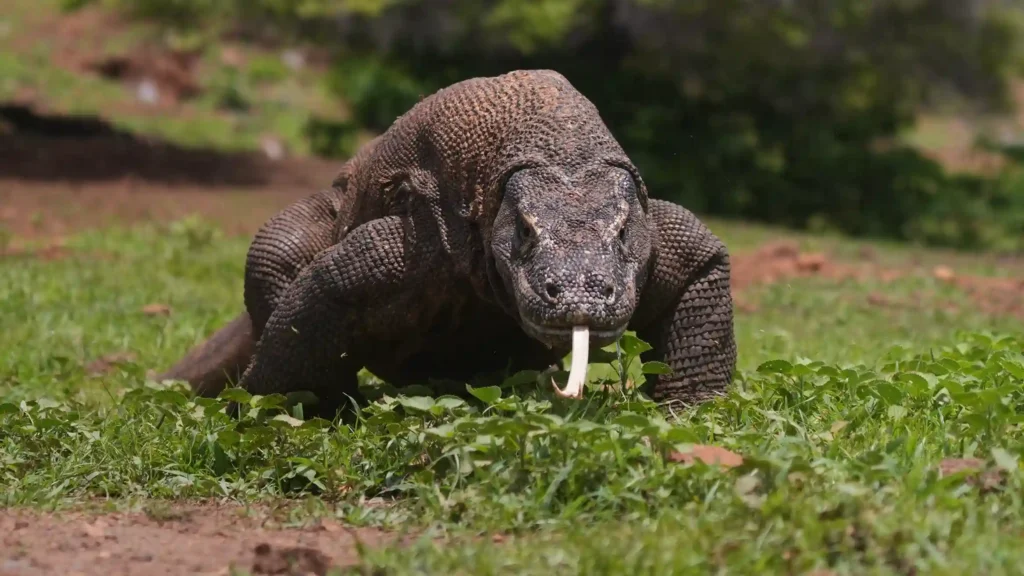
Komodo dragons have long captured the world’s imagination with their immense size and prehistoric appearance, the largest lizard on Earth, and an apex predator with no real competition on its home islands. An adult male typically measures 2.2–2.6 meters (7.2–8.5 ft) from snout to tail tip and weighs 70–90 kg (154–198 lb) in the wild, with exceptional individuals approaching 3 meters; the largest ever verified, a captive male, reached 3.13 m (10.3 ft) and 166 kg (366 lb). Females are noticeably smaller, usually 1.8–2.3 m and 25–45 kg. This guide pulls together every measured figure worth knowing: average and record length and weight, how males compare to females, how the species stacks up against other giant reptiles, and what our own guides see on the trail every season.
Key Takeaways
- Komodo dragons are the largest lizard on Earth, but not the largest reptile, a saltwater crocodile, at over 7 m and 1,000+ kg, still dwarfs even a record-sized dragon.
- The species is one of the most sexually dimorphic lizards alive, with wild males averaging nearly three times the body mass of wild females.
- The all-time size record belongs to a captive animal, not a wild one, since regular feeding and no competition for food let zoo dragons carry more bulk than anything roaming Komodo’s hills.
- A dragon’s weight can swing dramatically within days, because it’s able to swallow up to 80% of its own body weight in a single feeding.
- Their size is sustained less by genetics alone than by ecology: an apex-predator niche with no rivals, a slow metabolism that stores fat between meals, and a stable island habitat with steady prey.
Varanus komodoensis hatchlings begin life at just 30–45 cm and around 100 g, and the species survives in the wild only in Komodo National Park and a few remote valleys of western Flores, Indonesia.
Komodo Dragon Size at a Glance
The table below consolidates measured data from the Smithsonian National Zoo, Guinness World Records, the San Diego Zoo fact sheet, SeaWorld’s species profile, and peer-reviewed field studies of wild dragons in Komodo National Park.
| Measurement | Adult male | Adult female |
|---|---|---|
| Average total length | 2.59 m (8.5 ft) | 2.29 m (7.5 ft) |
| Average weight (Guinness) | 79–91 kg (174–201 lb) | 68–73 kg (150–161 lb) |
| Typical wild body mass (field studies) | ~70 kg | ~22–25 kg |
| Maximum length | 3.13 m (10.3 ft), verified record | ~2.5 m (8 ft) |
| Maximum weight | 166 kg (366 lb), verified record | ~70 kg (154 lb) |
Hatchlings begin life at roughly 35–40 cm (14–16 in) long and about 100 g, smaller than a house cat, before growing into the giants visitors meet on Komodo and Rinca.
How Long Is a Komodo Dragon?
Length is measured from the tip of the snout to the tip of the tail, and the tail accounts for roughly half of it. A mature wild male usually tapes out at 2.2 to 2.6 meters. In the classic field study by biologist Walter Auffenberg, still the reference dataset for wild dragons, the biggest males on Komodo averaged about 2.6 m. Rangers in the park today use the same yardstick: a “big male” is anything over 2.5 m, and a handful of individuals on Komodo and Rinca are estimated to push close to 3 m.
Females top out shorter, generally 1.8–2.3 m. Once you know what to look for, the difference is easy to spot on the trail: males carry a broader, heavier head, thicker jowls, and a more muscular tail base.
How Much Does a Komodo Dragon Weigh?
A healthy wild male weighs 70–90 kg, about the same as an adult man. Females typically run 25–45 kg in the wild, Guinness lists captive-influenced female averages of 68–73 kg, but long-term mark–recapture means sit near 25 kg. Two things make dragon weights slippery, and both are worth understanding before you compare figures between sources.
First, a Komodo dragon can swallow up to 80% of its own body weight in a single feeding. A 75 kg male that has just fed on a Timor deer may briefly tip the scales at well over 100 kg, which is why one-off weighings of wild dragons vary so widely. Second, captive dragons eat on a regular schedule and burn far fewer calories than an animal patrolling kilometers of savanna, so zoo specimens routinely grow heavier than anything we encounter in the park.
Read more: Komodo Dragon (Varanus komodoensis): The Complete Guide to the World’s Largest Lizard
Males vs Females: One of the Strongest Size Gaps Among Lizards
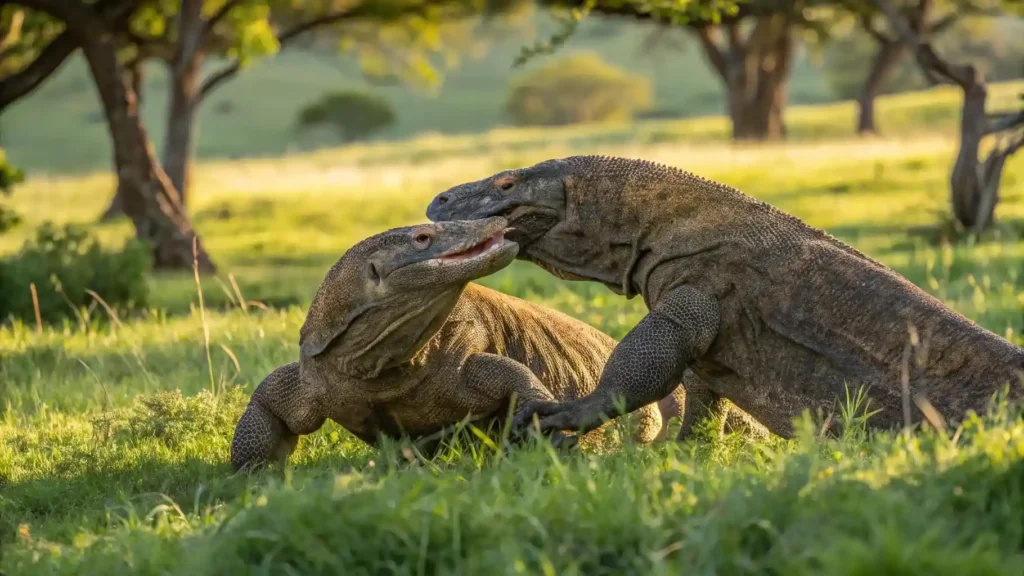
Komodo dragons show pronounced sexual size dimorphism. Long-term mark–recapture research on wild populations puts mean adult mass at roughly 70 kg for males versus ~25 kg for females, nearly a threefold difference. A growth study summarised by LiveScience found that at sexual maturity (around seven years), males already averaged 1.6 m and 65 kg while females averaged 1.2 m and 22 kg, and males keep growing for years afterwards.
Why the gap? Males wrestle in upright combat for mates and territory, so selection rewards mass; females channel a large share of energy into producing 15–30 eggs per clutch, which constrains their growth. The result is that virtually every record-class dragon photographed in Komodo National Park is male, making males noticeably bigger, bulkier, and more dominant in their environment than females.
How Big Is a Komodo Dragon Compared to a Human?
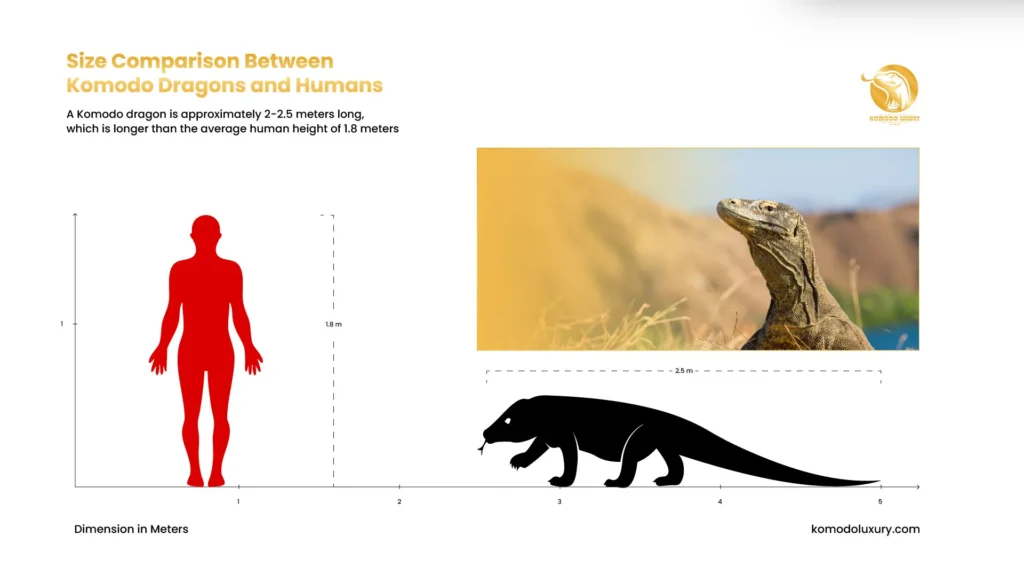
Lay a 2.6 m male dragon beside a 1.75 m (5’9″) adult and the dragon is almost a full meter longer than the person is tall, a Komodo dragon (roughly 2–2.5 m) is already longer than the average human height of 1.8 m before it even rises up. On all fours its shoulder reaches about an adult’s knee, but the impression changes completely when a dragon rises into its “tripod” stance, rearing up on its hind legs, propped on its tail, to sniff the air or contest a carcass. Standing like that, a big male can bring its head level with a person’s chest.
The size doesn’t just look impressive, it’s functional. A dragon’s large, muscular body, strong legs, and claws close to 5 cm long let it overpower prey significantly bigger than itself, from deer to water buffalo. Add roughly sixty serrated teeth and a bite that delivers venom causing rapid blood loss and shock, and you get an animal built to weaken and bring down prey far larger than a lone predator normally could.
Numbers on a page still undersell it. Guests on our ranger-guided treks tell us the same thing almost daily: photos made them expect a large monitor lizard, but in person it reads more like a low-slung crocodile on walking legs. That is exactly why park rules keep everyone at least 5 meters back, always behind the ranger and his forked staff.
How Fast Do Komodo Dragons Grow? Size by Age
Komodo dragons hatch tiny and vulnerable, small enough to rest in two open palms, and adult dragons will eat them, so hatchlings scramble into trees and live there for their first years. They reach full adult size at roughly 8–10 years and can live 30 years or more in the wild. The full timeline, from a 7–8-month egg incubation to a ~30-year lifespan, is covered in our guide to the Komodo dragon lifespan and life cycle.
| Life stage | Age | Typical length | Typical weight |
|---|---|---|---|
| Hatchling | 0–12 months | 30–45 cm | 80–150 g |
| Juvenile (tree-dwelling) | 1–4 years | 1–1.5 m | 5–20 kg |
| Sub-adult | 5–8 years | 1.5–2 m | 20–40 kg |
| Adult female | 8+ years | 1.8–2.3 m | ~25–45 kg |
| Adult male | 8+ years | 2.2–2.6 m (rarely near 3 m) | 70–90 kg |
| Largest verified (captive) | — | 3.13 m | 166 kg |
Ranges compiled from Komodo National Park ranger briefings, Auffenberg’s field data, and Smithsonian’s National Zoo species records. Individual dragons vary, and wild weights swing with feeding.
Why Are the Biggest Komodo Dragons in Captivity?
The record book belongs to a captive animal: a male measured at 3.13 m and 166 kg, cited by Guinness World Records as the largest verified lizard ever documented, and even that weight included a recent meal. Captive dragons eat reliably, never lose a carcass to a bigger rival, and never walk kilometers of dry hills between meals, so they carry more bulk than their wild cousins. Wild dragons stay leaner, and leaner is the healthy, authentic condition. If the dragon in front of you on Komodo looks slimmer than the one in zoo photos, you are seeing what the species actually looks like at work.
SeaWorld’s species data lists an essentially identical maximum of 164.25 kg (365 lb). This animal was a well-fed captive; wild dragons rarely exceed 90 kg, although a morphometric study on Komodo Island measured wild adults up to 120 kg and 3.14 m ventral length. Claims of four-metre dragons circulate in travel folklore, but no such measurement has ever been verified.
Why Do Komodo Dragons Grow So Large?
The classic explanation is island gigantism: on predator-poor islands with deer and pig prey, the biggest lizard wins. Modern fossil work complicates that story, the lineage evolved among already-giant monitors in Australia, so today’s dragons may be a relict giant whose size was refined, not created, by island life. Several factors sustain their bulk today:
- Apex-predator niche: no mammalian carnivore competes with them for deer, pigs, or carrion on their islands, and with such an abundant food supply and no real threats, dragons have the luxury of growing big and strong.
- A famously slow metabolism: this lets an adult go for weeks without food after a big meal, conserving energy over long periods and storing the surplus as fat reserves that push big males past the 100 kg mark, dragons are often seen simply basking in the sun between hunts to conserve energy this way.
- Prolonged growth: males continue somatic growth long after maturity, producing very large senior individuals.
- A stable island environment: Komodo, Rinca, and the other islands offer minimal environmental change and a steady prey base, letting the species evolve into the giant it is today.
- Warm tropical climate: large ectotherms thermoregulate efficiently in the savanna heat of the Lesser Sundas.
The evolutionary backstory, Australian fossils, Megalania, and a million-year-old arrival on Flores, is detailed in where Komodo dragons come from.
How Does a Komodo Dragon Compare to Other Reptiles?
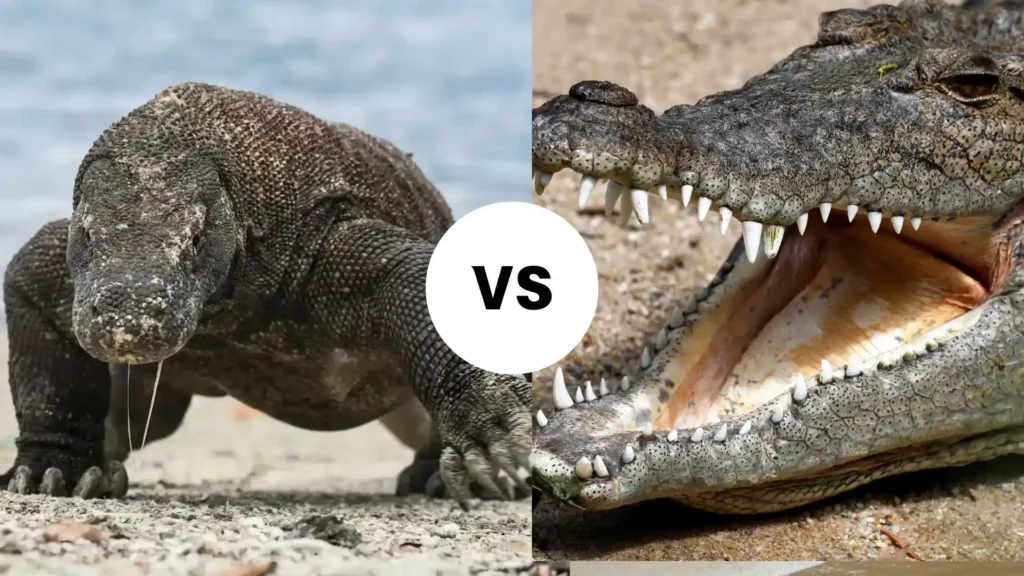
Though Komodo dragons are the largest lizards in the world, they aren’t the largest reptiles overall. That title belongs to the saltwater crocodile, which can grow past 7 m (23 ft) and weigh over 1,000 kg (2,200 lb), several times a Komodo dragon’s bulk. Crocodiles are reptiles but not lizards, which is why the two records don’t compete directly.
Among other giant reptiles, an anaconda might out-length a Komodo dragon, but it carries nowhere near the same weight or muscular power. Other monitor lizard species, the dragon’s closest relatives, are considerably smaller still, which is exactly why, size for size, the Komodo dragon remains the uncontested giant of the lizard world even though it’s a middleweight among reptiles generally.
Despite the size and power, Komodo dragons aren’t slow: they’re capable of short sprints up to about 20 km/h (12 mph) when ambushing prey, faster over ten meters than most visitors expect from a 70 kg lizard.
How Big Are the Dragons You Actually See on a Komodo Tour?
Here we can speak first-hand. Our guides walk the ranger-led trails at Loh Liang on Komodo Island and Loh Buaya on Rinca nearly every day of the season, and our trip logs are consistent: most adult dragons guests photograph fall in the 2 to 2.5 m range, with females and sub-adults around the water points and one or two notably large males holding the shaded prime spots near the valley floor. The biggest wild male our guides regularly point out at Loh Liang is estimated by the rangers at a little over 2.7 m. Morning treks give the best sightings, when dragons bask in the open to warm up before the day’s heat; by midday the big ones retreat to shade and sightings get shorter.
Rinca is the reliable choice if seeing dragons is your priority, its population density is higher, so encounters come more frequently even if the very largest males we know of live on Komodo itself.
Read more: Komodo Dragon Facts: The Field-Checked List
Let’s See Komodo Dragons in the Wild with Komodo Luxury
Nowhere on Earth outside Indonesia, and within Indonesia, only in Komodo National Park (Komodo, Rinca, Gili Motang, and Nusa Kode) plus a few remote coastal valleys of western Flores. The IUCN Red List classifies the species as Endangered (2021), with a wild population of a little over 3,000, most of it inside the park. That rarity is exactly what makes a properly guided visit worth doing well, the wrong season, the wrong island, or the wrong time of day can be the difference between a distant glimpse and watching a 2.7 m male cross the trail ten meters ahead of you.
That’s where a bit of local knowledge goes further than a search engine. Our team is based year-round in Labuan Bajo, the gateway harbor town at Flores’ western tip, and plans dragon-sighting trips daily, whether that means timing a morning trek at Loh Liang for the best basking activity, choosing Rinca over Komodo for higher encounter odds, or building a full liveaboard route around it.
Tell us your dates and what you’re hoping to see, and we’ll match you to the right option: a shared open trip if you’re traveling light, a private Komodo trip at your own pace, or a few nights aboard a luxury phinisi waking up inside the park itself. Coming from Bali, it’s just a one-hour direct flight, see how a Komodo tour from Bali works in practice.
Ready to see them for yourself? Talk to our Labuan Bajo concierge team on WhatsApp, we’ll help you plan your trip around the best dragon-sighting conditions of the season.

FAQs About Komodo Dragon Size
Key references for this article: Komodo National Park ranger briefings at Loh Liang and Loh Buaya, Walter Auffenberg’s field research on Komodo, the IUCN Red List (2021 assessment), Guinness World Records, and Smithsonian’s National Zoo species data — cross-checked against our own guides’ daily trip logs.
This guide is part of our Dragon Encyclopedia series, anchored by our complete Komodo dragon guide, by Komodo Luxury – a registered Indonesian PT under Juara Holding Group Limited with 1,500+ verified guest reviews (4.9/5 across Google and TripAdvisor). Reading about a 2.6-meter lizard is one thing; watching one cross a savanna trail ten meters ahead of you is another. When you’re ready to see them in the wild, explore Komodo National Park, browse our full Komodo tour packages, check upcoming open trip departures, or talk to our Labuan Bajo team on WhatsApp at +62 811-3823-875, we’ll help you plan it around the best dragon-sighting conditions.