




Last updated: September 2026 · Prices & availability verified for the 2026/2027 season
Last updated: September 05, 2026
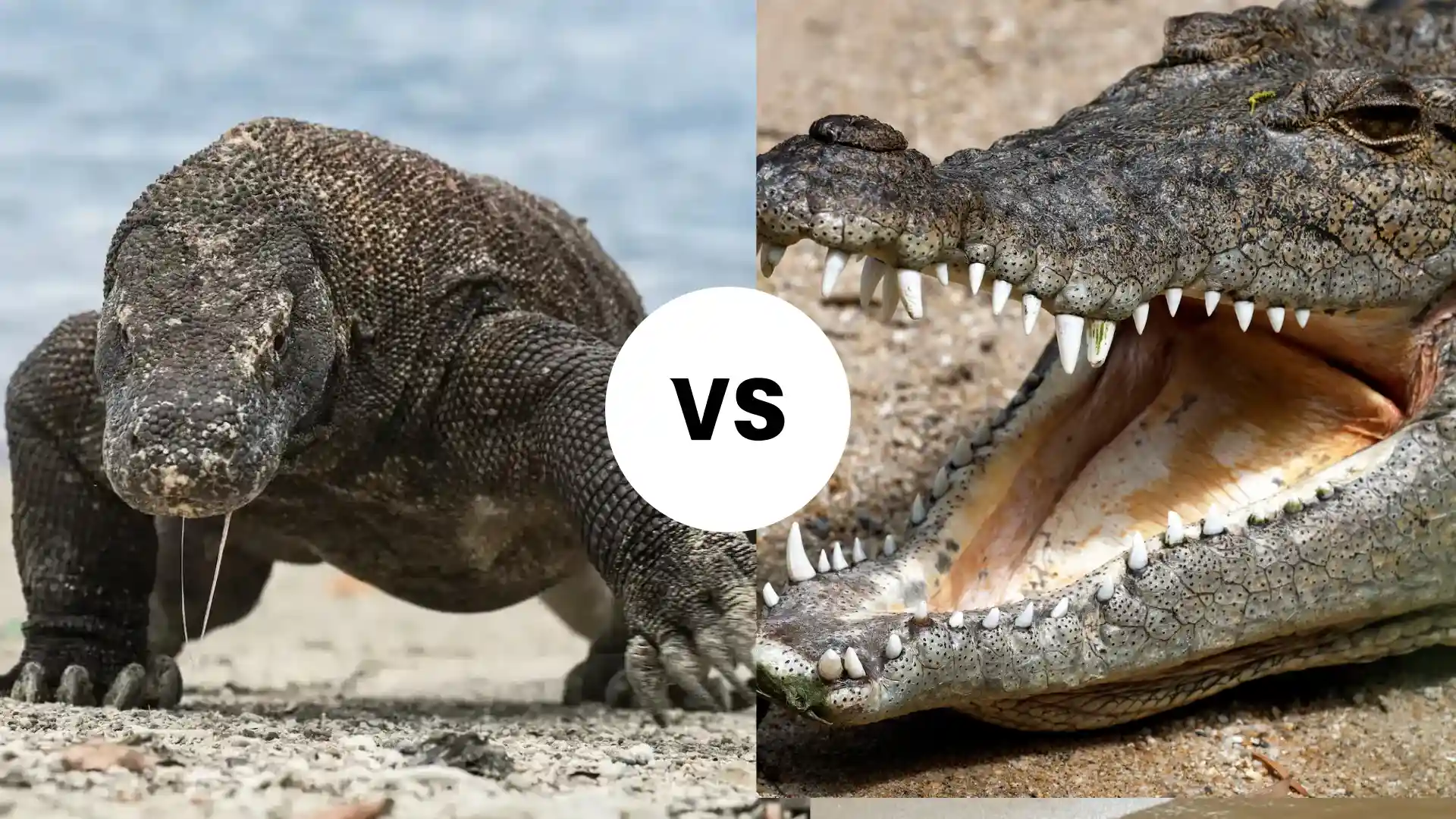
In a head-to-head fight, the Saltwater Crocodile would beat the Komodo Dragon. The crocodile’s sheer size (up to 6 meters and over 1,000 kg) and record bite force of roughly 3,700 psi overwhelm the Komodo Dragon’s 3-meter frame, comparatively weak bite, and slow-acting venom in almost any confrontation.
It’s a matchup our ranger-guides field constantly, dragon trekking is part of every itinerary we run, from the 3D2N shared sailing trip to multi-week charters, and guests debate it on the sundeck between Rinca and Padar almost every crossing. The salties, conveniently, stay out of the park entirely, so the two never actually meet on our routes, which is exactly why the question keeps coming up. This article breaks down the full picture: size, speed, bite force, and hunting style for both animals, then scores them head-to-head to see who really comes out on top.
Key Takeaways
- In a straight fight, the Saltwater Crocodile wins on almost every measurable trait, backed by a bite force of roughly 16,414 newtons compared to the Komodo dragon’s 148 newtons, making it the strongest bite ever directly measured in a living animal.
- The Komodo dragon compensates with a completely different strategy, relying on around 60 serrated teeth and an anticoagulant venom that causes prolonged bleeding rather than trying to overpower its opponent in a single strike.
- Size and terrain decide almost everything in this matchup, since the crocodile’s weight and swimming speed make water a lopsided fight, while the dragon’s agility on land is the only real edge it has.
- This confrontation is almost entirely hypothetical in the wild, because saltwater crocodiles don’t inhabit the dragons’ core territory inside Komodo National Park, so the two predators’ paths rarely cross.
- Both animals can be dangerous to humans, but saltwater crocodiles carry a significantly higher track record of fatal attacks, which is why licensed ranger guidance remains essential when visiting either species’ habitat.
Komodo Dragon: The King of Lizards
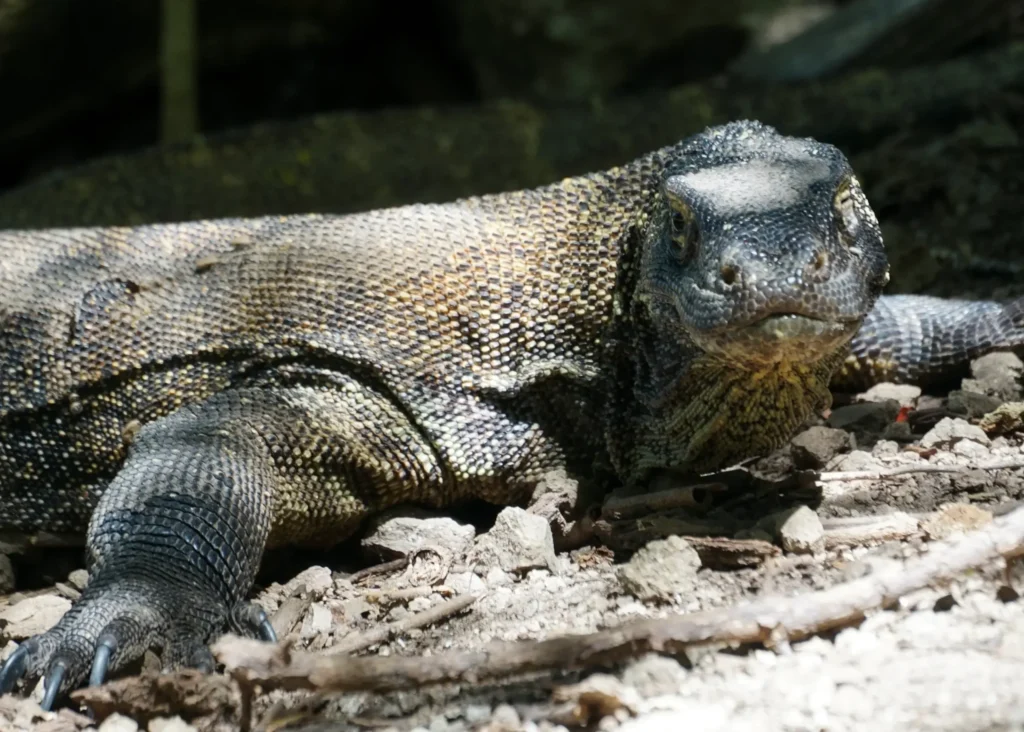
The Komodo dragon at Komodo Island
The Komodo Dragon (Varanus komodoensis) is the largest living lizard in the world, native to a few Indonesian islands, including Komodo, Rinca, and Flores. These impressive creatures can grow to an average length of 2-3 meters (6-10 feet) and weigh around 70-90 kilograms (150-200 pounds). What makes them deadly isn’t just their size, though—it’s their venomous bite. A Komodo Dragon’s saliva contains deadly bacteria and venom that can cause massive blood loss, shock, and eventually, death. Komodo Dragons are ambush predators, attacking prey at high speeds with lacerating bites, but they do not inject venom like snakes.
Komodo Dragons are solitary hunters, relying on stealth and patience to stalk their prey. They can run at speeds of up to 20 km/h (12 mph) in short bursts, which is fast enough to surprise and take down animals like deer, pigs, and even water buffalo. While they aren’t built for long chases, once they land a bite, it’s often only a matter of time before their prey succumbs to infection or venom. Komodo Dragons are generally faster and more agile on land compared to Saltwater Crocodiles.
The science behind that bite is remarkable. In 2009, a research team led by Dr. Bryan Fry confirmed that Komodo Dragons possess genuine venom glands in the lower jaw, with ducts opening between the teeth. Rather than being injected like snake venom, the toxins seep into open wounds, where they prevent blood from clotting and cause a sharp drop in blood pressure—hastening shock and blood loss. This discovery largely overturned the older “dirty mouth” theory that credited only bacteria for the kill. Their roughly 60 curved, serrated teeth act like steak knives, slicing deep gashes that let the venom do its work.
Komodo Dragons are also equipped with an extraordinary sense of smell. Flicking a long, forked tongue and reading the air with a vomeronasal (Jacobson’s) organ on the roof of the mouth, they can detect carrion from several kilometers downwind. This lets them locate a wounded animal—or their own escaped prey—long after the initial ambush, a patient tracking strategy that suits their land-based hunting perfectly.
Habitat
Komodo Dragons thrive in dry savannas, grasslands, and scrubby forests found on the islands of Indonesia.
Key Strengths
- Venomous bite that can incapacitate prey over time.
- Powerful jaws capable of tearing flesh.
- Quick bursts of speed, making them efficient ambush hunters.
Weaknesses
- Limited stamina for long chases.
- Not well-adapted to water, restricting their hunting range to land.
Saltwater Crocodile: Water’s Top Predator
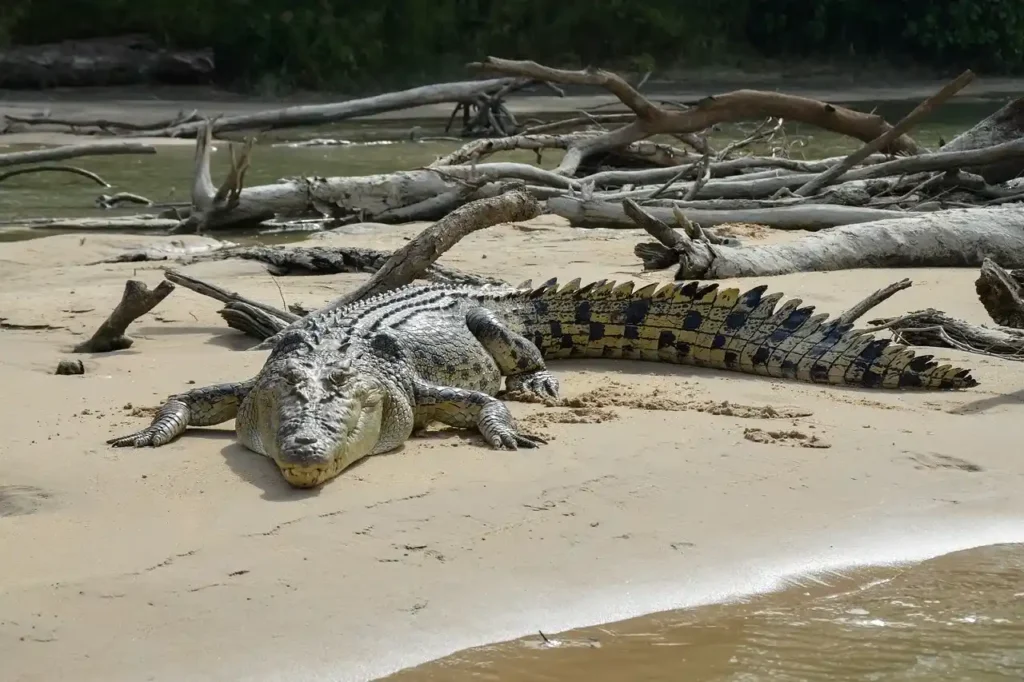
Crocodile (source: unsplash.com)
The Saltwater Crocodile (Crocodylus porosus) is not only the largest living reptile, but it also holds the title for the strongest bite of any animal on Earth. Saltwater crocs are true giants of the animal kingdom, reaching over 6 meters (20 feet) and weighing more than 1,000 kilograms (2,200 pounds). Their bite pressure exceeds 3,500 psi, strong enough to crush bones and break through thick hide with ease.
Saltwater crocodiles are ambush predators, primarily hunting in water where they’re quick and agile. They lurk just below the surface, waiting for the perfect moment to launch a surprise attack on their prey. They can swim at speeds of 24-29 km/h (15-18 mph) in water and are known to attack everything from fish and birds to large mammals, including cattle.
Once a saltwater crocodile clamps down, escape is nearly impossible. To subdue and dismember larger prey, it performs the infamous “death roll”—spinning its entire body with explosive force to tear off chunks of flesh or drown a struggling animal. That grip is backed by the strongest bite ever directly measured in a living creature: in Gregory Erickson’s landmark 2012 study, a large Crocodylus porosus bit down at roughly 3,700 psi (about 16,460 newtons), enough to shatter bone.
Their range is vast for a reason. Special salt glands on the tongue let saltwater crocodiles tolerate seawater, so they patrol estuaries, mangroves, and open coastlines from eastern India through Southeast Asia to northern Australia—occasionally riding ocean currents between islands. They are also remarkably long-lived, with many individuals surviving well past 70 years in the wild, giving the biggest bulls decades to reach their record-breaking size.
Habitat
These crocodiles are found in saltwater and brackish environments, including rivers, swamps, estuaries, and coastal waters, across Southeast Asia, northern Australia, and surrounding regions.
Key Strengths
- Extremely powerful bite is capable of crushing bones.
- Massive size and strength, making them nearly invincible in water.
- Agility in water allows them to attack with lightning speed.
Weaknesses
- Slow and awkward on land.
- Relies heavily on water for effective hunting.
Komodo Dragon vs Saltwater Crocodile: Side-by-Side Comparison
Features | Komodo Dragon | Saltwater Crocodile |
Size | 2-3 meters (6-10 feet) | 5-6 meters (16-20 feet) |
Weight | 70-90 kg (150-200 lbs) | 500-1,000 kg (1,100-2,200 lbs) |
Speed | 20 km/h (12 mph) on land | 24-29 km/h (15-18 mph) in water |
Main Strength | Venomous bite, sharp jaws | Strongest bite in the animal kingdom |
Weakness | Not strong in water | Limited mobility on land |
Lifespan | 30 years | 70 years |
Habitat | Savannas, dry grasslands | Rivers, swamps, estuaries |
Diet | Carnivore (deer, pigs, buffalo) | Carnivore (fish, birds, mammals) |
Reproduction | Lays around 20 eggs/year | Lays 40-50 eggs/year |
Komodo Dragon vs Saltwater Crocodile: Side-by-Side Comparison Table | Komodo Luxury
Key Differences Between Komodo Dragons vs Saltwater Crocodiles
Komodo dragon vs Crocodile | Komodo Luxury
While both are powerful predators, they are distinct in many ways. Here are some of the key differences between the two:
1. Body Shape
The Komodo Dragon has a more streamlined, slender body, built for agility on land. In contrast, the Saltwater Crocodile is bulkier, with a powerful tail designed for swimming and maneuvering in water.
2. Teeth
Komodo Dragons have razor-sharp teeth that help tear flesh. On the other hand, Saltwater Crocodiles boast large, crushing teeth designed to grip and break through bones.
3. Size
Saltwater Crocodiles are considerably larger than Komodo Dragons, often more than doubling their weight and length, giving them a significant size advantage.
4. Coloration
Komodo Dragons are typically a dark, earthy brown or grey color, while Saltwater Crocodiles have a mix of greenish-brown shades with black bands, providing excellent camouflage in water.
5. Skin Texture
Saltwater Crocodiles have thick, armor-like skin, covered in tough scales that offer protection against physical attacks. Komodo Dragons, while having tough skin, are much less armored in comparison.
6. Head Shape
Komodo Dragons have narrow, elongated heads, while Saltwater Crocodiles feature a broad, wide snout with massive jaw muscles optimized for their powerful bite.
Komodo Dragon vs Crocodile: Are They Dangerous to Humans?
Both creatures can be incredibly dangerous to humans, though encounters are relatively rare.Komodo Dragons are not known to attack humans frequently, but when they do, their bites are highly lethal due to the venom and bacteria in their saliva. Even a small bite can lead to serious infections or worse if untreated. On the other hand, Saltwater Crocodiles are notorious for attacking humans, especially in areas where humans and crocs share close proximity to water. Their ambush tactics make them one of the deadliest reptiles in the world, with numerous documented cases of fatal crocodile attacks.
In short, both animals should be approached with extreme caution, though Saltwater Crocodiles have a much higher track record for attacking humans. Both Komodo Dragons and Saltwater Crocodiles can be dangerous to humans, but Saltwater Crocodiles have a higher track record of fatal attacks. While both predators can be dangerous in the wild, encounters with Komodo dragons are carefully managed in their natural habitat. When you explore the area with proper guidance, the experience becomes both safe and unforgettable.
Read more: Wildlife Wonders: From Australia’s Kangaroos to Indonesia’s Komodo Dragons
Who Would Win? Komodo Dragon vs Crocodile Head-to-Head
Strip the fight down to the factors that actually decide a life-or-death clash, and the Saltwater Crocodile wins on almost every one. On raw power it isn’t close: a large saltwater crocodile bites at roughly 16,414 newtons, the strongest bite ever directly measured in a living animal (Erickson et al., PLoS ONE 2012), versus roughly 148 newtons for a Komodo dragon (D’Amore et al., 2011), more than 100 times the force. The table below scores every combat trait head-to-head:
| Combat Factor | Komodo Dragon | Saltwater Crocodile | Edge |
| Max Size | 3 m (10 ft) | 6+ m (20 ft) | Crocodile |
| Max Weight | ~90 kg (200 lbs) | 1,000+ kg (2,200 lbs) | Crocodile |
| Bite Force | ~148 N — kills via laceration + venom | ~16,414 N — strongest ever measured | Crocodile |
| Primary Weapon | Venom & serrated teeth | Crushing bite & death roll | Crocodile |
| On Land | Agile, 20 km/h | Slow, awkward | Komodo Dragon |
| In Water | Poor swimmer | Dominant, 24-29 km/h | Crocodile |
| Armor | Moderately tough skin | Thick, bony-plated hide | Crocodile |
| Overall Verdict | Challenger | Winner | Crocodile |
The dragon simply fights a different way. Rather than trying to match that crushing force, around 60 serrated, steak-knife teeth open deep wounds, while anticoagulant venom (Fry et al., PNAS 2009) keeps the bleeding going, a slash-and-wait strategy rather than a knockout blow. Terrain is the one variable that gives the Komodo Dragon any hope: in water, the contest isn’t close, since the crocodile is faster, heavier, and armored, and a single clamp-and-roll would end things in seconds. On land, the dragon’s agility lets it dart around a sluggish crocodile and land slashing, venom-laced bites, but it still has to overcome an opponent that outweighs it more than ten times over. Its realistic path to victory isn’t a knockout, it’s a hit-and-retreat, then waiting hours or days for venom and blood loss to take hold.
In practice, this matchup is almost entirely hypothetical. Komodo Dragons are endemic to a handful of Indonesian islands, while saltwater crocodiles are absent from the dragons’ core islands in Komodo National Park, so their paths rarely cross in a way that would trigger a genuine fight. When we weigh raw combat ability, though, the crocodile’s overwhelming size, armor, and bite make it the clear favorite in any direct confrontation.
More head-to-heads: monitor lizard vs Komodo dragon and the full Komodo dragon profile. Watch apex predators on their own islands from a Komodo sailing tour or private boat charter.
Meet Komodo Dragon in Its Own Habitat with Komodo Luxury
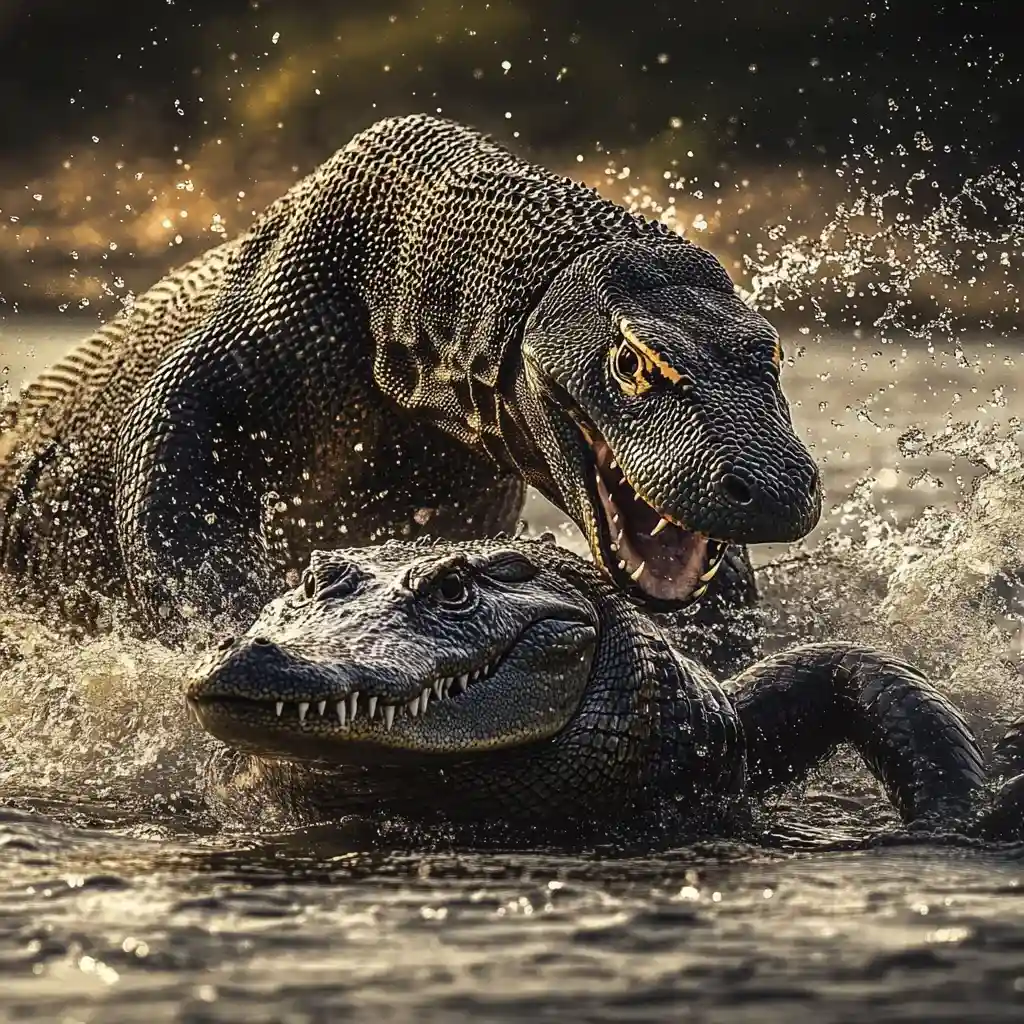
Komodo dragon vs Crocodile Illustration – Komodo Luxury
If a Komodo Dragon were to face off against a Saltwater Crocodile, the Saltwater Crocodile would likely come out on top. Its immense size, brute strength, and bone-crushing bite give it a significant advantage in a direct confrontation. However, the Komodo Dragon isn’t without its deadly assets, especially its venomous bite, which could eventually prove fatal—but in a drawn-out battle, the Crocodile would likely win before that venom takes effect. If you are interested in seeing the Komodo Dragon live in its natural habitat, visit Komodo Island and enjoy an extraordinary experience through the Komodo Island Tour Package offered by Komodo Luxury. It is a rare opportunity to see one of the world’s most iconic predators in its natural habitat. Many travelers choose a Labuan Bajo yacht rental to enjoy a more controlled and comfortable journey, allowing you to explore Komodo National Park while observing wildlife from a safe distance. Don’t let space run out! Book now!

If this matchup made you curious about the real animal, you can watch Komodo dragons in their natural habitat on a boat trip through Komodo National Park. Komodo Luxury operates shared and private phinisi departures from Labuan Bajo year-round; the shared Komodo boat tour is the easiest entry point.
Only one of these two can be met on foot tomorrow morning. Dragon trekking is included on all Komodo sailing packages; divers can add crocodile-free reef time at Batu Bolong on a liveaboard itinerary.
By the Komodo Luxury Expedition Team — a licensed Komodo National Park tour operator running daily expeditions from Labuan Bajo since 2015. Fleet, rates and itineraries: Komodo yacht charter.
Curious how the dragon measures up beyond this matchup? The definitive Komodo dragon page collects every comparison, fact, and field observation in one place.