


Last updated: August 2026 · Prices & availability verified for the 2026/2027 season
Search “luxury Komodo cruise” from Sydney, Melbourne or London and you get pages of boats describing themselves identically. Teak decks. Sunset. Barefoot elegance. The photographs are frequently beautiful, and frequently taken on a different vessel than the one you would board. For a trip most Australian and British guests take once, the gap between brochure and boarding ladder is the whole problem.
This guide closes it, not with adjectives but with the five things that separate a luxury Komodo cruise from a well-photographed one: the crew, the cabins, the space per guest, the service, and the safety culture on board. Every one is checkable before you pay. We have written the criteria down publicly in our Komodo luxury vessel quality standard, and you are welcome to hold any operator in Labuan Bajo to them, including us.
Komodo Luxury is operated by PT Komodo Bahari Nusantara. We have sailed this park since 2015, we are part of Juara Holding Group, and we hold Tripadvisor Travellers’ Choice awards for 2025 and 2026 with a 4.9 out of 5 rating from more than 1,500 verified guest reviews across Google and Tripadvisor. That record is why we would rather teach you to interrogate a boat than ask you to trust a mood board.
What luxury actually means on a Komodo cruise
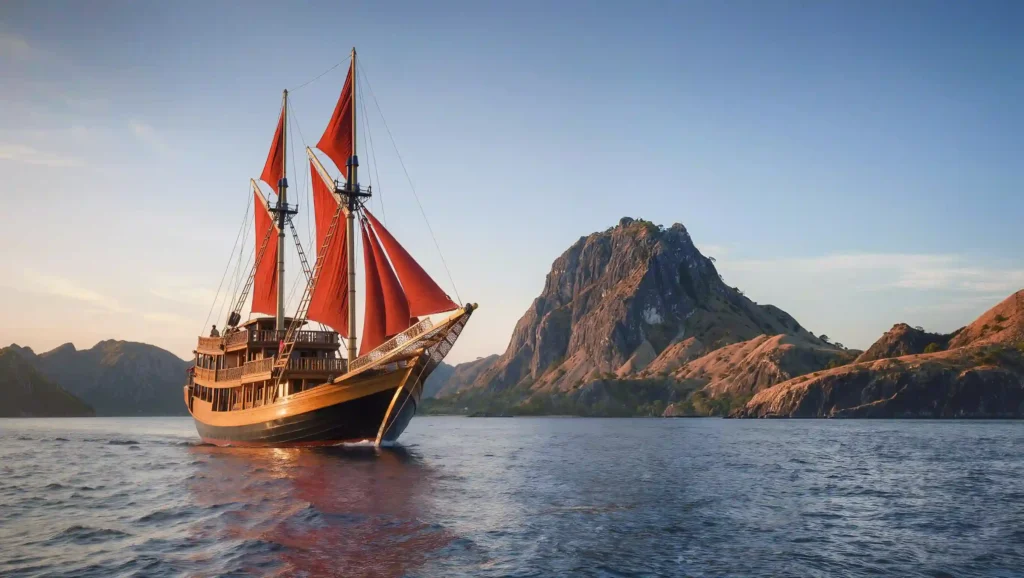
There are no hotels inside Komodo National Park. The resorts are back in Labuan Bajo, and there is nowhere to retreat to if the boat disappoints. Your vessel is your accommodation, restaurant, transport and safety net at once, usually with no road access and patchy mobile signal. That is why the word has to mean something more structural here than on a city break.
Five tests do most of the work. Pass all five and the photographs stop mattering. Fail one and no photograph will save your holiday. Use them on three operators and the differences appear within a day.
1. The crew, and the ratio behind them
This is the biggest variable and the least visible in a gallery. A phinisi is a working sailing vessel: it needs a captain who reads these currents, engineers who maintain rather than improvise, a cook who can produce three services a day from a galley at sea, deckhands, and a cruise director whose job is you rather than the vessel.
Establish not just how many crew there are, but how many per guest, and whether they are permanent or hired per departure. Permanent crews develop the habits that define a good trip: they know which anchorage is quiet at dawn, and they do not need asking twice. Ask directly whether the crew on your dates is the vessel’s regular team.
2. Ensuite cabins, and why the detail matters
Ensuite is where listings quietly stretch. On a boat it should mean a private bathroom inside your own cabin, with a proper marine toilet, a working shower and hot water, ventilation, and enough fresh water to support every cabin at once for the length of the trip. A shared bathroom on deck is not a lesser version of that. It is a different product.
The follow-up questions are the useful ones. Is the cabin air-conditioned overnight, and does the generator run through the night to support it? Is there a power point beside the bed, and what fitting does it take? None of this is fussy. Over several nights it is the difference between sleeping and enduring.
3. Space per guest
Two boats can carry the same number of guests and feel nothing alike. What matters is deck and shared living area per person: somewhere to eat out of the sun, somewhere shaded to lie down that is not your cabin, somewhere at the bow to be alone, and enough room at the stern that the group is not queuing to get into the water.
Ask for the guest capacity, then ask how many separate seating and lounging areas exist. If the answer is one saloon and one sun deck for a full manifest, you will spend the trip negotiating for a chair. Our best Komodo yachts by use case guide sorts vessels by this kind of fit rather than by price alone, and how to compare Komodo phinisi vessels walks through the comparison method itself.
4. Service, meaning anticipation rather than staffing
Service on a small vessel is not formality. Nobody wants white gloves on a wooden boat in the Flores Sea. It is anticipation: fresh towels waiting when you climb out after a dive, a dietary restriction handled once at booking and never raised again, the tender ready before you asked, the day reshuffled because the light will be better at Padar tomorrow.
You can test this before departure. How an operator handles your questions at the enquiry stage previews how they will handle you at anchor. Vague or copy-pasted answers now predict vague answers later.
5. Safety, which is a culture rather than a checkbox
This is the part guests skip and the part we would insist on. Ask what safety equipment is carried, including life jackets sized for children if you travel with family. Ask whether there is a life raft, whether the tender carries its own safety kit, and how the vessel communicates where there is no mobile coverage. Ask whether there is a briefing on day one, whether crew are trained in first aid and oxygen use, and what happens if someone needs to return to Labuan Bajo quickly.
A good operator answers all of that without hesitation, because they have answered it before. Hesitation is your answer.
The five tests in one table
| Test | What to ask before you pay | What a weak answer sounds like |
|---|---|---|
| Crew | How many crew per guest, and is this the vessel’s permanent team on my dates? | “Enough crew” with no number, or a team hired per departure |
| Ensuite cabins | Private bathroom in every cabin, hot water, overnight air conditioning, fresh water for a full manifest | “Ensuite available” without confirming it applies to your cabin |
| Space per guest | Guest capacity plus separate shared areas: dining, shaded lounge, sun deck, bow, swim platform | Capacity quoted, layout avoided |
| Service | Who handles dietary needs, who runs the itinerary on board, how fast enquiries are answered now | Generic replies, no named point of contact |
| Safety | Life jackets including child sizes, life raft, tender safety kit, offshore comms, first-aid trained crew, day-one briefing | Reassurance without specifics |
Private charter or a shared cabin
This is the second real decision, and it is not simply a budget question. The two formats produce different holidays. A private charter means the whole vessel belongs to your group. You set the wake-up time, the itinerary flexes to your interests, the crew cooks for your table only, and nobody else’s schedule constrains yours. It suits families, groups of friends, milestone birthdays, honeymoons, and anyone bringing children or older parents whose pace should not have to match a stranger’s.
A shared cabin, or open trip, means you book a cabin on a set departure alongside other guests. The itinerary is fixed, meals are communal, and you meet people. For couples and solo travellers who like the social side of a small boat, that is not a compromise, it is the appeal, and it is the more accessible way onto a good vessel.
| Consideration | Private charter | Shared cabin |
|---|---|---|
| Who is on board | Only your group | Your cabin plus other guests |
| Itinerary control | Flexible within park permits, weather and tides | Fixed, set by the operator |
| Pace | Yours, including slow mornings | Group pace, earlier starts for sunrise sites |
| Best for | Families, groups of friends, honeymoons, multi-generation travel | Couples, solo travellers, first visits, sociable trips |
| Booking horizon | Longer, because you hold an entire vessel | Shorter, but popular boats still fill early |
| Where to start | Komodo boat charter and luxury phinisi | Komodo liveaboard and Komodo island tours |
One note for Australian and British guests: because you are flying a long way, the step up from a cabin to a private charter is often smaller as a share of total trip cost than it looks in isolation. Work out the whole-trip figure before deciding, not the boat figure alone.
The route, and what you are sailing to
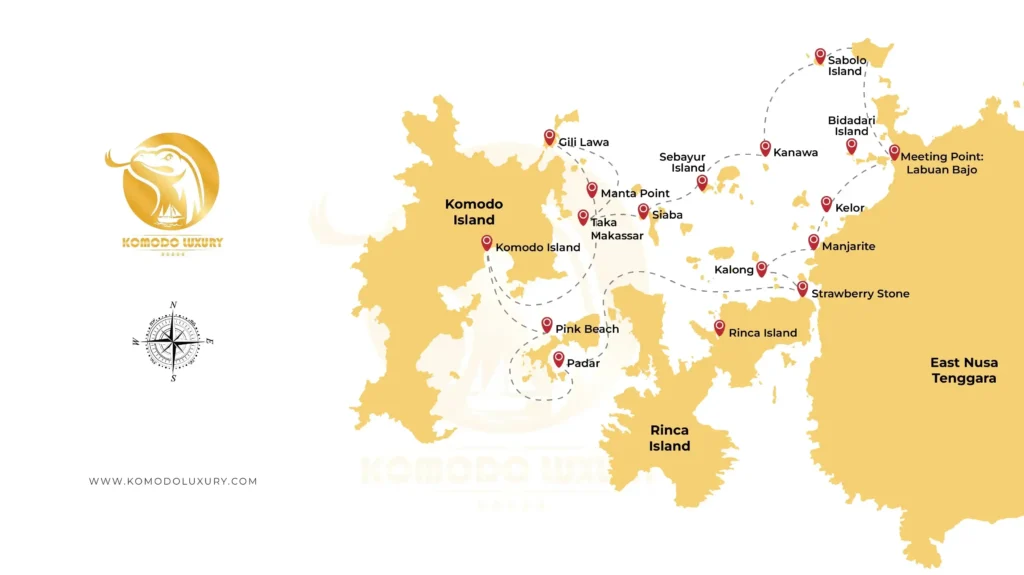
Komodo National Park sits west of Flores and is reached from Labuan Bajo. Almost every itinerary is built around the same short list of places, because they are the reason people come.
- Padar Island, the ridge climb with the three-bay view most people picture when they picture Komodo.
- Komodo Island and Rinca Island, where ranger-guided walks show dragons in their own habitat rather than behind glass.
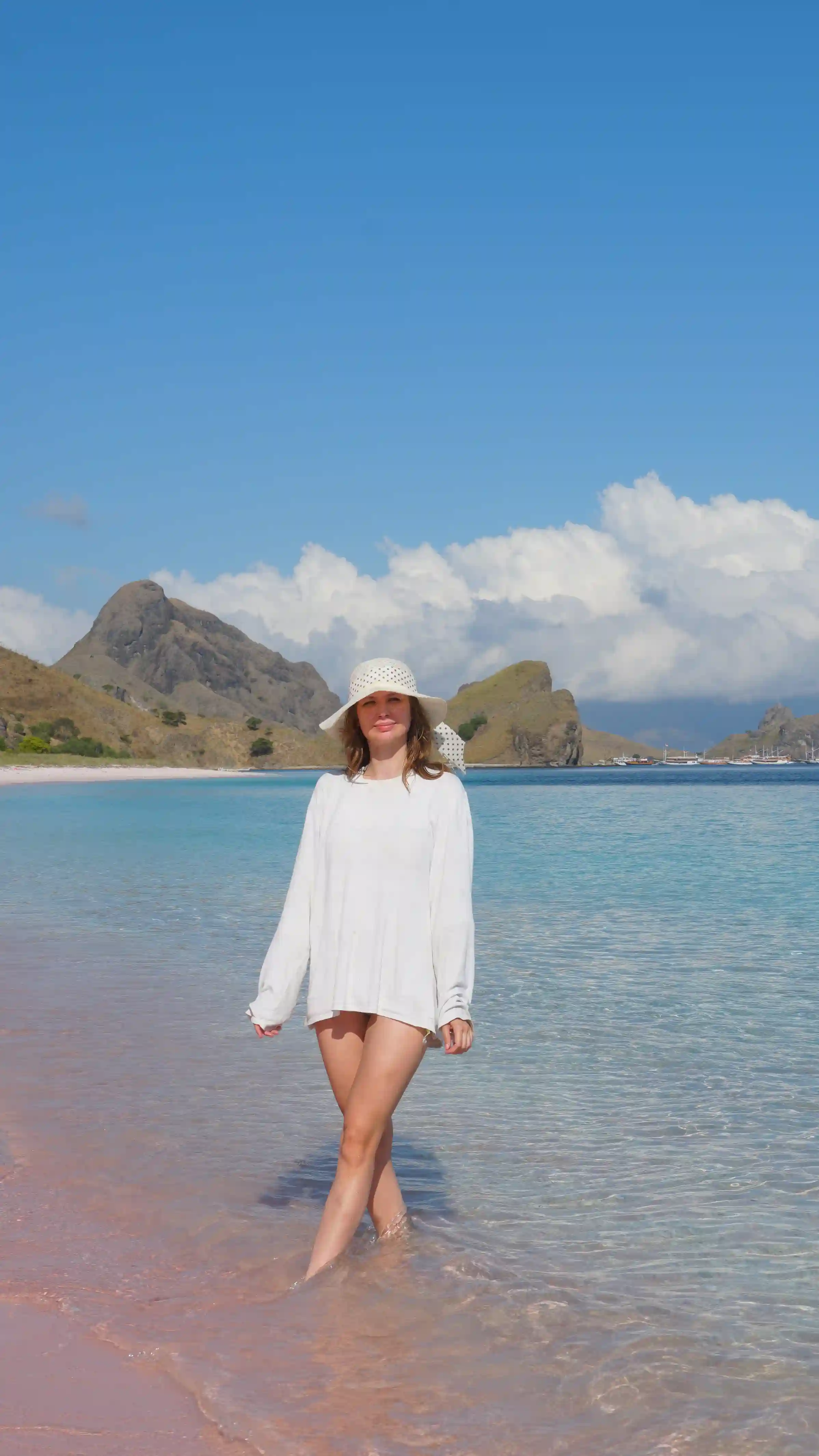
- Pink Beach, sand tinted by fragments of red organ pipe coral, with easy snorkelling straight off it.
- Manta Point, a cleaning station where manta rays gather. A highlight when conditions are right, and never a guarantee, because wild animals do not run to schedule.
- Taka Makassar, Kanawa, Kelor and Siaba, the sandbars, reefs and turtle grounds between the headline stops.
What no honest operator can promise is a fixed running order. Currents here are strong and tidal, weather moves, and park access depends on permits and ranger availability. A good captain reorders the day to put you in the right place at the right hour, and that flexibility is a feature rather than vagueness.
Budget separately for park admission. Komodo National Park tickets are not part of a cruise fare; they are charged by the authorities per person and differ by day, so we keep them on their own page: Komodo National Park entrance fees.
When to sail
Komodo is a dry, hot, savannah-and-reef environment, and the season shapes the experience more than in most destinations. Rather than compress that into a paragraph, we keep a month-by-month guide written from operating experience rather than climate averages. Four months carry most of the questions from Australian and British travellers.
- Komodo in September, the tail of the dry season, dry landscapes and settled water.
- Komodo in October, warm, still largely dry, and a favourite window for photography.
- Komodo in November, the transition month, greener hills and more variable afternoons.
- Komodo in December, the festive-season window, and the one that books furthest ahead.
If your dates are fixed by school terms or annual leave rather than by weather, read the month you are locked into and build the trip around what it is genuinely good at. That works better than bending the calendar.
Arriving in Labuan Bajo
Every cruise begins and ends at Komodo Airport in Labuan Bajo. From Singapore there is a nonstop option: Scoot flies Singapore to Labuan Bajo directly in roughly three hours and twenty to thirty minutes, the only market with a same-day direct run. From Australia and the UK you will connect, in practice through Bali or Jakarta and then a domestic flight onward. Schedules on those routes move from season to season, so check current timetables with your airline rather than trusting a figure printed on a tour page.
Whatever the routing, two habits protect the trip. Arrive in Labuan Bajo the day before you board, so a delayed domestic leg costs a hotel night instead of the first day of your cruise. Build a buffer night at the end too, before any long-haul connection home. Australian guests can find the market-specific version on our Komodo island tour from Australia page.
How to book, step by step
- Send your dates and your group first, not your boat preference. Availability drives everything. Tell us who is travelling, how many cabins you need, and whether anyone needs a particular cabin position, a child berth or a specific diet.
- Shortlist against the five tests above, not against photographs. If a vessel does not suit your group, we would rather say so at this stage.
- Confirm inclusions in writing. Park tickets are separate; check meals, drinking water, snorkelling equipment, guide fees and any dive arrangements.
- Secure with a deposit. A booking is held with a deposit and the balance falls due 30 days before departure, as set out in our published terms and conditions.
- Plan flights around the confirmed vessel, with a buffer night either side.
Our reservations team answers on WhatsApp at +62 811-3823-875, and written enquiries reach the same desk. Send your dates and group size and you will get availability rather than a brochure.
Where to start
Choose the boat by its crew, its cabins, its space and its safety culture, and let the photographs be a tiebreaker rather than the decision. Every question in the table above can be answered in writing before you pay anything.
When you are ready, send your dates, your group and anything that would change the answer, from a nervous swimmer to a milestone birthday. You will get availability, an honest read on which vessels suit you, and a written breakdown of inclusions. Reach the reservations team on WhatsApp at +62 811-3823-875, or through our contact page.