






Last updated: September 2026 · Prices & availability verified for the 2026/2027 season
Last updated: September 17, 2026
If you’ve ever wondered what would happen if a giant lizard faced off against a towering mammal, you’re not alone. Komodo dragons vs elephants are both famous for their size and power, though they live in completely different environments and have very different lifestyles. Here, we’ll explore their unique traits, compare them side by side, and even imagine a hypothetical showdown between these two remarkable creatures.
The buffalo-hunting savannah where this size question gets real is walked on every ranger-guided trek we operate — a standard morning across our Komodo tour packages.
One half of this matchup can still be met in the wild: Komodo Luxury’s guides, leading dragon treks since 2015, see Varanus komodoensis almost daily in Komodo National Park.
Komodo Dragon: The Giant Lizard of Legends
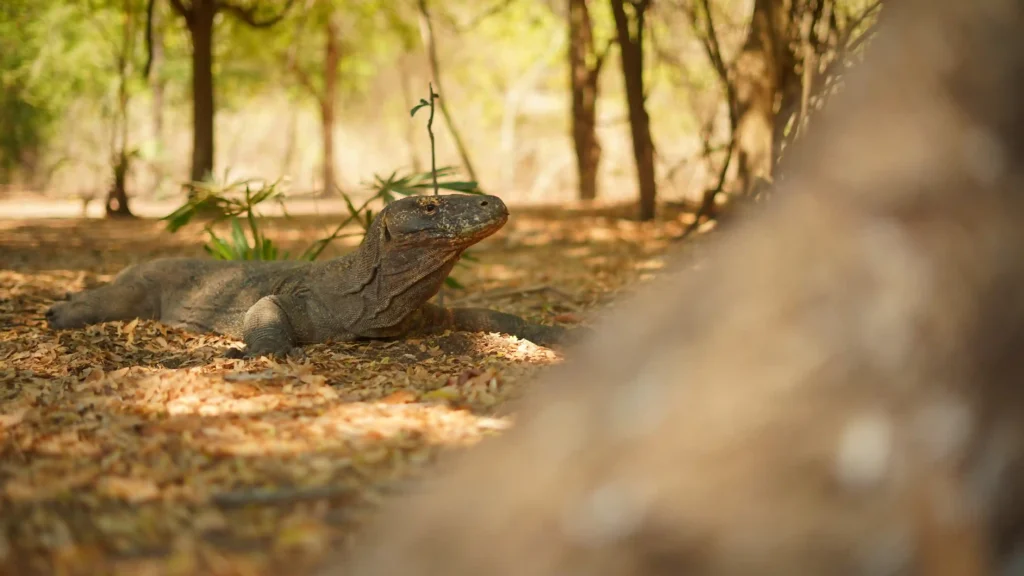
The Komodo dragon (scientifically known as Varanus komodoensis) is the largest living lizard on Earth. It can grow up to about 3 meters (around 10 feet) in length and can weigh anywhere from 70 to 90 kilograms (roughly 154 to 198 pounds). Despite its bulky physique, it’s surprisingly agile over short distances—sometimes reaching speeds of about 20 km/h (12 mph). Its scaly hide often comes in shades of grayish-brown or greenish-brown, helping it blend into scrubby vegetation.
One of the most striking features of the Komodo dragon is its powerful jaws filled with sharp teeth. Even more intimidating is its saliva, which contains a mix of bacteria that can cause serious infections. When a Komodo dragon bites its prey, the wound may become so severely infected that the victim weakens over time—making it easier for the Komodo to track it down later. This feeding strategy is quite effective in the wild, especially on the relatively small islands where Komodo dragons roam.
These fascinating reptiles are primarily found in Indonesia’s Lesser Sunda Islands, especially on Komodo Island, Rinca, and some parts of Flores. Though they rule their environment, they prefer to avoid risk by ambushing their targets rather than chasing them over long distances. Their diet usually consists of deer, wild pigs, water buffalo, and the occasional carcass they stumble upon. In certain situations, adult Komodo dragons have been known to eat smaller Komodos too, a behavior known as cannibalism.
Read more: Komodo Dragon vs. Alligator: Clash of the Giant Reptiles
Elephant: The Gentle Giant of the Wild
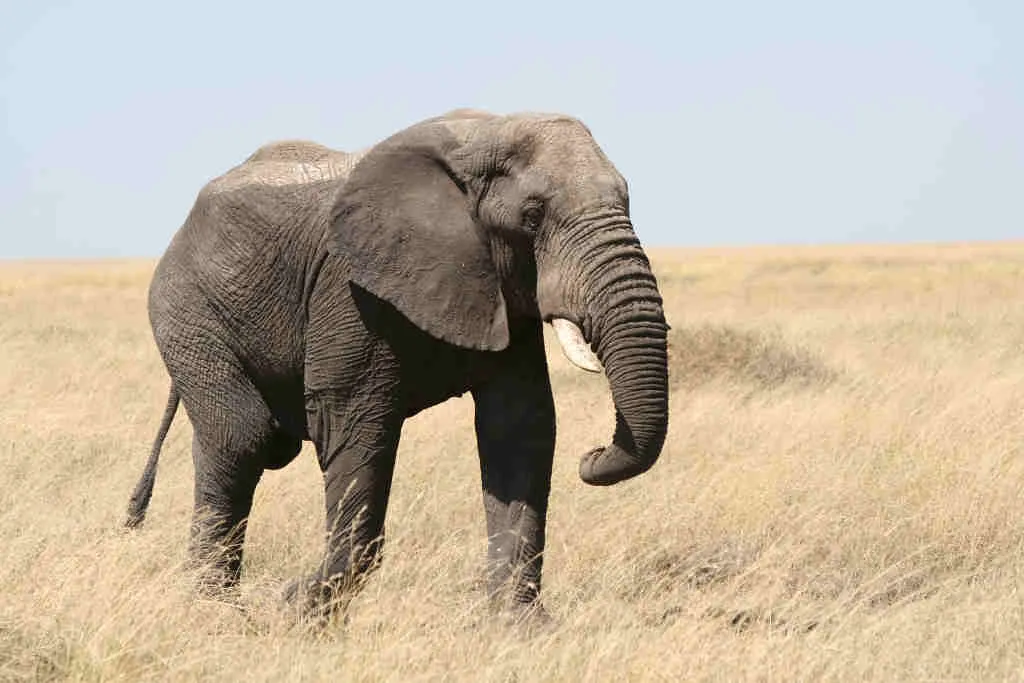
Elephants, on the other hand, belong to an entirely different class of animals. They’re mammals recognized for their huge bodies, expressive trunks, and (in most species) impressive tusks. There are three main species still living today: the African savanna elephant (Loxodonta africana), the African forest elephant (Loxodonta cyclotis), and the Asian elephant (Elephas maximus).
African savanna elephants tend to be the biggest, reaching up to 3 or 4 meters (9–13 feet) in shoulder height and weighing as much as 5 or 6 tons. Asian elephants are a bit smaller, but can still weigh around 4 or 5 tons. Their most iconic feature is the trunk, which serves as an incredibly versatile tool. Elephants use it to pick up food, drink water, and communicate through gentle touches or trumpeting signals.
Elephants are herbivores, mainly consuming grass, leaves, bark, and other vegetation. Because they need a massive amount of food, they often travel in search of fresh feeding grounds. Another notable trait is their strong sense of community; elephants typically form tight-knit family units led by a matriarch. These social structures help them protect each other from threats and teach young elephants how to survive in the wild.
Read more: Komodo Dragon vs. Black Mamba: A Clash of Two Deadly Predators
Komodo Dragon vs Elephant: Comparison
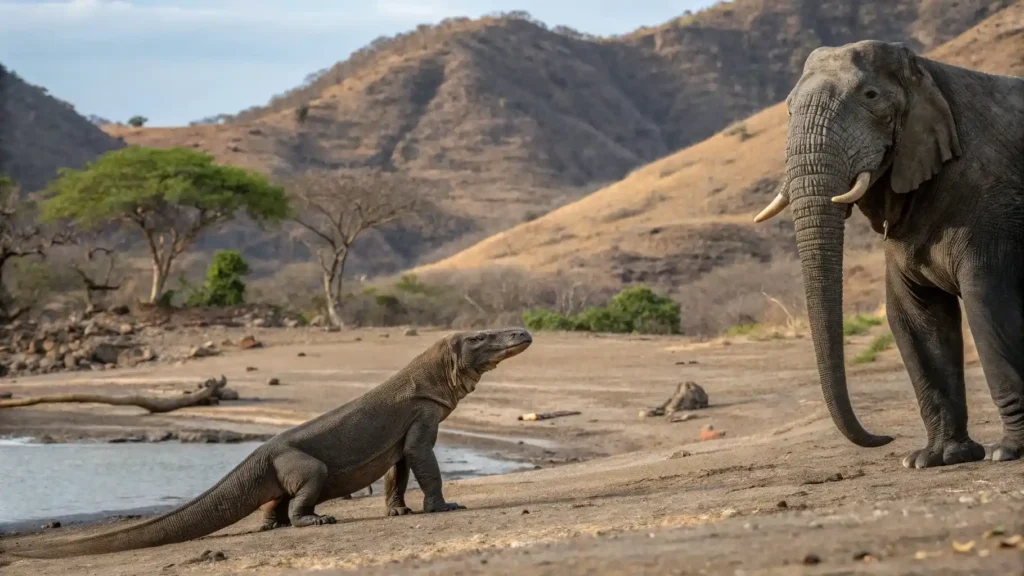
At a glance, comparing a giant lizard to a massive mammal might seem unusual. But these two creatures represent the pinnacle of survival in their respective habitats. Komodo dragons dominate the islands where they live as top predators, while elephants reign over grasslands and forests as some of the largest land animals on the planet.
From an evolutionary standpoint, Komodo dragons are like living dinosaurs—ancient reptiles that have adapted to island life. Elephants, meanwhile, are highly intelligent mammals that have developed strong social connections and the ability to traverse vast distances. Each species deserves admiration for the way it has carved out its niche on Earth.
Below is a simple table that lays out some main differences and similarities:
| Aspect | Komodo Dragon | Elephant |
| Classification | Reptile | Mammal |
| Average Length | Up to 3 meters (about 10 feet) | Body length up to 6–7.5 meters (nose to tail); shoulder height 3–4 meters |
| Average Weight | 70–90 kg (154–198 lbs); largest verified wild specimens up to 166 kg | 3–6 tons (depending on species) |
| Top Speed | Around 20 km/h (12 mph) for short bursts | Around 25 km/h (16 mph) in short sprints |
| Diet | Carnivorous (deer, wild pigs, carrion) | Herbivorous (grass, leaves, bark, fruits) |
| Habitat | Indonesian islands (Komodo, Rinca, Flores) | Africa (savannas, forests) & Asia (tropical forests) |
| Main Defense | Toxic bite (bacteria), sharp claws, strong tail | Huge body, trunk, tusks, protective herd behavior |
| Unique Adaptations | Bacterial saliva, thick scales, strong jaws and limbs | Thick skin, advanced memory, trunk for multiple tasks, group defense |
Physical Appearance
From a visual standpoint Komodo dragons look “prehistoric” with rough scales, muscular build and a long snout with sharp teeth. Their coloration is dark or dull which helps them blend in with dry shrubs or rocky hillsides. Elephants are recognized for their tall height, column-like legs and iconic trunks. Their skin is thick and wrinkled which serves as a protective layer against bugs and harsh weather. In short Komodo dragons look menacing and predatory while elephants look mighty and calm.
Size and Weight
An adult Komodo dragon can be around 3 meters long and weigh up to 90 kg on average, though the largest verified wild specimens have reached 166 kg. An elephant, by contrast, can reach 3 to 4 meters in shoulder height and weigh several tons, meaning even an average-sized elephant outweighs the biggest Komodo dragon ever recorded by more than twenty times. This size difference changes how each animal moves, hunts, and defends itself.
Hunting and Feeding
Komodo dragons are predators. They hide and wait for deer, pigs or other prey to wander by and then bite quickly. Even if the prey escapes the infected wound often becomes severe and the Komodo can track it later. Sometimes Komodos scavenge on carcasses. Elephants on the other hand don’t need to hunt. Their plant based diet can include grass, bark and fruit. Since elephants need large quantity of food and water they often travel far to find new grazing spots and waterholes. It’s a totally different way of life compared to the Komodo’s ambush tactics.
Defense
A Komodo dragon’s defense is its deadly bite, strong limbs and powerful tail. It can also blend into its environment making it easy to surprise unsuspecting prey or intruders. Elephants rely on size, strength and social unity. A single elephant can use its trunk and tusks if needed but in most cases a group of elephants forms a protective circle around vulnerable members (like calves) when faced with danger. Elephants are also intelligent enough to assess threats carefully and coordinate actions among the herd.
Habitat and Distribution
Komodo dragons favor dry, hot islands with sparse vegetation. The islands in eastern Indonesia can be quite harsh with limited water sources outside of the rainy season. Elephants on the other hand occupy a broader range of habitats. African elephants roam savannas, forests and sometimes semi-desert regions while Asian elephants mostly stick to tropical forests and nearby grasslands. Both animals show tremendous adaptability within their respective environments but they rarely overlap since their habitats are worlds apart.
Adaptations for Survival
The Komodo dragon’s success lies in its lethal saliva, thick scales and a powerful metabolism that allows it to go days or even weeks without a big meal. They can store fat in their tails and are excellent swimmers so traveling between nearby islands isn’t a problem. Elephants have developed advanced social systems, memory and communication skills using low frequency rumbles and body language to coordinate with each other. An elephant’s trunk is especially useful for gathering food, lifting objects or even showing affection to herd members. Their large ears (especially in African elephants) help regulate body temperature in hot climates.
Komodo Dragon vs. Elephant: Who Would Likely Win?
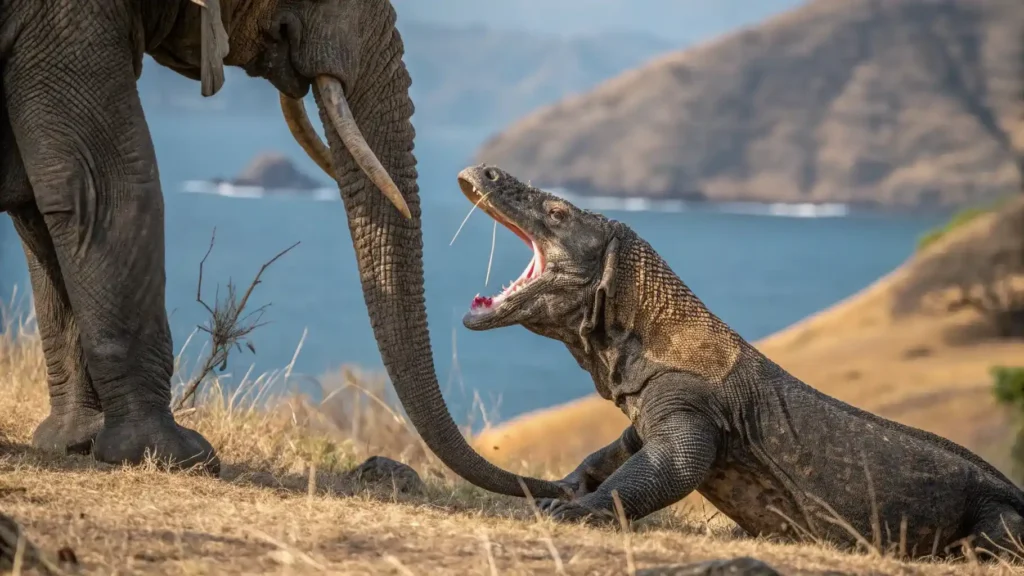
Now for the big question: if a Komodo dragon and an elephant ever crossed paths and ended up in some kind of conflict, who would come out on top?
If we look purely at physical power, the elephant’s massive body and strength would pose a huge advantage. An adult elephant could potentially stomp or toss a Komodo dragon aside with relative ease. A single blow from an elephant’s trunk or a thrust of its tusks could be devastating. On the flip side, Komodo dragons rely on their stealth and their infectious bite. In a direct fight with a healthy adult elephant, it’s unlikely a Komodo would get a bite in without being noticed. Even if the Komodo managed to bite the elephant’s leg, the reptile would then have to escape and wait for the infection to take effect.
However, elephants rarely roam alone. Herd members stand by each other, which boosts their ability to repel predators. Unless the elephant is isolated, weakened, or very young, the Komodo dragon’s chances of success are slim. So in most realistic scenarios, the elephant would win because of its size, power, and family support.
Book a Komodo Tour with Komodo Luxury
Although these two animals don’t share the same environment and are unlikely to ever face off in real life, it’s still interesting to line them up side by side. The Komodo dragon stands out as a legendary reptile with a deadly bite and ancient lineage, while the elephant stands tall as a highly intelligent, socially complex, and physically overwhelming mammal.
No elephants on these islands, but watching a dragon command a waterhole recalibrates your sense of scale. The elephant will need a different trip, the dragon is just a short boat ride from Labuan Bajo.
Komodo Luxury’s guided Komodo Island tours put you on ranger-led trails where wild dragons still hunt, while its Komodo boat tours wrap the trek into a full day on the park’s pink beaches and reefs. For a more complete itinerary, book a Komodo Tour package, join a 3D2N Komodo sailing tour, or linger longer on a liveaboard for the ultimate immersive experience.
Either way, you’ll come away with a story worth telling, and a better sense of just how wild this corner of Indonesia still is.

Read more: Komodo Dragon Vs: The Ultimate Guide to Epic Wildlife Showdowns
Written by the Komodo Luxury Expedition Team — licensed Komodo National Park operators guiding treks and crossings from Labuan Bajo since 2015. See our Komodo sailing tour packages.