






Last updated: November 2026 · Prices & availability verified for the 2026/2027 season
A phinisi charter specification sheet summarises a vessel’s dimensions, capacity, accommodation and history, but its figures only become useful when you understand what they describe. Before comparing two yachts, you need to know how their measurements are defined and whether the published arrangements suit your group. But how much can you really tell about a yacht from its specification sheet alone?
You might see a listing that promises 40 metres of length, six cabins and accommodation for 12 guests. While these figures may look straightforward, they do not explain how the length was measured, which cabins have double beds or whether every guest will have a permanent berth. This guide to phinisi charter specifications explained shows you how to read each specification, compare charter options consistently, and identify the questions to ask before booking. All numerical examples are hypothetical and do not describe a named yacht.
Key Takeaways
- A phinisi charter specification sheet is a sales summary, not a condition survey or a complete charter agreement.
- Compare length figures only after confirming their endpoints, measurement basis and, where relevant, loading condition.
- Gross tonnage and displacement describe different quantities and should be recorded separately.
- Confirm paying guest capacity, itinerary-specific crew numbers and the sleeping arrangements used to reach the advertised capacity.
- Review each cabin individually, and clarify what the published build year, refit date, and inspection details actually refer to.
What Does a Phinisi Charter Specification Sheet Tell You?
A phinisi charter specification sheet is a summary of a vessel’s main characteristics. It typically includes dimensions, tonnage, guest capacity, cabin arrangements, construction details, and onboard facilities. These details give you an initial overview of the yacht and help you decide whether it may suit your group.
However, a specification sheet is a sales document, not a full technical survey or charter agreement. It may not explain how every measurement was taken, whether the listed capacity includes crew, or how the sleeping arrangements are configured.
When reviewing a specification sheet, consider three questions:
- What exactly does this figure or description mean? A listed length, for example, may refer to a different measurement depending on the document.
- What measurement, document, or arrangement supports it? Ask for clarification if the specification does not explain its basis.
- How does it relate to your charter? A yacht’s advertised capacity may not reflect the sleeping arrangements or shared spaces your group needs.
Understanding these distinctions helps you look beyond headline figures and assess whether the vessel is suitable for your planned trip. If you are considering a Komodo liveaboard, use the specification sheet to review the sleeping arrangements and shared spaces alongside the proposed itinerary. This connects the yacht’s published characteristics with how you plan to spend your time aboard.
How to Read a Phinisi Charter Specification Sheet
Not every detail on a specification sheet has the same practical importance. Some describe the vessel’s physical dimensions, while others explain how many people it can accommodate and what the onboard arrangements look like. The following sections explain five key specifications you should understand before comparing phinisi charter options.
1. Length, Beam and Draft: What Do the Dimensions Tell You?

Length is one of the first figures you may notice on a phinisi specification sheet. However, the number alone does not tell you exactly how much space is available onboard.
A vessel’s length may be presented using different measurement terms, including:
- Length overall (LOA): The vessel’s total length measured between its outermost points, based on the stated measurement convention.
- Length on deck: The length measured along the deck, which may differ from the vessel’s overall length.
- Waterline length (LWL): The length of the vessel where the hull meets the water under a particular loading condition.
- Registered length: A measurement recorded for registration purposes, following the applicable measurement rules.
The exact measurement points can vary depending on the standard used. Features such as a bowsprit, davit or boarding platform may also affect the reported figure. This is why two phinisi yachts advertised as 40 metres long may not have the same usable deck space. One measurement might include features extending beyond the main hull, while another may describe a different part of the vessel.
When comparing length specifications, ask the operator:
- Does the published figure refer to length overall, length on deck, or another measurement?
- Where are the measurement endpoints?
- Is the measurement supported by a registration or technical document?
- How much usable deck space is available for your group?
Two other dimensions can help you understand the vessel’s proportions:
- Beam refers to the width of the vessel. It can give you a general idea of the available space across the yacht, although the actual layout depends on how the interior and exterior areas are arranged.
- Draft describes the vertical distance between the waterline and the lowest part of the hull or its appendages, depending on the measurement basis. Because draft can change with loading and other conditions, it is useful to ask which condition the published figure represents.
These dimensions provide context, but they do not independently determine whether a yacht is suitable for a particular route or anchorage. That assessment needs to consider the specific vessel and planned itinerary.
2. Tonnage and Displacement: What Does the Number Represent?
Tonnage can be confusing because it does not always describe a vessel’s physical weight. In particular, gross tonnage (GT) and displacement are two different measurements. According to the International Maritime Organization (IMO), gross tonnage (GT) is calculated based on the moulded volume of a ship’s enclosed spaces. It is therefore a volume-based measure, not the vessel’s mass in tonnes. You can refer to the IMO’s International Convention on Tonnage Measurement of Ships, 1969 for the explanation.
Displacement, on the other hand, refers to the weight of the water displaced by a vessel. It represents the vessel’s mass under a particular loading condition. For example, a specification sheet might list a yacht as having 395 GT. This does not mean that the vessel weighs 395 tonnes. If another listing states 395 tonnes of displacement, the two figures cannot be compared as though they describe the same property.
When reviewing this section, check whether the specification identifies:
- Gross tonnage (GT).
- Displacement, including the stated loading condition.
- The supporting measurement or registration document.
- Whether the figures refer to the same vessel and measurement basis.
If a listing only provides a number followed by the word “tonnes”, ask the operator to clarify what it represents before using it to compare yachts.
3. Guest Capacity: Who Is Included in the Published Number?
Guest capacity tells you how many people a yacht is advertised to accommodate. However, you should confirm whether the published number refers to paying guests, total persons onboard, or another capacity category. Crew members and charter guests have different accommodation requirements.
A yacht advertised for 12 people, for example, may accommodate 12 guests in addition to its crew, or the number may refer to a different total. The specification should make this distinction clear. You should also check whether the stated capacity is based on permanent sleeping arrangements or includes additional berths in shared spaces.
Before comparing guest capacity, ask:
- What is the maximum number of paying guests?
- Is the crew counted separately?
- How many crew members will be aboard on our proposed itinerary?
- Does the capacity include extra beds in the salon or other shared areas?
- Are all guests provided with permanent sleeping berths?
A yacht with a higher advertised capacity is not automatically the better option. The number should match your group size and the accommodation arrangements you are comfortable with. If you are still deciding between booking the whole vessel and reserving a cabin, read our guide to private charter vs shared Komodo trips. Then confirm which accommodation and shared spaces form part of your particular booking.
4. Cabins and Berths: How Will Your Group Actually Sleep?
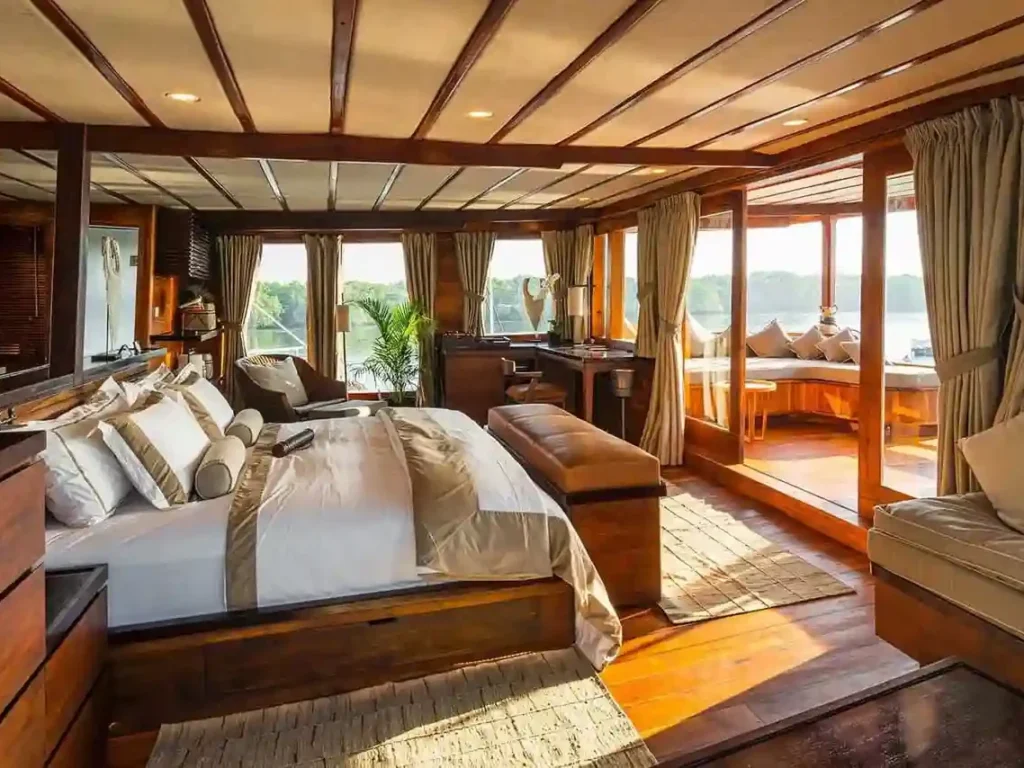
The number of cabins is another important detail, particularly when you are travelling with family, friends or a group that needs separate sleeping arrangements. However, two yachts with six cabins may offer very different accommodation. One might have six cabins with fixed double beds, while another may combine double, twin and bunk-bed configurations. A berth refers to an individual sleeping space onboard. It is useful to distinguish between the number of cabins and the number of berths because one cabin may accommodate more than one guest.
When reviewing the accommodation section, look for:
- Bed configuration: Is the cabin fitted with a double bed, twin beds, bunk beds or a convertible arrangement?
- Deck level: Is the cabin on the lower, main or upper deck?
- Natural light: Does it have a window, porthole or no direct natural light?
- Bathroom arrangement: Does it have a private bathroom or share facilities with other cabins?
- Headroom and access: Is there enough room to move comfortably, and are there stairs or narrow passages leading to the cabin?
In marine terminology, a bathroom is often called a head. A specification sheet may use this term when describing private or shared bathroom facilities. Request a current deck plan and cabin photographs to understand the actual layout instead of relying on the cabin count alone.
As you browse the VIP fleet, use the published cabin and guest numbers to create an initial shortlist. Then request a cabin-by-cabin breakdown for the yachts you are considering, rather than assuming the category alone confirms the sleeping arrangement your group needs.
5. Build and Refit Dates: What Happened in the Published Year?
A phinisi specification sheet may include a construction year and one or more refit dates. Although both are useful, they describe different aspects of the vessel’s history. The build year may refer to different milestones, such as when construction began, when the vessel was launched, when it was completed, or when it first entered service. Ask which milestone the published year represents rather than assuming every operator uses the same definition.
A refit date indicates that work was carried out on the vessel, but it does not explain the scope of that work. Depending on the project, a refit may involve interior updates, new furnishings, equipment replacement, or other maintenance.
For a clearer picture, ask:
- What does the stated build year refer to?
- When was the most recent refit completed?
- Which areas or systems were included in the refit?
- Was the work cosmetic, functional or both?
- When was the vessel’s most recent condition inspection, and who carried it out?
A recent refit date does not automatically establish the vessel’s overall condition. The scope of the work and any available inspection records provide important context.
Read more: How Komodo Luxury Vets Its Fleet: Safety Standards & the 200-Vessel Inspection Bar
How Do You Compare Two Phinisi Specification Sheets Fairly?
Once you understand the main specifications, you can compare two phinisi yachts more consistently. The key is to make sure you are comparing equivalent information rather than relying on similar-looking figures.
Consider the following hypothetical examples:
| Specification | Yacht A | Yacht B |
| Published length | 40 m | 38 m |
| Tonnage | 395 GT | 395 tonnes |
| Published capacity | 12 guests | 14 passengers |
| Accommodation | 6 cabins | 6 cabins |
| Vessel history | Built in 2015 | Refit in 2023 |
- At first glance, Yacht A appears longer, while Yacht B has a higher published capacity and a more recent date in its history. However, these details do not provide enough information to determine which yacht is more suitable.
- Yacht A’s figure is labelled as gross tonnage, while Yacht B’s ‘395 tonnes’ remains undefined. Ask what Yacht B’s figure represents before attempting a comparison. If it refers to displacement, the two figures describe different quantities.
- The capacity descriptions also need clarification because “guests” and “passengers” may not refer to the same group. Meanwhile, the six-cabin descriptions do not reveal the actual bed configurations or bathroom arrangements.
- The build and refit dates also describe different events. You would need to understand the scope of the refit and the meaning of the stated build year before drawing conclusions.
A fair comparison should therefore focus on information that uses the same measurement basis and describes equivalent arrangements. If a specification is unclear or missing, ask for clarification rather than treating the available figures as directly comparable.
When you are ready to build a shortlist, explore our guide to the best luxury phinisi in Komodo. Use it to identify vessels for further consideration, then apply the same questions about dimensions, capacity, cabins, and vessel history to each option.
What Should You Request Before Confirming a Private Charter?
A specification sheet is a useful starting point, but you may need additional information to understand how the yacht will work for your group. Before confirming a charter, request supporting details and make sure important arrangements are clearly documented.
Your Phinisi Charter Specification Checklist
Use this checklist when reviewing a yacht or comparing several charter options:
- Vessel identity: Confirm the yacht’s name and the operator responsible for the charter.
- Length: Check the measurement basis, endpoints, and available usable deck space.
- Beam and draft: Ask for the measurement basis and the loading condition used for the draft figure.
- Tonnage and displacement: Request gross tonnage and displacement as separate entries, together with their supporting documents and the stated condition for displacement.
- Guest capacity: Establish the maximum number of paying guests, excluding crew.
- Crew: Confirm the crew number for your proposed itinerary and record it separately from paying guest capacity.
- Additional berths: Check whether extra sleeping spaces are included in the advertised capacity.
- Cabin configuration: Request the bed type, deck level, natural light, headroom and access details for each cabin.
- Bathrooms: Confirm which cabins have private bathrooms and which share facilities.
- Build year: Clarify which construction milestone the date represents.
- Refit history: Ask for the latest refit date and a summary of the work completed.
- Condition inspection: Request details of the most recent inspection, including who conducted it and when.
- Visual references: Ask for a current deck plan and recent photographs of the cabins and shared spaces.
- Systems and premium features: Verify that the vessel is equipped as shown in marketing materials by asking for confirmation of major systems and optional higher-end features that matter to your booking decision, such as high-capacity desalination watermakers, large fuel tanks, satellite Wi‑Fi, spa areas, or outdoor cinema setups.
Having these details in writing makes it easier to review the information later and identify any points that still need clarification.
Turn Your Preferences Into Specific Requests
Your group’s needs should guide which specifications you pay the most attention to. Instead of asking only whether a yacht can accommodate eight guests, explain what kind of arrangement would make the trip comfortable. For example, you might request four cabins with fixed double beds and private bathrooms if you are travelling as four couples. If your group enjoys dining outdoors, ask whether the yacht has a shaded dining area that can seat everyone at the same time.
Other preferences may include cabins with easier access for guests who prefer fewer stairs, enough indoor seating for everyone, or additional sleeping arrangements for children. These details help the operator understand what matters to your group and provide more relevant yacht options. They also give you a clearer basis for checking whether the published specifications match the arrangements being offered.
Read more: How Komodo Luxury Ensures Safe Sailing in Komodo National Park
What Can a Phinisi Specification Sheet Not Prove?
Although a specification sheet provides useful information, it has limitations. It should not be treated as proof of every aspect of a vessel’s condition or suitability. For example, a published length, tonnage, or build year cannot independently establish the yacht’s structural condition, stability, or overall safety. Similarly, photographs and cabin descriptions do not replace a physical inspection or relevant technical documentation.
A specification sheet may also become outdated if the vessel undergoes changes to its layout, facilities or equipment. This is why you should confirm that the information reflects the yacht currently being offered for your charter.
Keep in mind that this guide is intended to help you interpret and compare published information. It is not a technical survey, engineering assessment, or determination of the regulatory requirements applicable to a particular phinisi. If you have questions about a vessel’s technical condition or documentation, request the relevant records and seek clarification from the responsible operator or a qualified professional.
Discuss Your Luxury Phinisi Charter Specifications With Komodo Luxury
Understanding a phinisi charter specification sheet can help you make a more informed decision, but choosing the right yacht also depends on where you want to sail, your travel dates, group size, and preferred accommodation. Whether you are planning a private yacht charter Komodo Island or exploring the islands and marine landscapes of Raja Ampat, understanding the vessel’s specifications can help you find an arrangement that suits your journey.
As a luxury yacht charter operator, Komodo Luxury can help you explore available yacht options based on your destination, travel dates, group size, and accommodation preferences. Share the vessel you are considering or describe your preferred charter arrangements with our team to discuss the relevant specifications and request a written quotation.
Ready to plan your private voyage to Komodo Island or Raja Ampat? Visit the official Komodo Luxury contact page to discuss your requirements and explore the yacht options available for your charter.