





Last updated: September 2026 · Prices & availability verified for the 2026/2027 season
Which birds of paradise actually live in Raja Ampat?
Two species, and only two. The family Paradisaeidae contains 44 species across 17 genera worldwide, and about 38 of them occur on New Guinea and its satellite islands. Raja Ampat sits at the western edge of that range and holds a small, specific share of it: Wilson’s bird-of-paradise and the Red bird-of-paradise. Indonesians call the whole group cendrawasih.
That narrow list is the point. People arrive expecting a jungle full of them and are surprised to learn the archipelago’s headline bird occupies two islands and nothing else. Raja Ampat has more than 300 recorded bird species in total — hornbills, cockatoos, kingfishers, cuscus in the same forest — but the two paradise species are what people fly for, and they are worth building a morning around on a Raja Ampat yacht charter.
What does Wilson’s bird-of-paradise look like?
Cicinnurus respublica is small and absurd. The male is roughly 16 cm long, about 21 cm counting the two curled violet tail wires, and weighs 53–67 g — lighter than a golf ball. The crown is not feathered at all: it is bare turquoise-blue skin, crossed by fine black lines, over a crimson back, yellow mantle and a green breast shield. The IUCN lists it as Near Threatened, with a declining population.
And the Red bird-of-paradise?
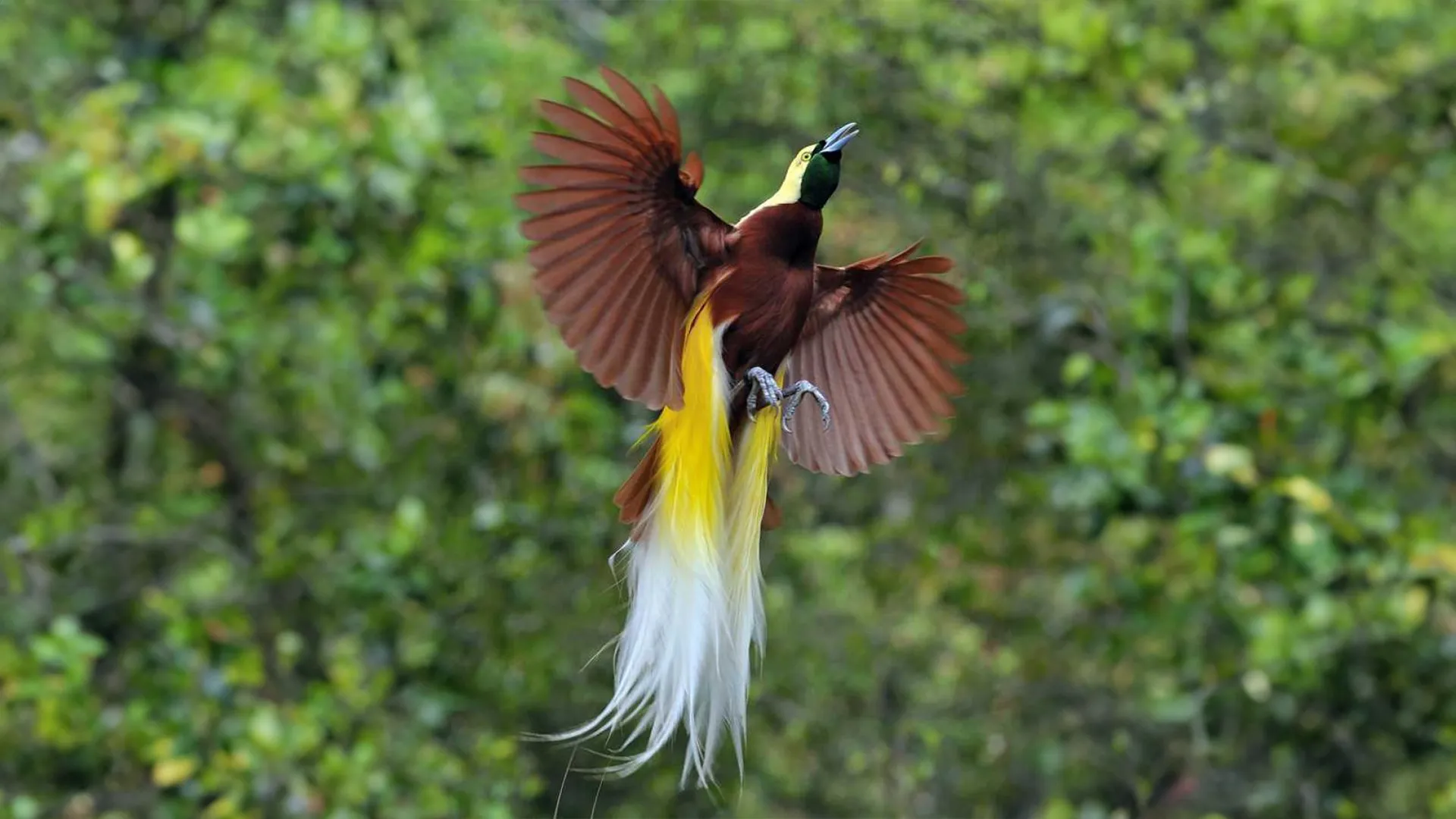
Paradisaea rubra is the larger, more theatrical bird: males run about 33 cm in the body before you count the long tail streamers, with deep red flank plumes and a yellow nape. It displays as a lek — several males in the same emergent tree, competing in the same few minutes of light. The IUCN lists it as Least Concern, though the population trend is also declining. Both species are on CITES Appendix II.
| Wilson’s bird-of-paradise | Red bird-of-paradise | |
|---|---|---|
| Scientific name | Cicinnurus respublica | Paradisaea rubra |
| Global range | Waigeo and Batanta only | Waigeo, Batanta, Gam and adjacent islets |
| Male size | 16 cm; 21 cm with tail wires | ~33 cm plus streamers |
| Weight | 53–67 g | Not consistently published |
| Displays | Cleared court on the forest floor | Lek high in an emergent tree |
| You are looking | Down, or level, into the understorey | Up, steeply, into the canopy |
| IUCN status | Near Threatened, declining | Least Concern, declining |
Where do you actually stand to see them?
Not from the boat. Every sighting means going ashore and walking into hill forest before sunrise. The sites are village-managed, and the village guide decides which hide is active that week — display trees and courts shift between seasons, and a site that produced birds last April may be quiet in November.
The Red bird-of-paradise villages are the reliable ones. Sawinggrai, on Gam, is the best known and has hosted birdwatchers the longest. Yenwaupnor and Yenbuba on Waigeo work the same way. For Wilson’s, the walks go into the hill forest behind Waisai — the Sapokren and Warkesi trails on Waigeo — and into the forest on Batanta. Batanta matters because it is the one place a single anchorage puts both species within reach.
| Site | Island | Primary species | Character of the walk |
|---|---|---|---|
| Sawinggrai | Gam | Red bird-of-paradise | Short, well-established village trail |
| Yenwaupnor | Waigeo | Red bird-of-paradise | Village trail, easy grade |
| Yenbuba | Waigeo | Red bird-of-paradise | Village trail, easy grade |
| Sapokren | Waigeo | Wilson’s | Uphill into hill forest behind Waisai |
| Warkesi | Waigeo | Wilson’s and Red | Steeper, forest reserve edge |
| Batanta forest | Batanta | Both | Remote; needs a boat that can overnight there |
Why are the sites run by the villages?
Because the forest belongs to them, and so does the decision about what it is worth. A display tree that earns a guiding fee every dry-season morning is a tree with a standing value, which is a materially different proposition from a tree worth something once, felled. The guides at Sawinggrai and Sapokren know individual males and know which court is active this month, and that knowledge is not something a visiting operator can substitute. Paying the fee directly, in cash, to the people holding the trail is the arrangement that keeps it working.
When should you go — the hour and the month?
What time does the morning really start?
Earlier than guests expect. Raja Ampat sits within half a degree of the equator, so sunrise barely moves all year — it lands close to 06:00 WIT (UTC+9) in every month. The birds display in the first light, and activity drops away sharply once the sun is properly up. That arithmetic works backwards into an unpopular number: tender off the yacht around 04:30, in the hide before the forest is light enough to read by.
You will sit still for a while after that. Displays are not scheduled, and the wait in the hide is the part nobody photographs.
Which months are best?
Two calendars overlap here, and they are not the same calendar.
The sea decides the first one. The Raja Ampat charter season runs broadly October to April, when the northwest monsoon leaves the crossings calm; most liveaboards reposition to Komodo for May to September, with July to September the windiest stretch. If you want the archipelago’s full itinerary — Wayag, Piaynemo, the birding villages — you want the October to April window.
Many guests mirror the fleet itself, pairing an October-to-April Raja Ampat week with one of the Komodo liveaboard itineraries in the dry season, or a luxury yacht charter in Komodo when the same hulls sail south.
The birds run the second one, and it is less tidy. Display seasons for Wilson’s are poorly documented; the Australian Museum’s account describes the season as undefined, but probably at least May–June and October. October is the useful word in that sentence, because it is the only month that clearly sits inside both calendars. That is why we push birding-led Raja Ampat itineraries toward the October–November shoulder rather than the January peak.
How does a birding morning work from a chartered yacht?
The advantage of a yacht is not comfort. It is position. A land-based guest sleeps in Waisai and burns an hour of dark getting to the trailhead. A yacht anchors off the village overnight, which turns that hour back into sleep and puts you at the jetty when the guide arrives.
That positioning is the quiet argument for a Raja Ampat yacht charter: the itinerary is built backwards from the 04:30 tender rather than a hotel breakfast.
The sequence we run is unglamorous and it works. Crew wake you with coffee and nothing else. The tender leaves in the dark. A village guide meets the boat — the site is theirs, and the fee is paid to them directly. You walk in single file, you stop talking at the treeline, and you stay in the hide until the guide says the display is over. No flash, no playback of recorded calls to draw birds in, no stepping off the trail for a better angle. Breakfast happens back aboard, usually before nine, and the rest of the day is a normal Raja Ampat day.
What should you wear and carry?
Long sleeves and long trousers in dull colours, and shoes with grip that you do not mind ruining — the Sapokren and Warkesi trails are steep, and the clay holds water long after the rain stops. Bring insect repellent, a head torch with a red setting, and a rain shell small enough to forget about. Leave the bright dry-bag on the boat. The forest floor is dim even after sunrise, so a fast lens does more for you than a long one, and a monopod does more than either. Nobody has ever regretted the second pair of dry socks.
We have been running boats out of Labuan Bajo since 2015 and hold 4.9 out of 5 from more than 1,500 verified guests, plus TripAdvisor Travelers’ Choice in 2025 and 2026. Raja Ampat mornings like this are the part of the job where the crew’s habits matter more than the boat’s specification — though it helps that the vessels are ours. We run nine yachts we own and operate, alongside 200+ vetted partner yachts, so you book with the operator rather than a middleman. You can see the owned boats on our fleet page, and the full birding brief on our Raja Ampat birdwatching page.
What permits and fees apply in 2026?
Raja Ampat charges a marine park entry permit, sold as a PIN card. For foreign visitors the rate is IDR 1,000,000, and the card is valid 12 months from the date of purchase — a second trip inside the year does not pay twice. Charter guests do not queue for it; we buy it against your passport details before you land.
Village birding fees are separate, smaller, and paid in cash on the spot to the community that manages the site. They are set locally and they change, so we confirm the current figure with each village before your trip rather than quoting a number that ages badly. Bring small rupiah notes.
Fee structures in the regency have been revised more than once recently. If you are comparing quotes, check whether the permit is inside the charter price or bolted on afterwards — that single line explains most of the gap between two Raja Ampat proposals.
Will you definitely see one?
No, and any operator promising otherwise is selling you something. These are wild birds on Near Threatened and declining trajectories, displaying on their own schedule in forest they share with nobody’s timetable. Rain suppresses activity. A tree that held four males in October can be empty in February.
What raises the odds is boring and controllable: go at dawn rather than mid-morning, budget two mornings instead of one, use the village guides who watch these courts year-round, and accept the October shoulder over the calendar that suits your office. Guests who do all four usually connect. Guests who allow a single lie-in morning frequently do not.
Building it into a real itinerary
A birding morning is one dawn inside a longer trip, and it slots naturally into a whole-boat itinerary that already covers Wayag, Piaynemo and the reefs. Whole-boat rates across our fleet run USD 1,800 to 30,000 per night depending on vessel, and you can compare the structure on the yacht charter pricing hub. Guests who want the same private-boat format in Komodo take a private yacht charter in Komodo, and those combining both regions across a season usually start from the Komodo liveaboard itineraries.
One planning note worth acting on: our median booking lead time is about two months, and the October–November birding shoulder is the narrowest window in the Raja Ampat year. The boats that can overnight off Batanta are the first ones gone.
Checking the boat charter calendar early is the practical fix, particularly if you want a traditional luxury phinisi hull with the range to hold that anchorage.
If you want a specific morning costed against a specific vessel, message us on WhatsApp at +62 811 3823 875 or email [email protected], and tell us which species matters more to you. That one answer changes the anchorage.
Frequently Asked Questions
Can you see birds of paradise and dive Raja Ampat on the same trip?
Yes, and most guests do. The birding walk finishes by around 08:00, which leaves the whole diving day intact. Anchoring off Gam or Waigeo overnight puts the village jetty and the morning dive sites within the same short tender run, so no day is spent travelling between them.
Do I need to be a birdwatcher to enjoy the morning?
No. Most guests who do this are not birders. What sells the morning is the theatre of it: a 16 cm bird with a bare blue head clearing a stage on the forest floor at first light. The walk is short and the guide does the finding.
How early do we have to leave the boat?
Around 04:30. Sunrise in Raja Ampat sits close to 06:00 all year because the archipelago straddles the equator, and displays happen in the first light. Leaving later means arriving after the birds have finished. Crew have coffee ready on deck before the tender goes.
What is the chance of actually seeing a bird of paradise?
Good, but never guaranteed. These are wild birds displaying on their own schedule, and rain suppresses activity. Budgeting two mornings rather than one is the single biggest improvement you can make to the odds. Village guides who watch the same courts year-round make the second-biggest difference.
Is Wilson's bird-of-paradise found anywhere else in the world?
No. Wilson's bird-of-paradise is a global endemic restricted to Waigeo and Batanta in Raja Ampat. It occurs nowhere else on Earth, which is why the species drives so much of the archipelago's birding traffic. The IUCN lists it as Near Threatened with a declining population.
Can I photograph them, and is flash allowed?
Photography is fine; flash is not. Nor is playing recorded calls to draw birds in. Light and playback disturb displaying males and can push them off a court entirely. Expect dim forest light, so a fast lens helps more than a long one — the famous images of these species were made with patience, not brightness.
What does the Raja Ampat entry permit cost in 2026?
The marine park PIN card is IDR 1,000,000 for foreign visitors and is valid 12 months from the date of purchase, so a second trip within the year does not pay again. Village birding fees are separate, set locally, and paid in cash to the community managing each site.
When should I book a Raja Ampat charter with birdwatching?
Earlier than you think. Bookings reach our desk about two months ahead, and the October–November window — the one that overlaps both the calm-sea season and the documented display months — is the narrowest in the Raja Ampat year. Boats able to overnight off Batanta book out first.
A dedicated birds of paradise luxury cruise itinerary times landings around lek displays.