




Last updated: September 2026 · Prices & availability verified for the 2026/2027 season
The dragon questions our desk answers on WhatsApp every day come down to one thing: where exactly will I see the dragons, what is the ranger walk like, and does my trip length actually reach them?
Quick answer: Wild Komodo dragons are seen inside Komodo National Park on ranger-led walks from two stations, Loh Liang on Komodo Island and Loh Buaya on Rinca Island. Every Komodo Luxury sailing trip that enters the park stops at one of them; the 3D2N open trip walks Komodo Island on Day 2. Compare the formats on our Komodo Island sailing tour packages page.
Where do you actually see Komodo dragons?
Wild Komodo dragons live inside Komodo National Park and on a few stretches of the western Flores coast. Visitors meet them at two ranger stations, always with a licensed ranger. Bali has no wild population; see do Komodo dragons live in Bali.
Loh Liang, Komodo Island: the stop on the standard 3D2N route
Loh Liang is the station on Komodo Island, roughly 35 to 40 km west of Labuan Bajo, about 2 hours by speedboat and 3 to 4 hours by phinisi, as stated on our Komodo Island page, checked 12 September 2026. Short, medium and long ranger-guided loops run through forest and savannah; Pink Beach is on the same coastline.
Loh Buaya, Rinca Island: nearer Labuan Bajo, on some day trips and the usual substitute
Loh Buaya is the station on Rinca Island, about 45 to 60 minutes by speedboat, as stated on our Rinca Island page, checked 12 September 2026. A raised walkway runs over the valley the animals patrol, and dragons often gather near the station’s water sources. Some day routes choose Loh Buaya for its shorter crossing, and when weather or Harbour Master instructions close the Komodo Island landing, Rinca is the substitution the crew communicates on the day.
Komodo Island or Rinca Island: which station will your trip use?
You do not normally pick the station; the trip format does, and walking both is a 4D3N or private charter arrangement confirmed per date. The cells below come from our two destination pages, checked 12 September 2026, and from how our crews run the route; the full comparison is in Komodo Island vs Rinca Island.
| Loh Liang, Komodo Island | Loh Buaya, Rinca Island | |
|---|---|---|
| Boat time from Labuan Bajo | About 2 hr by speedboat; 3 to 4 hr by phinisi | About 45 to 60 min by speedboat; longer by phinisi |
| Komodo Luxury trips that stop here | 3D2N open trip (Day 2); most speedboat day trips; private charters | Some day routes; 4D3N and longer charters; the usual substitute when Komodo Island is closed |
| Walk options | Short, medium and long ranger-guided loops; the ranger sets the pace | Short about 30 min, medium about 1 hr, long 1.5 to 2 hr, chosen on arrival |
What happens on the ranger walk
The sequence is the same at both stations, as our Komodo Island trekking page describes:
- Tender to the jetty. The boat anchors in the bay and the crew runs you ashore.
- Ticket check. Your park tickets were arranged by the desk before departure; the guide handles the check at the station.
- Briefing. The ranger explains the distance rule, single file, no running and no food, and asks who wants which loop.
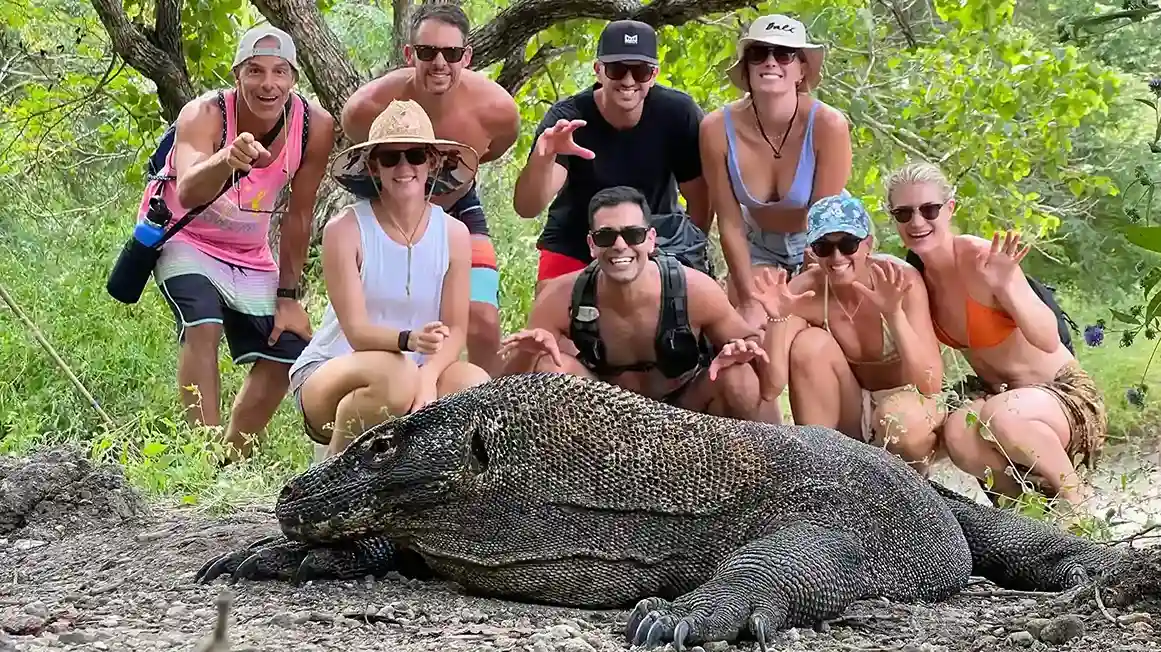
- Ranger-led loop. You walk behind and beside the ranger, who carries the forked staff.
- Viewpoint and return. Medium and long loops climb to a viewpoint over the bay, then back to the tender.
Short, medium or long loop: who chooses and who can skip
The ranger sets the loop and the pace on the day, weighing the heat and the group; if a group splits, the short loop is offered, and guests who prefer not to walk should tell the desk before departure so the crew can plan the landing.
Sightings are not promised, and why most groups still see one
No one can promise a sighting of a wild animal, and we do not. Most groups do see dragons near the stations, where the animals favour water and shade; rangers know where the animals were last seen and may adjust the loop; nothing is promised.
Which trip gets you to the dragons?
The 3D2N open trip: Komodo Island on Day 2
The Komodo open trip is a cabin on a shared boat on the 3D2N program; most boats follow a similar route: Day 1 Kelor Island, Manjarite and Kalong Island; Day 2 Padar Island, the Komodo Island dragon walk, Pink Beach and Taka Makassar or Manta Point; Day 3 a final snorkel stop such as Kanawa or Siaba, then back to Labuan Bajo. Departures run on a fixed schedule, Friday to Sunday, plus Monday to Wednesday on selected boats; the order flexes with weather, sea and Harbour Master instructions. Detail: the 3D2N Komodo tour page and our 3 days 2 nights itinerary post.
A day trip by speedboat from Labuan Bajo
The one day trip by speedboat leaves Labuan Bajo in the morning, reaches a ranger station, adds Padar and Pink Beach, and returns in the afternoon; the boat type depends on the number of participants. Day boats: our Komodo boat tour page; the one-day trip guide covers the day hour by hour.
2D1N, both stations, or a slower morning: private charter
We do not currently run a 2D1N open trip. A two-day route, both stations in one trip, or a boat anchored off the island overnight so you walk at opening time is a private Komodo trip or private yacht charter arrangement: the whole boat is yours and duration, schedule and itinerary follow your preferences; we check availability per date and confirm in writing.
Every trip starts and ends in Labuan Bajo, as a Labuan Bajo tour or a Komodo tour from Bali; times are in pickup, return times and flights.
Park entrance and ranger fees: how they are handled
The Komodo National Park entrance fee, including guide and ranger fees, is arranged separately and is not part of the base trip price. The desk issues the tickets against each passenger’s full name, ID or passport number, gender and nationality, adds the amount to your invoice, and the dated tickets are non-refundable. On a standard 3D2N the ticket is paid once for the whole trip; for 4D3N or a custom route the desk confirms the exact total with the permit. Detail: our park fees and permits guide.
Rules on the walk and what to wear
The rules the ranger briefs before every landing and our crews repeat on the tender:
- Stay behind and beside the ranger, on the marked trail.
- Keep the distance the ranger sets, and more from nesting females; dragons sprint over short bursts, so use a zoom lens.
- No running, no sudden moves, no crouching in front of an animal unless the ranger positions you for the perspective photo.
- No food on the trail; dragons hunt by scent.
- Tell the ranger if you are menstruating; the protocol is discreet, explained in can Komodo dragons sense blood.
- Children walk between an adult and the ranger; see what parents must know before visiting Komodo with children.
- Closed shoes, a hat, sun protection and water; packing list: what to bring to Komodo Island.
Safety in depth: is it safe to visit Komodo Island.
When in the day and the year
Morning is cooler and busier, because the day fleet arrives mid-morning; guests on a luxury phinisi anchored off the island overnight can be on the trail at opening time. Dragons are present year-round; our destination pages list April to November as the most comfortable months for trekking. Timing in depth: the best time of day to see Komodo dragons and the best time to visit Komodo.
Plan your dragon walk with the reservations desk
Tell us your dates, group size and whether you want the 3D2N open trip, a day trip or a private charter; we check availability and confirm in writing, on WhatsApp +62 811 3823 875, [email protected] or the contact page. Our report on whether Labuan Bajo is safe after the earthquake covers the August 2026 event; it does not change the ranger walk.

Questions our reservations desk hears
Is 2D1N enough to see the dragons and Padar, or do we need the 3D2N trip?
Both fit a 2D1N route, but only as a private charter; open trips are 3D2N and walk Komodo Island on Day 2 with Padar and Pink Beach. Send your dates; we confirm in writing.
Does the 3D2N open trip visit Komodo Island or Rinca Island, and can we do both?
The 3D2N open trip walks Komodo Island at Loh Liang on Day 2. Rinca appears on 4D3N and longer charters and some day routes, and usually stands in if the Komodo Island landing is closed; the crew confirms on the day. Walking both is a 4D3N or private charter arrangement, confirmed per date.
Do we need a ranger to see the Komodo dragons, and is the ranger fee included in the boat price?
Yes, every walk is led by a licensed park ranger. The park entrance and ranger fees are arranged separately from the base trip price: the desk issues dated, non-refundable tickets per passenger and adds the amount to your invoice.
How long is the dragon walk on Komodo Island and how fit do we need to be?
Loh Liang offers short, medium and long ranger-guided loops; day-trip visitors spend roughly 1.5 to 2 hours on the island, as stated on our Komodo Island page. The short loop is flat; the long loop climbs to a viewpoint in full sun.
Can we see Komodo dragons on a day trip from Labuan Bajo and be back the same evening?
Yes. The speedboat day trip leaves Labuan Bajo in the morning and returns in the afternoon, with the ranger walk, Padar and Pink Beach in between; the desk confirms the boat type for your group size and the pickup time in writing.
Will we definitely see a Komodo dragon on the walk?
No one can promise it, and we do not. Dry-season mornings are the most comfortable time, but sightings depend on the animals, not the calendar.
What should we wear and bring for the ranger walk?
Closed shoes with grip, a hat, sun protection and water; light long trousers help on the long loop. Leave food on the boat and bring a zoom lens.
Whichever format you choose, the dragons are reached the same way: by boat from Labuan Bajo to a ranger station, then on foot behind a ranger. Compare the formats on our Komodo Island sailing tour packages page, then send the desk your dates; we confirm in writing.