





Last updated: August 2026 · Prices & availability verified for the 2026/2027 season
Last updated: August 16, 2026 · Written from Labuan Bajo by the Komodo Luxury guide team
Komodo dragons are venomous — they do not kill with “dirty mouths.” A landmark 2009 study led by venom researcher Dr. Bryan Fry, published in the Proceedings of the National Academy of Sciences, used MRI imaging and gland dissection to confirm that Komodo dragons possess true venom glands in the lower jaw, delivering anticoagulant compounds that accelerate blood loss and drop blood pressure in prey. The older story — that dragons rely on toxic bacteria in their saliva — is a myth that modern science has retired.
TL;DR: Komodo dragons combine roughly 60 serrated, iron-tipped teeth with genuine venom that prevents blood clotting and induces shock. They can sprint at 18–20 km/h in short bursts. Bites on visitors in Komodo National Park are extremely rare, because every trek is led by certified rangers using strict distance protocols — and after guiding thousands of guests, our team has never had a guest bitten.
- Venom confirmed: 2009, Fry et al. (PNAS) — anticoagulant and hypotension-inducing toxins
- Bacteria theory: proposed in 1981, disproven; a 2013 microbiology study found dragon mouths no dirtier than other carnivores’
- Teeth: ~60 curved, serrated teeth; 2024 research found iron-reinforced cutting edges
- Sprint speed: 18–20 km/h over short distances
- Seeing them safely: ranger-escorted trekking is mandatory inside Komodo National Park
Are Komodo dragons venomous, or is it bacteria?
For nearly three decades, the accepted explanation came from biologist Walter Auffenberg’s 1981 field monograph: dragons supposedly harbored virulent bacteria in their saliva, and prey that escaped a bite would later die of sepsis. It was a memorable story, and it spread through documentaries and guidebooks worldwide.
Then came the 2009 study. Dr. Bryan Fry’s team ran a surgically excised gland from a terminally ill zoo dragon through MRI scanning and mass spectrometry. The results showed a complex, multi-compartment venom gland — among the most structurally sophisticated ever described in a reptile — with ducts opening between the teeth of the lower jaw. The venom contained proteins that inhibit blood clotting, dilate blood vessels, and induce hypotension and shock.
The bacteria theory took its final blow in 2013, when a team including infectious-disease specialist Dr. Ellie Goldstein sampled the mouths of wild and captive dragons and found ordinary reptilian oral flora — nothing exceptionally septic. The scientific consensus today is clear: the Komodo dragon is a genuinely venomous lizard, the largest in the world.
What does Komodo dragon venom actually do?
Komodo venom is not a fast-acting neurotoxin like a cobra’s. It works as a force multiplier for the bite itself:
- Anticoagulation: venom proteins stop blood from clotting, so wounds keep bleeding freely.
- Hypotension: other compounds lower blood pressure sharply, weakening prey and hastening shock.
- Combined-arsenal strategy: Fry described the dragon’s method as “grip and rip” — serrated teeth open deep wounds, the venom keeps them flowing, and the dragon simply follows the weakening animal.
This explains what Auffenberg actually observed in the field: deer and buffalo that escaped an initial bite often collapsed hours or days later. It was never slow-acting bacteria — it was sustained blood loss and shock, chemically assisted by venom.
Why are Komodo dragon teeth so effective?
A dragon’s skull generates a relatively weak bite for its size, but its teeth make up for it. Each of the ~60 teeth is curved backward and finely serrated like a steak knife — a shape paleontologists compare directly to those of carnivorous theropod dinosaurs. Teeth are shed and replaced continually throughout the dragon’s life.
In 2024, a team led by Dr. Aaron LeBlanc at King’s College London added a remarkable detail: the serrations and tips of Komodo teeth are coated with a concentrated layer of iron, an adaptation that keeps the cutting edges sharp. It is one more piece of evidence that this animal is a purpose-built predator, not a scavenger that lucked into a septic bite.
How fast can a Komodo dragon run?
An adult dragon can sprint at 18–20 km/h (11–12 mph) in short bursts — faster than most people expect from a three-meter, 70–90 kg reptile that spends much of the day basking. They are ambush hunters: they conserve energy, wait beside game trails, and explode into motion at close range. They can also swim between islands and, when young, climb trees.
This is precisely why park rules are built around distance and awareness rather than speed. Nobody outruns a surprised dragon at five meters; the point is never to be surprised at five meters.
What are the key Komodo dragon facts?
| Fact | Detail |
|---|---|
| Scientific name | Varanus komodoensis — world’s largest lizard |
| Adult size | Up to ~3 m long, typically 70–90 kg in the wild |
| Venom (confirmed 2009) | Anticoagulant + hypotensive proteins; ducts between lower teeth |
| Teeth | ~60 serrated, iron-tipped, continually replaced |
| Sprint speed | 18–20 km/h in short bursts |
| Hunting style | Ambush; bite, release, and follow weakened prey |
| Where to see them | Komodo, Rinca, and nearby islands — ranger escort mandatory |
How dangerous is a Komodo dragon bite to humans?
A bite is a serious medical event: deep lacerations, heavy bleeding, and venom effects that require prompt wound care. There is no specific antivenom — treatment focuses on controlling bleeding and preventing infection. That is the honest answer, and it is exactly why the national park never allows unescorted trekking.
Context matters, though. Documented bites over the decades have overwhelmingly involved local villagers, rangers handling animals, or people who broke distance rules — not tourists on guided treks. Dragons do not see humans as prey; nearly every incident traces back to surprise, food smells, or someone getting far too close for a photo. Millions of visitors have walked Komodo and Rinca with rangers without incident.
How do rangers keep visitors safe? (What we see on every trek)
Our guides walk these trails with national park rangers almost every day of the season, and the protocol is refreshingly simple and disciplined:
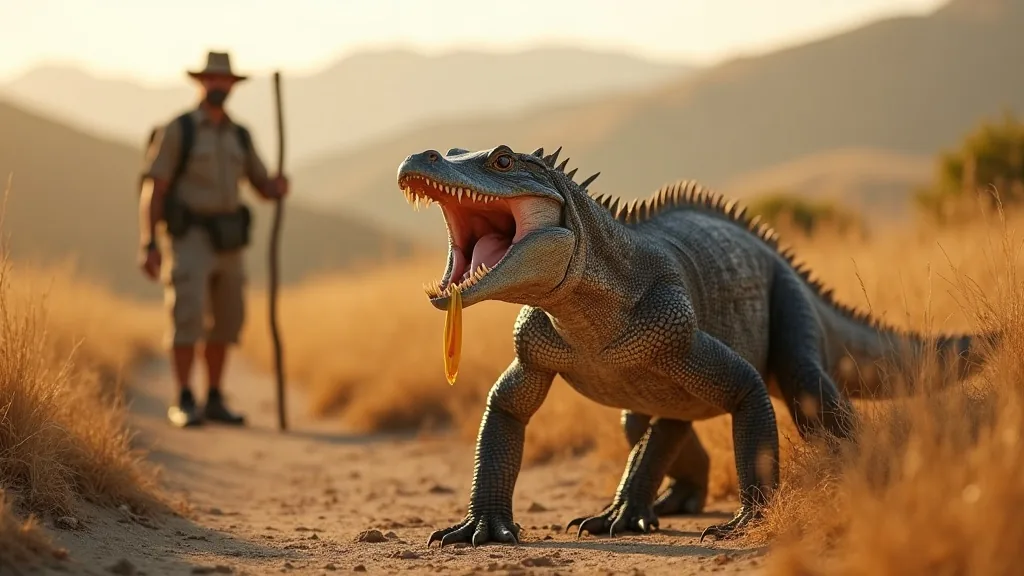
- Ranger escort, always. Every trekking group is led by a certified ranger carrying the iconic two-meter forked staff — used to gently pin a curious dragon’s neck at a safe angle if one approaches.
- Minimum distance. Guests keep roughly 5 meters from any dragon, more from nesting females, who are notably more defensive.
- Stay grouped, move calmly. No running, no sudden movements, no wandering off marked trails. Dragons read erratic movement as prey behavior.
- No food on the trail. Dragons can smell carrion from kilometers away with their forked tongues; snacks stay on the boat.
- Tell your ranger about open wounds. Guests with bleeding cuts (and traditionally, menstruating guests) are asked to inform rangers so extra spacing can be arranged — a precaution built on the dragon’s extraordinary sense of smell.
- Photos on the ranger’s terms. The famous “perspective shots” happen only where and when the ranger says the angle is safe.
In our experience, guests are consistently surprised by how calm the encounters feel. Dragons mostly conserve energy in the shade; the drama is in their presence, not their behavior. The system works because everyone follows it — so far, in all our years of daily operations, our guest record on dragon treks is spotless.
Can you see Komodo dragons up close safely?
Yes — with rangers, on the official trails of Komodo and Rinca Islands, it is one of the world’s great wildlife encounters. Every Komodo Luxury itinerary includes ranger-led dragon trekking, whether you join a shared open trip, book a private trip for your own group, or explore the islands on a day-format Komodo boat tour from Labuan Bajo. Our crews brief every guest on dragon etiquette before landing, and our guides coordinate directly with park rangers on trail conditions and recent dragon activity.
Trips are operated end-to-end by Komodo Luxury – a registered Indonesian PT under Juara Holding Group Limited with 1,500+ verified guest reviews (4.9/5 across Google and TripAdvisor).
What else do travelers ask about Komodo dragon bites?
Has a tourist ever been bitten on a guided trek?
Incidents involving escorted visitors are extraordinarily rare. The documented bites in park history overwhelmingly involve rule-breaking — approaching too close, feeding, or leaving the group. Follow your ranger and the risk is managed to near zero.
Can a Komodo dragon kill a human?
An untreated bite from a large adult could be life-threatening due to blood loss and shock, which is why the park’s escort system exists. With rangers enforcing distance, encounters remain observational, not physical.
Will a Komodo dragon chase me?
They can sprint at 18–20 km/h but rarely waste energy on humans. If a dragon approaches, do not run on instinct — stay with your group and follow the ranger, who will reposition everyone calmly.
Is there an antivenom for Komodo dragon bites?
No specific antivenom exists. Treatment is rapid wound care, bleeding control, and antibiotics. This is a strong argument for respecting the 5-meter rule rather than a reason to fear visiting.
Is Komodo National Park open and safe to visit right now?
Yes — the park is open and trips are running normally. For the latest regional travel status, see our continually updated report: Is Labuan Bajo safe to visit? You can also browse full Labuan Bajo tour options departing daily.
Ready to see Komodo dragons in the wild?
Reading about venom research is one thing; standing five careful meters from a three-meter predator on Rinca Island at sunrise is another. If you’d like to experience it with crews who do this every day, explore our Komodo National Park guide or design your own itinerary as a private trip aboard a traditional luxury phinisi. Questions about dragon trekking with kids, photography, or the best islands for sightings? Message our Labuan Bajo team on WhatsApp at +62 811-3823-875 or via our contact page — we answer from the source.
Named sources: Fry et al., 2009, Proceedings of the National Academy of Sciences (venom gland confirmation); Goldstein et al., 2013 (oral bacteria study); LeBlanc et al., 2024, King’s College London (iron-coated teeth); Auffenberg, 1981, “The Behavioral Ecology of the Komodo Monitor” (original field monograph); Komodo National Park ranger briefing protocols.