






Last updated: September 2026 · Prices & availability verified for the 2026/2027 season
Last updated: September 10, 2026
Have you ever wondered how deadly the venom of a Komodo Dragon is compared to that of venomous snakes? The Komodo Dragon, the largest lizard in the world, and venomous snakes—each with their unique power—are incredible creatures of nature. Although they may seem similar as large, dangerous reptiles, their venom is very different. So, what makes their venom so unique and dangerous? How do their venoms work, and which one is more deadly to humans? Here, we will take a deep dive into Komodo venom and snake venom, comparing how they function and the effects they have on their prey.
This venom science underpins the safety protocol on every dragon trek we guide — part of each 3D2N open trip and charter itinerary since 2015, with zero guest incidents.
The venom science below reads differently once you have watched a wild dragon hunt — something Komodo Luxury’s guides, trekking Komodo National Park since 2015, help guests witness from a safe distance.
Key Takeaways
- Komodo dragon venom works slowly, causing bleeding, shock, and infection that can take hours to kill, while snake venom like the Inland Taipan’s acts within minutes.
- Snake venom is generally more potent per bite, since a tiny amount from species like the Inland Taipan can kill a human quickly.
- Komodo venom’s slow effect actually suits its hunting style, letting the dragon track a bitten animal until it eventually collapses.
- The two venoms attack the body differently, since Komodo venom disrupts blood clotting and blood pressure while snake venom often targets the nervous system directly.
- Neither venom is delivered the same way, as Komodo dragons spread venom through saliva during a bite while snakes inject it directly through hollow fangs.
Komodo Dragon: The Venomous Giant Lizard
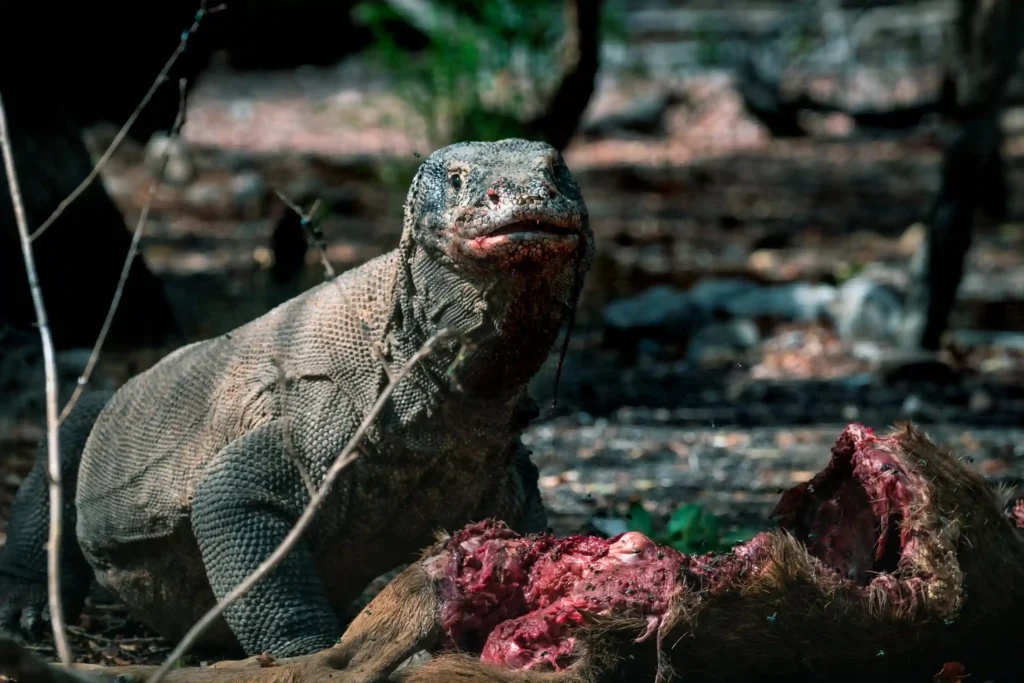
Komodo Dragon (Varanus komodoensis), a species of varanid lizards, is the largest lizard in the world, found only on Komodo Island and a few surrounding islands in Indonesia. With a body length reaching up to 3 meters and weighing over 70 kilograms, the Komodo Dragon is not only a powerful predator but also a terrifying creature for its prey. Because their habitat is limited to a few remote islands within Komodo National Park, encountering Komodo dragons in the wild requires proper access and guided exploration. One of the most reliable ways for you to reach these islands is through a Komodo Boat Tour, where you’ll be guided by experienced local rangers, follow well-planned island routes, and explore safely while getting closer to Komodo dragons in their natural habitat.
Komodo Dragons are apex predators in their environment. They eat a wide range of animals, including deer, wild boar, and even buffalo. While many think that Komodo Dragons rely only on their physical strength to hunt, they also have another deadly weapon: venom. Unlike most lizards, the Komodo Dragon has venom that helps incapacitate its prey. This venom comes from special glands in their mouth and consists of various enzymes that have dangerous effects on the prey’s body. Komodo venom contains several components, including blood-clotting enzymes, harmful bacteria, and toxins that cause shock.
When a Komodo bites its prey, the venom quickly disrupts blood pressure, slows blood clotting, and causes infections that can kill the prey in a short time. One way the Komodo uses its venom is by biting its prey and then letting it escape, allowing the venom to work slowly within the prey’s body and eventually kill it within hours. So, Komodo venom isn’t a myth—it’s a real and effective weapon.
Read more: Komodo Dragon vs Anaconda: Battle of the Giant Reptiles
Snakes: Venomous Reptiles

Snakes are a diverse group of reptiles, with hundreds of species found all over the world. They live in nearly every continent and thrive in many types of habitats, from deserts to lush tropical forests. Snakes can be classified into venomous and non-venomous categories, and here, we’ll focus on venomous snakes, which possess lethal venom.
Venomous snakes use their venom for two main purposes: hunting prey and self-defense. Snake venom varies greatly depending on the species. For example, the King Cobra, Inland Taipan, and some pit viper species possess extremely potent venom that can incapacitate their prey within minutes. Snake venom comes in several types, such as neurotoxic (damaging the nervous system), hemotoxic (affecting blood clotting), and cytotoxic (damaging cells in the body). In addition to these, cobra venom is known for its potent neurotoxic effects, which can cause rapid paralysis and death.
Venomous snake bites are often very fast and precise. The snake strikes its prey with hollow fangs, injecting venom directly into its body. The venom then quickly disrupts the prey’s body functions, halting blood flow or even causing paralysis. For instance, the Inland Taipan, known as the most venomous snake in the world, can coagulate the blood of its prey or cause total paralysis in a very short time.
Read more: Komodo Dragon vs. Black Mamba: A Clash of Two Deadly Predators
Komodo Venom vs Snake Venom: A Detailed Comparison
Komodo Dragons are well-known for their deadly venom, but snakes can be just as dangerous. How do these two venoms compare in action? Let’s look at a few key aspects of comparing the venom of a Komodo Dragon and a venomous snake, specifically the Inland Taipan, which is famous for being one of the deadliest snakes in the world.
| Aspect | Komodo Venom | Snake Venom |
| Venom Composition | Contains enzymes that disrupt blood clotting and bacteria that cause severe infections, leading to shock and internal bleeding. | Contains neurotoxins (attack the nervous system), hemotoxins (damage blood vessels), and cytotoxins (destroy tissues), acting rapidly on prey. |
| Speed and Effects on Prey | Works slowly; bleeding and shock last for several hours before death occurs. Gradual effects allow Komodo to track and overpower weakened prey. | Acts very fast; paralysis or death can occur within minutes as the venom quickly attacks the nervous system and blood vessels. |
| Venom Potency | Lethal but slower-acting, takes longer to kill due to gradual effects. | Highly potent; even a tiny amount can kill a human in minutes. One of the deadliest snakes with fast-acting venom. |
| How the Venom Affects the Victim | Causes bleeding, shock, and infection through blood-clotting mechanism and blood pressure disruption. Works slowly over time. | Causes paralysis, rapid tissue damage, or death through nervous system or blood vessel damage depending on the venom type. Lethal in minutes. |
| Venom Delivery Mechanism | Delivered through saliva when Komodo bites its prey. | Delivered through hollow fangs that inject venom directly into the prey’s body. |
1. Venom Composition
Komodo venom contains enzymes that disrupt blood clotting and bacteria that cause severe infections. When a Komodo bites its prey, bacteria in its mouth start to work, worsening the wound and triggering shock and internal bleeding. The effects of this venom are gradual, but deadly in the long run.
In contrast, Inland Taipan venom is very potent and works much faster. It contains neurotoxins that attack the nervous system, hemotoxins that damage blood vessels, and cytotoxins that destroy tissues. This combination allows the snake to incapacitate its prey very quickly, often in minutes.
2. Speed and Effects on Prey
Komodo venom works more slowly. The prey experiences bleeding and shock that can last for several hours before death occurs. The effects are gradual and often take time to be fully lethal. This slow-acting venom complements the Komodo dragon’s predatory lifestyle, allowing it to track and eventually overpower its weakened prey.
On the other hand, Inland Taipan venom acts much faster. Once bitten, the prey may experience paralysis or death in a very short time, as the venom quickly damages the nervous system and blood vessels.
3. Venom Potency
In terms of venom potency, Inland Taipan is one of the deadliest snakes, with a tiny amount of venom enough to kill a human. While Komodo venom is lethal, it takes longer to kill because of its gradual effects. Therefore, when it comes to quick lethality, the venom of snakes like Inland Taipan is far more deadly in a short period of time. The Inland Taipan’s venom contains potent toxins that can kill a human with just a few milligrams.
4. How the Venom Affects the Victim
Komodo Dragon venom causes bleeding, shock, and infection through its blood-clotting mechanism and blood pressure disruption. Snake venom, on the other hand, causes paralysis or rapid tissue damage via the nervous system or blood vessels, depending on the type of venom. Komodo venom works more slowly in killing, while snake venom can be lethal in minutes.
5. Venom Delivery Mechanism
Komodo Dragons deliver their venom through their saliva when they bite their prey, while venomous snakes inject venom through hollow fangs that directly deliver venom into the prey’s body. Both methods are highly effective, though they differ in how the venom is spread.
Read more: Komodo Dragon vs Blue Viper: The Battle of Two Venomous Reptiles
Komodo Venom vs Snake Venom: Which One is Deadlier?

Komodo Dragons, although slower in their attack, possess venom that is incredibly dangerous due to its gradual, yet lethal, nature. When a Komodo bites its prey, the venom in its saliva, which is rich in harmful bacteria, starts working silently. These bacteria infect the wound and cause severe infection, which can quickly spread through the bloodstream. Combined with toxins that disrupt the circulatory system, the prey experiences a drastic drop in blood pressure, fatigue, and shock. Without medical treatment, this venom can continue to cause death over a longer period, depending on the prey’s condition and how fast the infection spreads.
Meanwhile, venomous snakes like the Inland Taipan work much faster. The venom acts directly on the body, and once injected, it flows quickly through the bloodstream. The venom of Inland Taipan is extremely powerful, containing neurotoxins that attack the nervous system and hemotoxins that damage blood vessels. As a result, the victim can experience paralysis in vital organs, including the lungs and heart, in a very short time. If no medical intervention is provided, death can occur in less than an hour. The speed and efficiency of this venom make venomous snakes, such as the Inland Taipan, some of the deadliest creatures in the world. This intense predator-prey dynamic drives the continuous evolution of both venomous snakes and their prey.
Overall, while snake venom is more deadly in terms of speed and immediate lethality, Komodo venom is not to be taken lightly. Although death from a Komodo bite takes longer, the long-term effects of infection and circulatory disruption can be just as dangerous, especially if the prey is unable to escape the first bite and doesn’t receive medical attention quickly.
Read more: Komodo Dragon vs King Cobra: Battle of Deadly Predators
Visit Komodo Dragon with Komodo Luxury
Both Komodo venom and snake venom are deadly, but they work differently. The Komodo Dragon uses venom to slow down its prey, while venomous snakes strike quickly and directly. Which is more dangerous? It depends on the situation and how quickly it is handled. But one thing is certain: both are perfect examples of nature’s brilliance in creating creatures with remarkable survival abilities.
With a better understanding of the comparison between Komodo venom and snake venom, we can appreciate how extraordinary and dangerous these creatures are in their ecosystems. The Komodo Dragon is Indonesia’s pride, and although it may seem intimidating, with proper safety protocols, you can safely observe these magnificent creatures in their natural habitat. Through Komodo Island Tour with Komodo Luxury, you can experience the beauty of Komodo Island and interact with the Komodo Dragon in a safe and educational environment. These delicate ecosystems are home to a variety of unique species, making conservation efforts crucial. With strict protections and expert guides, a trip to Komodo Island will be an unforgettable adventure.
Don’t miss the chance to see the Komodo Dragon up close and enjoy the natural beauty of Indonesia with Komodo Luxury!

Curious to see the world’s largest venomous lizard in the wild rather than a lab diagram? Komodo Luxury’s liveaboard itineraries pair ranger-guided dragon treks with diving and snorkelling across Komodo National Park. Komodo liveaboard itineraries
See the protocols this biology built, in action: ranger-guided treks anchor our Komodo tour packages, and our naturalists debrief the science each evening on liveaboard departures.
Frequently Asked Questions
Written by the Komodo Luxury Expedition Team — licensed Komodo National Park operators guiding treks and crossings from Labuan Bajo since 2015. See our Komodo sailing tour packages.