



Last updated: August 2026 · Prices & availability verified for the 2026/2027 season
If you’re researching a Banda Sea crossing liveaboard, you’re looking at one of the more specialized routes in Indonesian sailing, a passage that connects two of the country’s most celebrated charter regions through some of its least-visited waters. The Banda Sea is the deep-water basin of eastern Indonesia, historically known as the Spice Islands sea, lying between Sulawesi, Maluku and the Lesser Sunda Islands. For sailors, it means something more specific: this is the crossing route that expedition phinisi run between the Komodo season and the Raja Ampat season, and quietly, it’s become one of the more rewarding liveaboard journeys available anywhere in Asia.
This guide walks through why boats make this crossing at all, what you’ll actually see along the way, when the seasonal windows open, and how to think about chartering one of these voyages yourself.
Key Takeaways
- A Banda Sea crossing liveaboard is a one-way expedition that can connect Komodo, the Lesser Sunda Islands, the Banda Islands and Raja Ampat rather than functioning as a conventional round-trip cruise.
- Seasonal repositioning voyages commonly operate around the March to May and September to November transition periods, although actual dates depend on the vessel, route, weather and operational schedule.
- Banda Neira adds an important cultural dimension through its nutmeg history, colonial-era landmarks and location within the historic Spice Islands.
- Diving can include volcanic walls, seamounts, strong currents, sea snakes and seasonal hammerhead encounters, but marine-life sightings and visibility are never guaranteed.
- The route is best suited to travelers who enjoy remote liveaboard diving, long ocean passages and flexible expedition-style itineraries rather than a short, predictable island holiday.
Why Boats Cross the Banda Sea
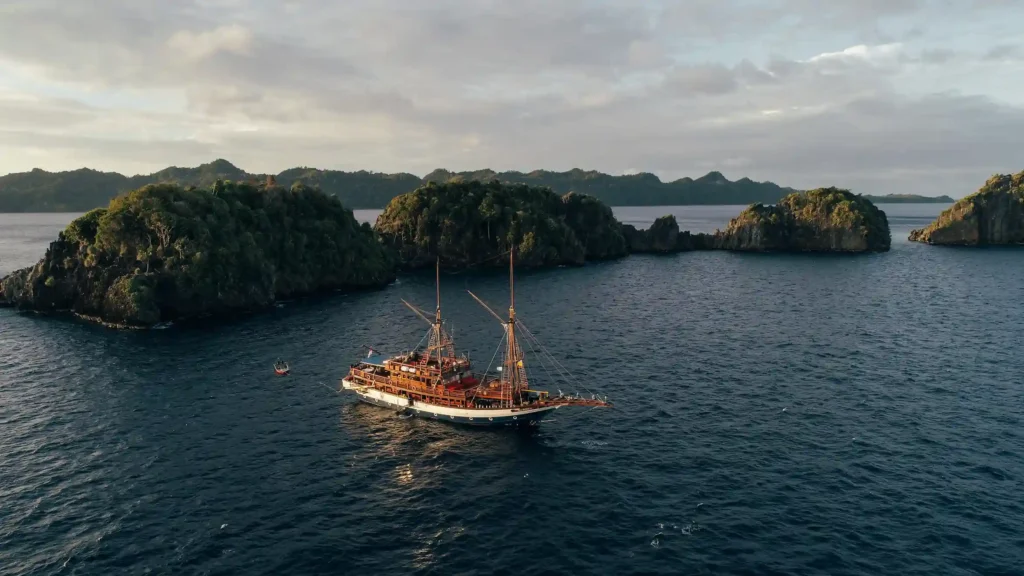
The two great Indonesian charter regions run on genuinely opposite calendars. Komodo sails best from April through November, while Raja Ampat runs its prime season from October through April. That seasonal mismatch means each October, and again each April, expedition phinisi need to reposition their fleets across the water separating these two regions.
Rather than sail that repositioning leg empty, the strongest operators sell the crossing itself as a dedicated voyage: roughly ten days to two weeks of open-ocean passage, volcanic island stops, and reef sites that see only a handful of visiting boats in an entire year. Exact crossing windows vary by vessel and operator, and they’re typically confirmed with the operations desk on a per-season basis rather than fixed permanently on a calendar.
When Is the Best Time to Cross the Banda Sea?
The Banda Sea crossing runs during two specific seasonal windows, and understanding both matters if you’re timing a trip around a particular experience.
- September through November is the primary crossing season, and it’s also the peak window for the region’s signature wildlife draw: schooling hammerhead sharks. October and November specifically tend to offer the highest probability of encountering large aggregations at known seamount sites.
- March through April functions as a secondary crossing window, offering calmer seas and often better visibility for photography, though hammerhead encounters during this stretch are less concentrated and less predictable than the autumn window.
Both windows fall during what are effectively inter-monsoon periods, when winds ease enough to make the open-water transit between regions genuinely safe for a liveaboard crossing. Outside these two windows, conditions become considerably rougher, and the itineraries that depend on calm open-ocean passages simply don’t run.
Banda Neira & the Spice Islands
At the historic heart of this route sits Banda Neira, a nutmeg-fort harbor town positioned beneath the active Api volcano, where the world’s entire nutmeg supply once loaded onto trading ships bound for Europe. Today, the town offers colonial arcades, walkable plantation trails, and what many sailors consider one of Indonesia’s most atmospheric anchorages anywhere in the archipelago.
This stop functions as the cultural high point of the crossing, sitting between two reef-focused regions and offering something genuinely different: a slower, history-rich pause amid what is otherwise a voyage built around open water and remote diving sites. Fort Belgica, the colonial-era fortification overlooking the harbor, remains one of the better-preserved historical structures in eastern Indonesia, and the walk up to it rewards you with sweeping views over the harbor and the volcano beyond.
What the Banda Sea Crossing Actually Shows You
Beyond the historical stop at Banda Neira, the crossing itself delivers a specific set of experiences that simply aren’t available on a standard regional charter.
- Seamount reefs with visibility the coastal parks can’t match. Sites like Manuk, Suanggi and Nil Desperandum sit in open water far from any coastal runoff, and visibility here regularly reaches 20 to 30 meters or more during the right conditions.
- Hammerhead aggregations at the region’s famous seamount ring, particularly around Suanggi and Nil Desperandum during the September through November peak, though sightings remain genuinely conditions-dependent. No honest operator promises pelagic encounters on any single dive.
- Sea snakes at sites like Manuk, an island whose waters are known specifically for concentrated sea krait populations, an unusual and memorable encounter for divers who haven’t seen them in numbers before.
- Night skies with essentially zero light pollution, a byproduct of sailing through some of the most sparsely populated open water anywhere in Indonesia.
This is fundamentally a voyage for travelers who value the sailing itself as much as the individual stops along the way, not simply a checklist of dive sites to tick off.
Read more: Best Yacht Charter Destinations Indonesia: Explore Luxury Sailing Adventures Here!
A Sample Banda Sea Crossing Liveaboard Itinerary

While every crossing gets custom-routed around current weather conditions, here’s roughly how a typical eastbound voyage from Komodo toward Raja Ampat might unfold across two weeks.
- Days 1 to 2: Depart from the Maumere or Alor line and begin the open passage east, settling into the rhythm of consecutive sailing days.
- Days 3 to 5: Stop at Alor or Wetar reefs, offering strong diving in a region most travelers never reach on a standard itinerary.
- Days 6 to 8: Arrive at Banda Neira and the surrounding nutmeg islands, combining history ashore with diving at nearby sites.
- Days 9 to 11: Reach the seamount ring and Koon, the stretch of the crossing most associated with hammerhead sightings during the September through November window.
- Days 12 to 14: Approach Misool and complete the crossing into Raja Ampat proper, transitioning from open-ocean passage into the archipelago’s famous karst-island scenery.
The reverse crossing, from Raja Ampat back toward Komodo each April, essentially runs this same sequence in the opposite direction, again adjusted to whatever weather the specific season presents.
How to Charter a Banda Sea Crossing
Crossings are typically sold either as full-vessel private charters or as cabin-based expedition departures, and both formats bridge the two home regions on either end of the route.
If you’re planning to sail in October, the natural starting point is a private yacht charter Komodo desk, since that’s where the crossing begins its eastbound journey. If you’re planning the April return instead, the Raja Ampat yacht charter desk is the better starting point, since the crossing connects directly to the tail end of that region’s season. In Raja Ampat itself, quiet-season sites like Aljui Bay’s pearl-farm jetties often bookend the arrival, offering a distinctive muck-diving stop for travelers who complete the full crossing.
Is a Banda Sea Crossing Right for Your Trip?
This kind of voyage suits a specific kind of traveler, and it’s worth being honest about who gets the most from it before committing to a two-week open-water itinerary.
- Choose the crossing if you’re drawn to genuinely remote diving. Sites like Manuk and Suanggi see only a fraction of the boat traffic found at more accessible regional dive sites, and that scarcity is part of the appeal.
- Choose the crossing if history genuinely interests you. Banda Neira offers a cultural dimension that neither Komodo nor Raja Ampat delivers on its own, and it’s a meaningful part of what makes this route distinctive.
- Skip the crossing if your time is limited. A proper crossing needs the better part of two weeks to do justice to both the open-water passage and the stops along the way, so travelers with only a few days available are better served by a focused regional itinerary in either Komodo or Raja Ampat alone.
- Skip the crossing if guaranteed pelagic encounters matter more to you than the journey itself. Hammerhead sightings during the peak window are genuinely likely, but never certain, and honest operators sell this route on the full voyage experience, with wildlife encounters as a probable highlight rather than a guaranteed outcome.
Read more: Banda Islands: Unveiling Indonesia’s Hidden Treasures
Plan Your Banda Sea Crossing with Komodo Luxury
A Banda Sea crossing liveaboard is a journey for travelers who want more than a conventional island-hopping itinerary. Connecting the waters around Komodo with the Banda Islands and, depending on the route, onward toward Raja Ampat, the voyage combines long ocean passages with remote diving, volcanic landscapes, seasonal marine-life encounters and the history of the Spice Islands. Because routes, dates and conditions can change between seasons, planning around the actual vessel schedule is essential.
Komodo Luxury is a luxury yacht charter operator that owns and operates its own fleet. Its official fleet and charter information covers private yacht charters and bespoke multi-day voyages across destinations including Komodo, Raja Ampat and the Spice Islands, with dedicated crews and customizable itineraries.
If you are considering a private Banda Sea crossing from Komodo to Raja Ampat, contact our team to discuss the available seasonal window, vessel options, embarkation point and route. You can also explore our yacht charter options depending on the direction of your journey.