






Last updated: September 2026 · Prices & availability verified for the 2026/2027 season
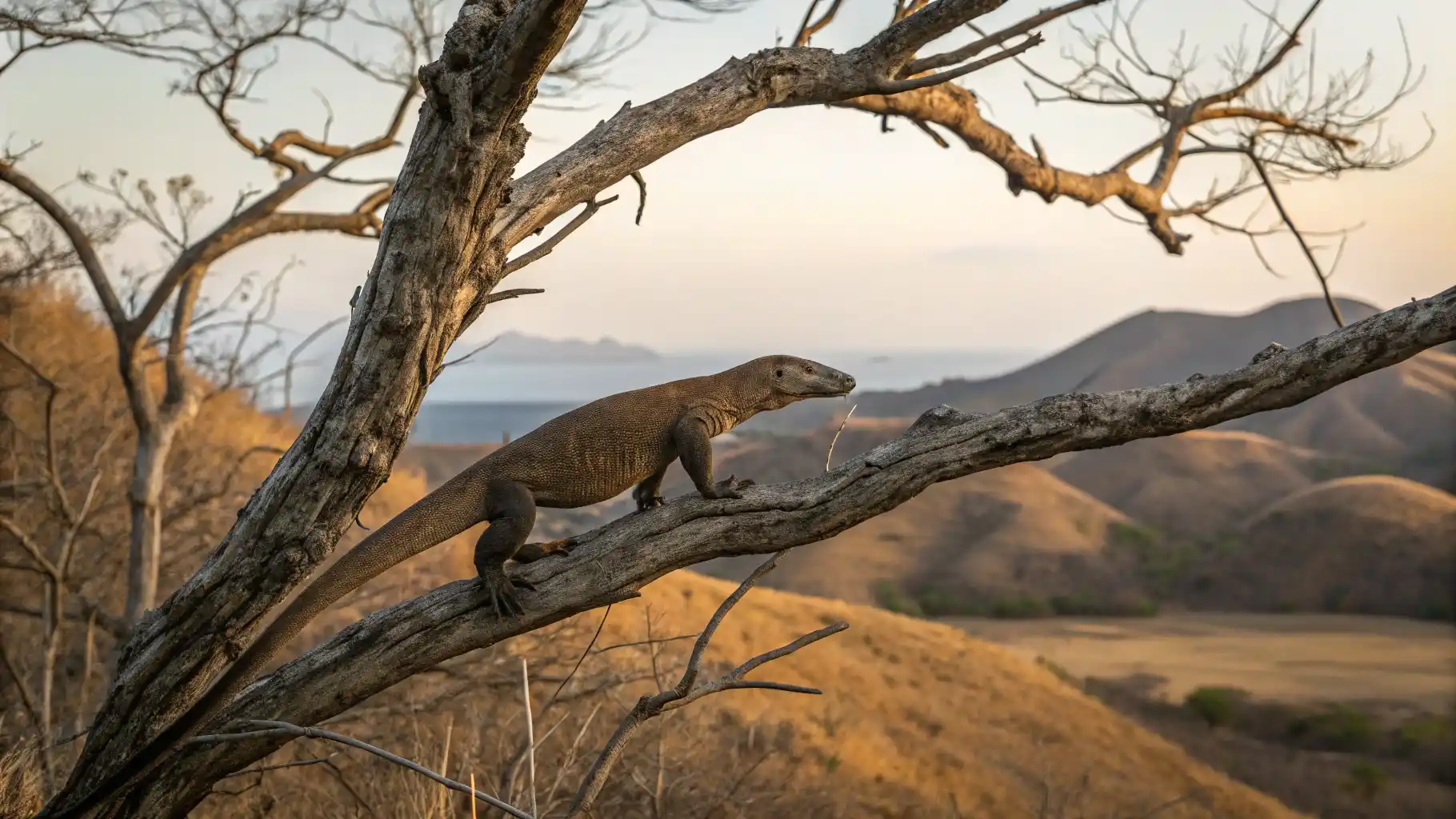
A baby Komodo dragon hatches at just 30–40 cm long and 80–100 grams — roughly the size of a small gecko’s bigger cousin — after a 7–8 month incubation inside a nest of about 20 eggs. Within hours of digging out of the nest, hatchlings do something adult dragons never do: they climb. Young Komodo dragons spend most of their first years living in trees, because the single biggest threat to a baby Komodo dragon is an adult Komodo dragon.
This guide covers the full early life of Varanus komodoensis — eggs, hatching, the arboreal years, parthenogenesis (yes, virgin births are documented), and where you can realistically see juveniles in the wild. It is part of our Komodo Dragon Encyclopedia, written from Labuan Bajo, where our crews sail into Komodo National Park every week.
Baby Komodo Dragon: Quick Facts
| Stage | Data |
|---|---|
| Eggs per clutch | Average ~20 (range 15–30; large females up to ~38) |
| Laying season | August–September |
| Incubation | 7–8 months; hatching around March–April |
| Hatchling size | 30–40 cm total length, 80–100 g |
| First years | Mostly arboreal (tree-living) to avoid predators |
| Juvenile diet | Insects, geckos, small lizards, eggs, young birds |
| Sexual maturity | About 7–8 years old |
| Main threats | Cannibalism by adults, feral dogs and pigs |
Sources: Komodo National Park authority; San Diego Zoo Wildlife Alliance fact sheet (Purwandana et al.); IUCN Red List.
Eggs and Nesting: Where Baby Dragons Begin
Female Komodo dragons lay their eggs in August–September, at the end of the dry season. A typical clutch averages about 20 eggs, with a documented range of roughly 15–30 and exceptional clutches approaching 38 from large, well-fed females, according to data summarized by the San Diego Zoo Wildlife Alliance.
Females often dig their nests into the abandoned mound nests of orange-footed scrubfowl (a megapode bird), hillside burrows, or ground nests — and frequently dig several decoy chambers to confuse egg predators, including other Komodo dragons. The mother guards the nest for the first months but provides no parental care after hatching. From the moment a hatchling digs out of the nest, it is entirely on its own.
Curious how many eggs actually survive? We break the numbers down further in How Many Eggs Do Komodo Dragons Lay?
Hatching: March–April in Komodo National Park
After roughly 7–8 months of incubation, hatchlings emerge around March–April — timed to the end of the wet season, when insects and small prey are most abundant. The Komodo National Park authority records an average hatchling at 30.4 cm and about 80 grams: a creature that will one day weigh 70–90 kg starts life lighter than a smartphone.
Hatchlings are also the most colorful Komodo dragons you will ever see — patterned in yellow, green and banded markings that serve as camouflage in the trees, unlike the uniform grey-brown of adults. For how those adults get so enormous, see our data-driven guide to Komodo dragon size.
Why Baby Komodo Dragons Live in Trees
This is the defining fact of dragon childhood: adult Komodo dragons eat juvenile Komodo dragons. Cannibalism is a routine part of adult foraging, especially around carcasses and nesting areas. The park authority notes that young dragons spend a large portion of their time in trees specifically to avoid predation by their elders, as well as by feral dogs and pigs.
Tree life solves two problems at once. Adults are far too heavy to climb, so the canopy is a predator-free refuge — and it is stocked with food no adult competes for: insects, geckos, eggs, nestling birds and small lizards. Juveniles observed feeding at carcasses on the ground have even been recorded rolling in carrion, likely to mask their scent from hungry adults.
Young dragons stay mostly arboreal for their first few years, descending more often as they grow too large to be easy prey — and too large for the branches. By around four years and roughly a meter in length, they shift to life on the ground.
From Hatchling to Giant: The Growth Timeline
Komodo dragons mature slowly for reptiles. They reach sexual maturity at about 7–8 years and can live around 30 years in the wild, growing throughout much of their life. The full journey — hatchling, arboreal juvenile, sub-adult, dominant adult — is mapped in our Komodo dragon lifespan & life cycle guide.
Parthenogenesis: Baby Dragons Without a Father
Komodo dragons are one of the few large vertebrates with documented parthenogenesis — females producing viable offspring without a male. The landmark cases, published in Nature (Watts et al., 2006), came from two UK zoos: Sungai at London Zoo and Flora at Chester Zoo, whose clutch of 11 self-fertilized eggs produced 7 healthy hatchlings.
Because Komodo dragons use a ZW sex-chromosome system, every parthenogenetic hatchling is male. In theory, a single stranded female could colonize an island, produce sons, and then breed with them — a remarkable survival mechanism for an island species.
How Many Baby Dragons Survive? The Conservation Picture
Juvenile mortality is high — between cannibalism, dogs, pigs and starvation, only a fraction of each clutch reaches adulthood. That matters because the species has no room to spare: the IUCN Red List classifies the Komodo dragon as Endangered (uplisted in 2021), with a wild population of roughly 3,400 individuals and only about 1,400 mature adults, per field monitoring by Jessop and colleagues. Every hatchling that makes it down from the trees counts.
The species survives only on Komodo, Rinca, and a few neighboring islands within and around Komodo National Park — the full story is in our guide to where Komodo dragons live and how they are protected.
Can You See Baby Komodo Dragons on a Tour?
Yes — but you have to know where to look: up. On ranger-guided treks on Komodo and Rinca islands, juveniles are spotted in trees near the trails, especially in the months after the March–April hatching season. Rinca’s more open savannah often gives the best juvenile sightings, and rangers know the active nesting grounds (which are strictly off-trail; a licensed ranger is mandatory on every dragon trek).
Practical notes for planning: since 1 April 2026, Komodo National Park caps visitors at 1,000 per day with advance permits via the park’s SIORA system, so peak-season trips should be booked early — current fees and permit steps are in our Komodo National Park fees & permits guide.
The comfortable way to do it is by sea. Our Komodo boat tours combine ranger-led dragon trekking with Pink Beach and Padar; a private boat charter lets you time your Rinca landing for early morning, when dragons — young and old — are most active; and our open trip departures make the same itinerary work for solo travelers and couples. Field-tested advice on timing, what to wear and trekking etiquette is in Seeing Komodo Dragons in the Wild: Visitor Guide.

Baby Komodo Dragon FAQ
How big is a baby Komodo dragon?
At hatching, 30–40 cm long and 80–100 grams. By age one it can double in length; by 7–8 years it approaches adult size of 2–3 meters.
Do Komodo dragons eat their babies?
Yes. Cannibalism by adults is a leading cause of juvenile death, which is exactly why hatchlings climb into trees within hours and stay largely arboreal for their first few years.
Can a Komodo dragon be born without a father?
Yes — parthenogenesis is documented in Nature (Watts et al., 2006) at London and Chester Zoos. All such offspring are male due to the species’ ZW chromosome system.
When is the best time to see baby Komodo dragons?
The months after hatching season — roughly April through August — on ranger-guided treks on Komodo and Rinca, looking into trees near the trails.