






Last updated: August 2026 · Prices & availability verified for the 2026/2027 season
Booking a liveaboard is a decision about time before it is a decision about a boat. How many nights can you actually be at sea, how much of the trip gets eaten by getting there, and how much margin you keep if something slips. For most of the world that arithmetic is unforgiving. From Singapore it is not: Scoot operates a nonstop service from Singapore (SIN) to Labuan Bajo (LBJ), and the flight time is roughly three hours and twenty to thirty minutes, which makes Singapore the only international origin with a direct flight to the gateway of Komodo National Park.
What follows is not a routing guide. It is a planning guide for the decisions that come after the flight is solved: how long a trip to book when your travel time is measured in hours rather than days, whether to take a cabin or the whole vessel, how to read a boat before you commit to it, and how far ahead to move if your dates are in 2027.
What a Three-hour Flight Actually Changes

Efficiency in travel is rarely about speed alone. It is about how many things can go wrong between your front door and the deck of the boat. Every connection you add multiplies that number: a delayed first leg, a missed onward sector, a bag that stays behind, an unplanned hotel night at an airport you never wanted to see. Most origin markets reach Labuan Bajo by connecting through Bali or Jakarta and accept those risks as the price of entry. Singapore does not have to.
The consequences for the booking itself are worth stating plainly:
- The trip stops competing with your annual leave allowance and starts competing with a long weekend elsewhere in the region.
- You are not obliged to buy a protective night in Bali to cover a connection you never make.
- Your decision window shortens. A group can move from idea to confirmed booking in weeks rather than seasons, as long as the vessel still has space on the dates you want.
- Nights ashore in Labuan Bajo become a choice you make for comfort, not an obligation the itinerary forces on you.
We do not publish airline schedules or fares on this page. Both change, and we will not put a number in front of you that we cannot stand behind. Confirm the current timetable with the airline, then send us the flight days you hold and our team will build the trip around them. That is the correct order of operations, and it is how most Komodo liveaboard bookings from Singapore are assembled.
The Long Weekend Arithmetic
Most enquiries that begin with a short calendar ask the same question in some form: is a few days enough. The honest answer depends less on the destination than on how you count. Below is the arithmetic as we work it at the reservations desk, assuming a standard Saturday and Sunday weekend with leave attached to it.
| Trip shape | Nights on board | Nights ashore in Labuan Bajo | Weekday leave used | Who it suits |
|---|---|---|---|---|
| Short liveaboard, no buffer | 2 | 0 | 1 | Repeat visitors and confident travellers whose flight days line up cleanly with embarkation |
| Short liveaboard, one buffer night | 2 | 1 | 1 to 2 | First-timers who want a calm start and no connection anxiety |
| Longer liveaboard, no buffer | 3 | 0 | 2 | Couples and small groups who want the full arc without extending leave |
| Longer liveaboard, buffer both ends | 3 | 2 | 3 | Families with young children, photographers, and anyone travelling with fragile equipment |
Two notes on reading that table. First, embarkation and disembarkation times differ by vessel, so whether a no-buffer plan works at all depends on the boat you choose and the flights you hold. We check that against your specific booking before you pay anything, and we will tell you when the plan is too tight to recommend. Our own terms put it plainly: we advise arriving in Labuan Bajo at least one day before the trip, and same-day arrival works only if you are in town and ready by 9:00 a.m. local time.
Second, a buffer night ashore is not a wasted night. Airline delays and cancellations sit outside our control and outside what any operator can absorb for you, so that night is the cheapest insurance in the entire itinerary. If a public holiday falls next to your weekend, the whole table shifts and the trip can cost you a single day of leave; we do not publish holiday calendars, but the moment you know your dates we will work backwards from them.
Three Days and Two Nights, or Four Days and Three Nights
This is the real decision, and it deserves more than a shrug. The shorter format exists because the market asked for it. The longer format exists because the archipelago is bigger than the shorter format can comfortably cover. Both are legitimate. They are answers to different questions.
| Consideration | Three days, two nights | Four days, three nights |
|---|---|---|
| Nights on board | Two | Three |
| Pace on the water | Compressed. Mornings start early and the sequence is tight. | Measured. There is room for a slow breakfast and a second swim. |
| Margin if a flight slips | Thin. A delay eats into the trip itself. | Better, particularly with a buffer night ashore. |
| Weekday leave, weekend attached | Typically one day | Typically two days |
| Best for | Second visits, short escapes, groups with tight calendars | First visits, families, guests who want a holiday rather than a sprint |
| Whole-boat economics | Lower total outlay, higher cost per hour on board | Higher total outlay, better value per hour on board |
The route and the anchorages depend on the vessel, on conditions on the day, and on the National Park regulations in force at the time. We confirm the intended plan in writing before payment, and we say so when the sea has other ideas. If you would rather compare formats against real programmes than in the abstract, the Komodo island tour pages set out what each style of trip is built to do, and the Komodo tour 2026 page carries what is currently bookable.
A Cabin, or The Whole Boat
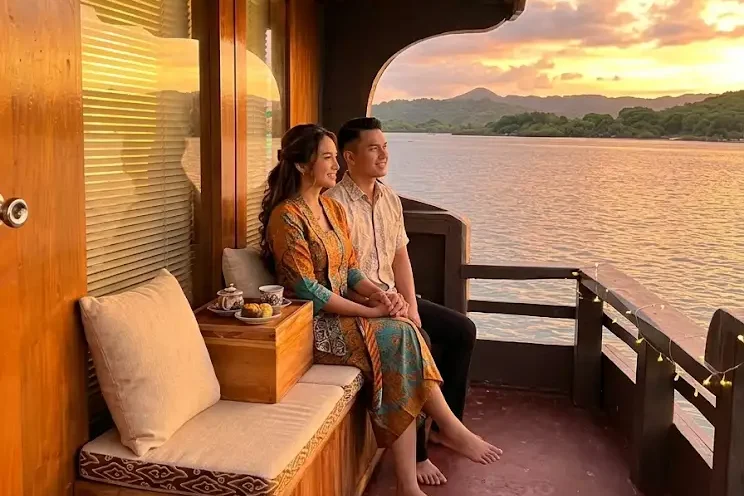
Groups arriving on a short flight tend to take one of three shapes: two or three couples travelling together, a multi-generation family, or a company group that has worked out that a boat is a better offsite than a hotel ballroom. Each shape points to a different booking mode, and the mode matters more than most people expect.
Cabin booking against whole-boat charter
Booking by cabin means you share the vessel with other guests. It is the lower commitment and it works well for couples and pairs of friends. Whole-boat charter means the vessel, the crew and the schedule belong to your group for the duration, which turns a shared experience into a private one. For six or more travelling together, the arithmetic of a private boat charter often lands closer to a per-person cabin rate than people expect, because the whole-boat figure is divided across the group rather than paid per head.
Charter also solves the problem that matters most on a short trip: control. When the boat is yours, the departure hour bends to your flights instead of the other way around, and the dining schedule follows your group rather than a shared timetable. On a long weekend that flexibility is worth more than any single feature on a specification sheet.
Reading a vessel before you commit
Photographs flatter every boat equally, which makes them useless for choosing between two. Documented detail is what separates them, so we publish a full review of each vessel we are asked about most often rather than a brochure adjective. The Cordelia Phinisi review sets out her layout, her cabins and who she genuinely suits, and the Ayvara cruise review covers the same ground for a different kind of trip. Cabin counts, deck plans and current rates live on the individual vessel pages and nowhere else, because those are the details that change and you should read them from the source.
If you would rather start from the category than the name, the luxury phinisi collection explains what a phinisi actually is and why the hull shape changes how a trip feels, and our comparison of the best Komodo liveaboards for 2026 and 2027 lines the options up side by side so you are choosing between documented boats rather than between adjectives.
Which Part of the Year to Aim At
Komodo is not one destination behaving the same way in every month. Sea state, underwater visibility, light for photography and how busy the anchorages feel all move through the year, and the month you choose shapes the trip at least as much as the boat does. Rather than compress that into a sentence, we keep month-by-month notes so you can read the specifics for the window you are considering: Komodo in September and Komodo in November are the two most useful starting points for travellers whose leave falls in the second half of the year.
One practical suggestion. If you have flexibility of even a week either side of your first choice, say so when you enquire. Flexibility opens vessels that a fixed date closes, and it is frequently worth more to a group than any negotiation on price.
Planning ahead for 2027

When the flight is short there is a temptation to leave the decision late. For a cabin on an ordinary date, that instinct is often fine. In two situations it is not.
The first is whole-boat charter. There is a finite number of vessels and a finite number of weekends in a year, and the better boats on the more attractive dates are committed early by groups who planned twelve months out. Our terms are built for exactly that traveller: for bookings made a year in advance, a thirty per cent deposit confirms the charter rather than the usual half. If your group has a fixed date, hold the vessel first and refine the details afterwards.
The second is any trip attached to a public holiday. Those dates are visible to every market at once, and the direct flight that makes Singapore efficient also makes those particular weekends competitive. Our 2027 liveaboard booking guide sets out how far ahead each type of booking realistically needs to be made, and what a deposit does and does not hold. Read it before you decide to wait.
Practical points before you book
- Park tickets are separate. Komodo National Park entrance and activity fees are set by the park authority and are not part of the boat price. The structure is explained on our Komodo National Park entrance fees page, and we confirm the amount applicable to your dates in writing before you travel.
- Payment runs in two steps. A fifty per cent deposit secures the booking and the balance is due no later than thirty days before departure; if you are booking inside thirty days, the full amount is payable at once. The complete wording sits in our terms and conditions, including the cancellation terms, which we would rather you read before you pay than after.
- There is no time zone to manage. Labuan Bajo runs on WITA, UTC+8, the same clock as Singapore, so a message sent during your working day reaches our reservations team during theirs.
- You are dealing with the operator. Komodo Luxury is operated by PT Komodo Bahari Nusantara, based in Labuan Bajo since 2015 and part of Juara Holding Group. We run nine yachts we own and operate, alongside more than two hundred vetted partner vessels which we always label as such. You book with the operator, never a middleman.
- The record is public. Komodo Luxury holds Tripadvisor Travelers’ Choice recognition for 2025 and 2026, with a 4.9 out of 5 rating drawn from more than 1,500 verified guest reviews.
- The fastest route to a human is WhatsApp at +62 811-3823-875, where the team can check live availability on a specific vessel and specific dates.
Where to Start
If you already know your dates, that is all we need to begin. Send them with your group size and whether you are leaning towards a cabin or a private charter, and we will come back with the vessels genuinely available on those dates rather than a catalogue. If you are still deciding whether a long weekend is enough, tell us that instead; we would rather talk you into the right length of trip than sell you the wrong one.
The short flight is the advantage. What you do with the days it saves you is the interesting part. Our team is ready when you are, and you can reach us through the contact page or on WhatsApp at +62 811-3823-875.