







Last updated: September 2026 · Prices & availability verified for the 2026/2027 season
Last updated: September 10, 2026
Dragones de Komodo los tigres son dos de los depredadores alfa más fascinantes de la naturaleza. Ambos dominan sus respectivos ecosistemas, pero de formas totalmente diferentes.
The Komodo dragon, the largest lizard on Earth, relies on its venomous bite and patient hunting tactics to take down prey. Tigers, on the other hand, are majestic powerhouses with unmatched speed and brute strength, making them the kings of the jungle. And among all tiger subspecies, none pushes that power to a greater extreme than the Siberian tiger, the largest cat alive today.
Let’s explore their characteristics, strengths, and how they would perform in a one-on-one confrontation, from tigers in general down to the biggest of them all.
Puntos clave
- A tiger, including the Siberian subspecies, would very likely win a direct fight against a Komodo dragon thanks to overwhelming size, speed, and raw power.
- The Komodo dragon’s real weapon isn’t strength, it’s its venomous bite, which can eventually kill even an animal many times its size, though not quickly enough to save it in a close-range fight.
- Size gaps get even more extreme with the Siberian tiger specifically, since adult males can weigh up to 320 kg, roughly four times a Komodo dragon’s average weight of 70 to 90 kg.
- Tigers win on nearly every physical category, including speed, agility, night vision, and hearing, while the Komodo dragon’s advantages are limited to smell, patience, and toxic saliva.
- The two predators never meet in the wild, since Komodo dragons live only on a few dry Indonesian islands while Siberian tigers roam the snow forests of the Russian Far East.
El komodo: la bestia venenosa de la naturaleza
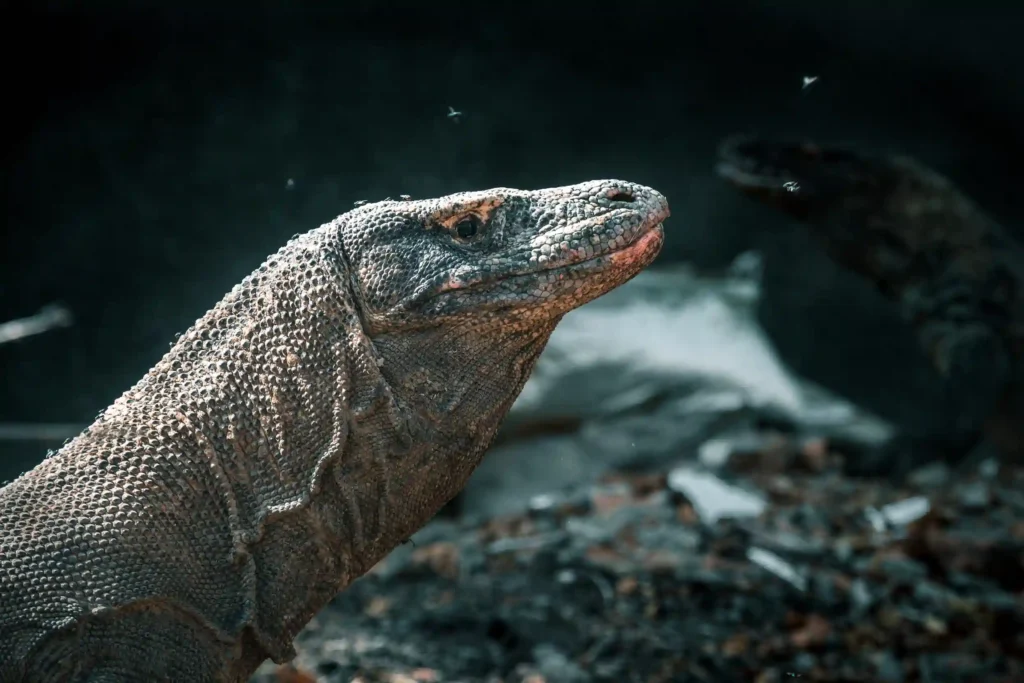
El dragón de Komodo es un reptil único que solo se encuentra en Indonesia, principalmente en Parque Nacional de Komodo. Con una longitud de hasta 10 pies y un peso de unas 200 libras, no solo es el lagarto más grande del mundo, sino también un depredador muy eficaz.
Los varanos de Komodo son cazadores que actúan al acecho: se acercan sigilosamente a sus presas antes de asestarlas una mordedura venenosa. Su saliva contiene proteínas tóxicas que provocan parálisis y una grave pérdida de sangre en sus víctimas. A pesar de su aspecto corpulento, los varanos de Komodo son ágiles y rápidos en distancias cortas, lo que los convierte en cazadores eficaces. Prosperan en las sabanas y los bosques tropicales, y su dieta abarca desde ciervos hasta búfalos de agua.
El tigre: el feroz cazador rayado
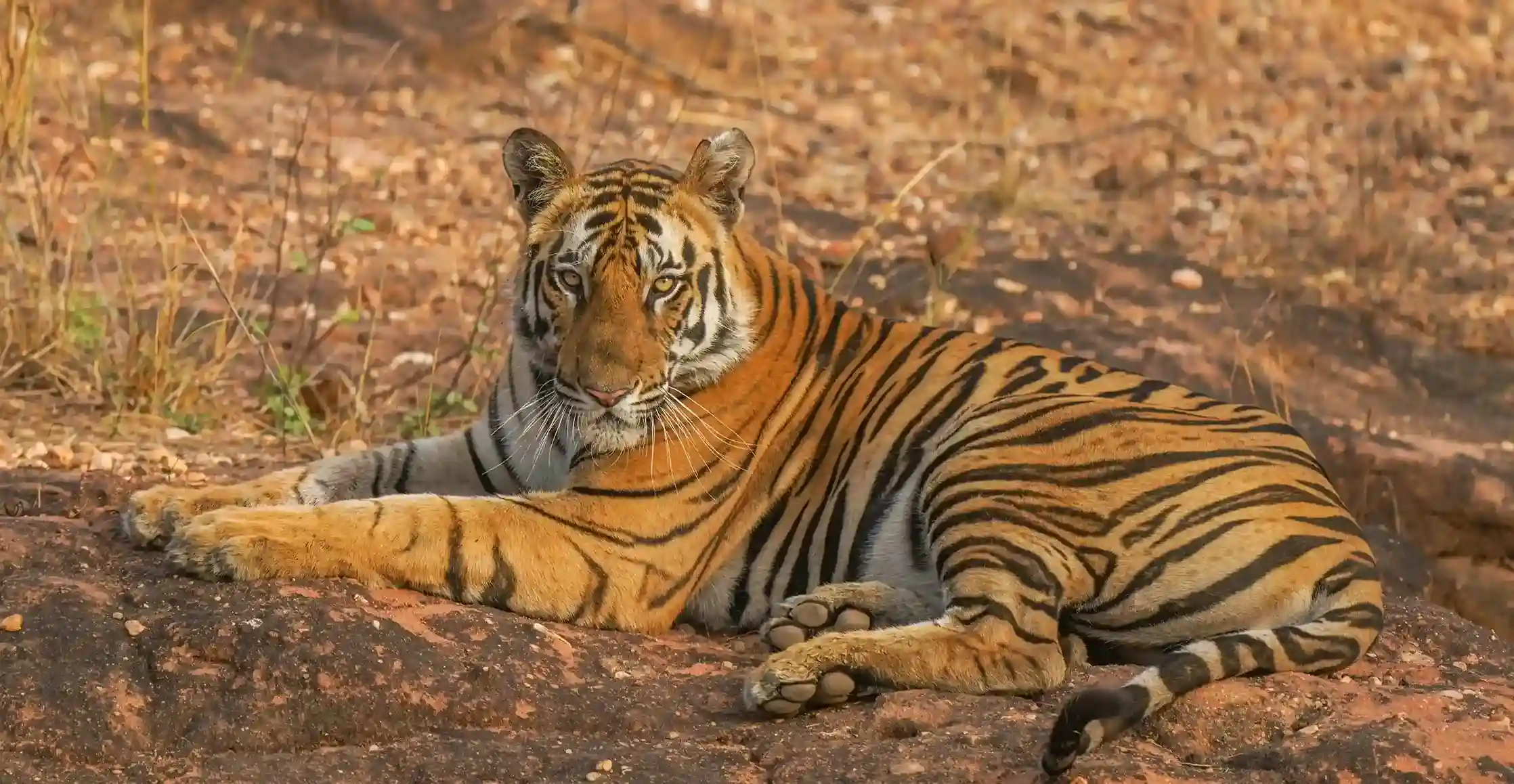
Los tigres son los felinos más grandes del mundo, siendo los tigres de Bengala y los siberianos las subespecies más famosas. Estos depredadores rayados pueden llegar a pesar hasta 300 kg y medir más de 3,3 metros de largo. Los tigres están dotados de fuerza, velocidad y sigilo, lo que los convierte en unos de los cazadores más eficaces del planeta.
Prefieren cazar en solitario, acechando a su presa en silencio antes de lanzar un ataque rápido y letal. Gracias a sus poderosas mandíbulas, sus afiladas garras y su musculoso cuerpo, los tigres pueden derribar presas mucho más grandes que ellos.
Tigers inhabit a wide range of environments, from dense tropical jungles to snow-covered forests in Siberia, and it’s that northernmost population, the Siberian tiger, that grows into the largest cat on the planet. We’ll come back to that specific matchup once we’ve compared the Komodo dragon against tigers as a whole.
Komodo frente a Tiger: una comparación detallada
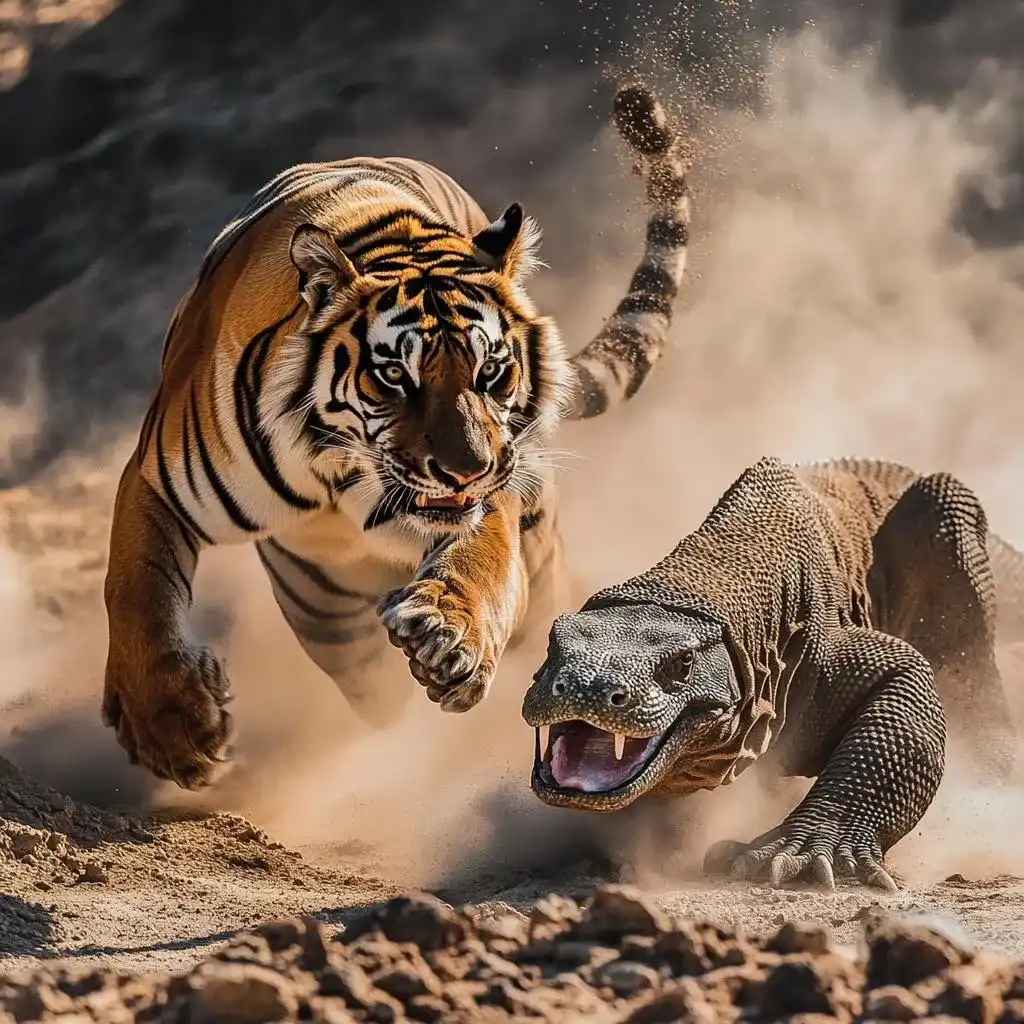
Tanto el varano de dragón de Komodo como el tigre son depredadores alfa, pero sus puntos fuertes residen en ámbitos muy diferentes. Mientras que el varano de Komodo se vale del veneno, las tácticas de emboscada y la resistencia, el tigre domina gracias a su enorme fuerza física, su velocidad y su agresividad.
| Categoría | Dragón de Komodo | Tigre |
| Dimensiones y peso | Hasta 3 metros de largo y 90 kilos | Hasta 3,3 metros de largo, 300 kilos |
| Hábitat | Las sabanas y los bosques tropicales de Indonesia | Selvas, praderas y bosques nevados |
| Estilo de caza | Depredador que acecha a sus presas y tiene una mordedura venenosa | Depredador que acecha y ataca con una fuerza bruta |
| Puntos fuertes | Veneno, escamas resistentes y paciencia | Velocidad, agilidad y complexión física |
| Puntos débiles | Lento en distancias largas, con menos fuerza física | Susceptible a las infecciones o al veneno |
Dimensiones y peso
El leopardo de la India ( dragón de Komodo ) puede alcanzar los 3 metros de longitud y suele pesar entre 70 y 90 kilogramos. En comparación, los tigres son mucho más grandes, con una longitud corporal de hasta 3,3 metros y un peso de hasta 300 kilogramos, dependiendo de la subespecie. En cuanto al tamaño, los tigres tienen claramente la ventaja.
Hábitat
Dragones de Komodo en sabanas tropicales y climas cálidos, principalmente en Isla de Komodo sus alrededores. Los tigres, por su parte, tienen un área de distribución mucho más amplia. Pueden vivir tanto en selvas tropicales como en los bosques nevados de Siberia, y en todos los entornos intermedios. Los tigres se adaptan mucho mejor a los diferentes entornos.
Estilo de caza y alimentación
Dragones de Komodo en tácticas de emboscada, utilizando su mordedura venenosa y su paciencia para debilitar a sus presas. Los tigres, en cambio, cazan con fuerza, velocidad y garras afiladas, derribando a animales mucho más grandes que ellos, como ciervos, jabalíes e incluso búfalos. Los tigres son cazadores más agresivos y activos que los dragones de Komodo.
Puntos fuertes y puntos débiles
Dragones de Komodo Tienen una mordedura mortal y una piel resistente que les sirve de protección. Sin embargo, no son muy rápidos y carecen de la fuerza física necesaria para ganar en un combate directo. Los tigres, por el contrario, son increíblemente fuertes y rápidos, y pueden dar grandes saltos, lo que los convierte en rivales difíciles. Dicho esto, los tigres seguirían siendo vulnerables a la mordedura venenosa de un dragón de Komodo.
Leer Más: «dragón de Komodo » contra un lagarto: ¿Puede un jaguar enfrentarse al lagarto más grande del mundo?
dragón de Komodo ¿Quién ganaría en una pelea contra un tigre?
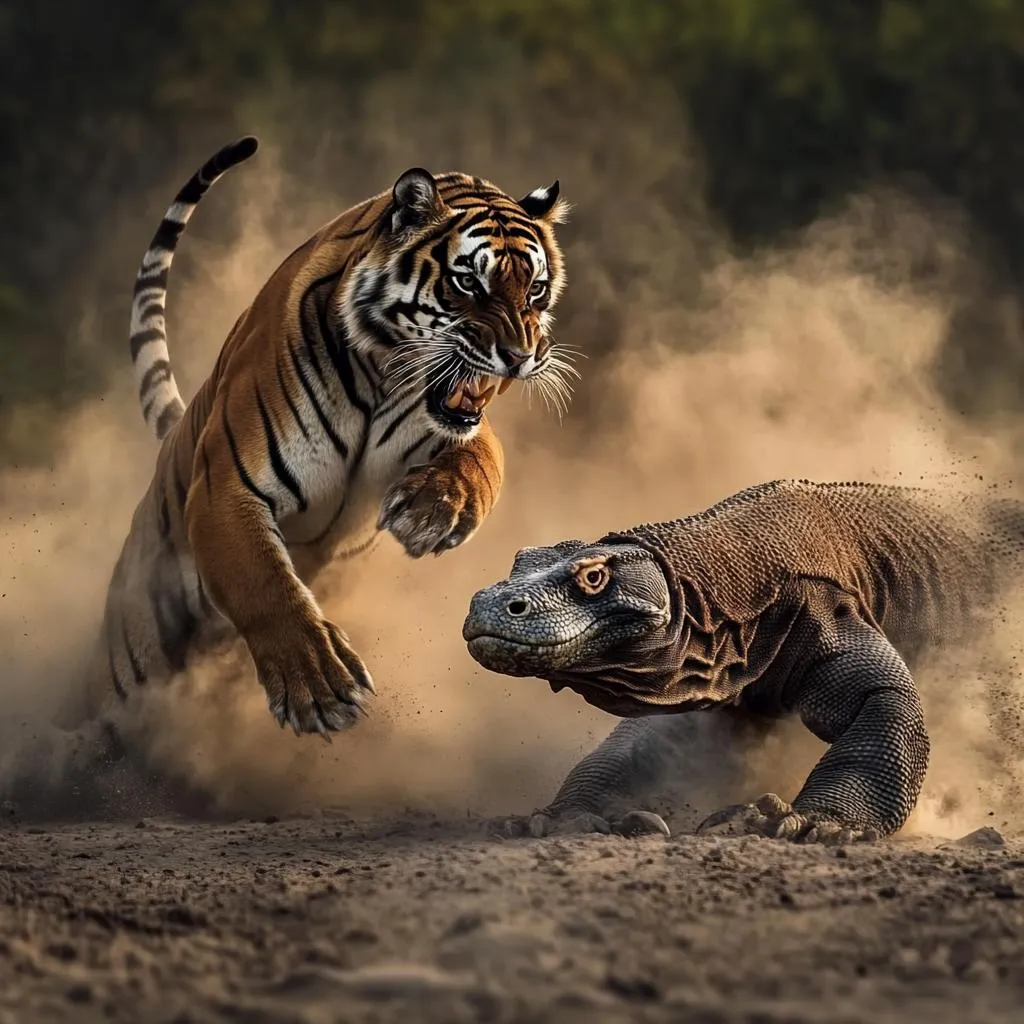
En una hipotética pelea, el resultado dependería en gran medida de los siguientes factores:
- Ventaja en el combate cuerpo a cuerpo: Es probable que el tigre se impusiera gracias a su abrumador tamaño, velocidad y fuerza. Con sus garras y sus mandíbulas, un tigre podría dejar fuera de combate a un « dragón de Komodo » en cuestión de minutos.
- Amenaza del veneno: Si el « dragón de Komodo » logra morder al tigre, el veneno de su saliva podría, con el tiempo, debilitarlo y matarlo. Sin embargo, esto llevaría horas o incluso días, y es posible que el varano de Komodo no sobreviviera al enfrentamiento inicial.
In most scenarios, the tiger’s superior physical abilities would give it the upper hand, but the Komodo’s venomous bite is a wildcard that cannot be ignored. That’s the picture with tigers in general. But if we swap in the largest tiger subspecies on Earth, the gap only widens further.
dragón de Komodo tigre siberiano: enfrentamiento entre depredadores en la naturaleza

The Siberian tiger (Panthera tigris altaica), also known as the Amur tiger, is the largest tiger subspecies and an apex predator in its northern range. Adult males can reach lengths of up to 3.3 meters and weigh as much as 320 kilograms, giving them a tremendous advantage in raw strength over most predators in their habitat. Their thick, orange-and-white striped fur not only protects them from sub-zero temperatures but also provides natural camouflage in snowy forests.
Unlike the Komodo dragon, the Siberian tiger relies on stealth, patience, and explosive power to capture its prey, often targeting large ungulates such as elk, deer, or wild boar. Siberian tigers are solitary hunters, moving silently through dense forests while using keen eyesight and acute hearing to detect prey. Their combination of agility, strength, and strategic hunting techniques makes them one of the most formidable predators in the animal kingdom.
dragón de Komodo tigre siberiano: una comparación exhaustiva
Comparing the Komodo dragon vs Siberian tiger gives fascinating insight into the different ways apex predators adapt to their environments. Let’s break it down by key aspects:
| Aspecto | Dragón de Komodo | Tigre siberiano |
| Tamaño y resistencia | Up to 3m long, 70-90 kg; relies on ambush and venom | Up to 3.3m long, ~320 kg; very strong and muscular |
| Velocidad y agilidad | Lento en tierra, pero capaz de dar ráfagas de velocidad; buen nadador y trepador | Es extremadamente ágil y rápido; puede correr a toda velocidad para tender una emboscada a su presa |
| Técnicas de caza | Depredador que caza al acecho utilizando el sigilo y el veneno | Un acechador solitario que se vale de la paciencia, el camuflaje y la fuerza |
| Los sentidos | Excelente olfato para detectar a sus presas | Una vista y un oído excepcionales para la caza |
| Capacidades defensivas | Escamas gruesas, cola poderosa, mordedura venenosa | Fuerza, garras afiladas y agilidad |
Tamaño y resistencia
When it comes to sheer size, the Siberian tiger is the undisputed heavyweight. Adult males can weigh over four times a Komodo dragon’s average mass, giving them a massive weight advantage in any potential confrontation. The tiger’s muscular build, combined with powerful jaws and claws, enables it to overpower large prey effortlessly. The Komodo dragon, by contrast, relies on ambush tactics and its venomous bite rather than brute strength. While the dragon’s size is still intimidating within its own island ecosystem, the tiger’s strength and jaws clearly give it the upper hand here.
Velocidad y agilidad
While the Komodo dragon may appear slow and cumbersome at first glance, it can sprint in surprising bursts and is also an adept climber and swimmer. In contrast, Siberian tigers are incredibly agile for their size, capable of quick bursts of speed to ambush prey from a distance. Comparing the two, the tiger’s reflexes and mobility are superior, making it better equipped to respond to threats or kill prey efficiently. In a direct encounter, the Komodo dragon would struggle to keep up with the tiger’s nimble movements.
Técnicas de caza
The Komodo dragon is an ambush predator that relies heavily on stealth and its deadly bite. Its venomous bite contains toxins that can cause paralysis and severe blood loss in prey, making it an incredibly effective weapon, and after striking, it may follow its prey for hours or even days while the venom weakens it. The Siberian tiger’s hunting style instead combines patience, camouflage, and explosive power to kill prey in a single strike. Both predators are highly specialized for survival, just in remarkably different ways.
Los sentidos
The Komodo dragon has a highly developed sense of smell, allowing it to locate carrion or live prey over long distances. Siberian tigers, on the other hand, have exceptional vision, especially in low light, and acute hearing that aids in stalking and precise attacks. Both sets of senses are perfectly tuned to their environments, but the tiger’s combination of multiple heightened senses makes it the more versatile hunter overall.
Capacidades defensivas
When it comes to defense, the Komodo dragon relies on its thick scales, tail, and venomous bite to fend off threats. The Siberian tiger, however, uses its immense strength, sharp claws, and agility to avoid or neutralize danger. Here again the tiger has a significant edge, thanks to its ability to both protect itself and intimidate potential predators. Even though the Komodo dragon is formidable in its own territory, its defenses would likely be insufficient against a tiger’s raw power and speed in a hypothetical clash.
Leer Más: ¿Quién ganaría en un combate dragón de Komodo un león?
¿Quién ganaría en un enfrentamiento dragón de Komodo el tigre siberiano?
Scaling the matchup up to the largest tiger subspecies only confirms what the general comparison already suggested, just more decisively. In a direct confrontation, the odds favor the tiger even more heavily here: its superior size, strength, agility, and strategic hunting skills would likely lead to victory, and landing an effective bite on such a swift, powerful predator would be extremely difficult for the dragon. The dragon’s counterpunch is still real, since a single venomous bite causes rapid blood loss that no predator walks away from unharmed, but the tiger would end the fight long before venom becomes the deciding factor. The honest verdict, at any scale: the tiger wins, though the dragon makes it costly.
Of course, the two will never meet outside a hypothetical page like this one. One rules a frozen forest, the other a tropical savanna, and only one of them is a guaranteed sighting for travelers: a 3D2N Komodo tour from Labuan Bajo includes ranger-guided treks on both Komodo and Rinca Island, and ranger-guided dragon treks anchor every Komodo open trip and charter Komodo Luxury runs.
Conclusión
The Komodo dragon and tiger, right up to the mighty Siberian subspecies, are incredible predators, each a testament to nature’s ingenuity. Tigers dominate with strength, speed, and agility, and that advantage only grows more lopsided at the Siberian tiger’s scale, while the Komodo dragon’s venom and patience make it a formidable opponent in its own right, even if it would likely lose a direct confrontation at any size. Both animals deserve admiration for their unique adaptations, regardless of which one would win on paper.
Wild Komodo dragons live only within one Indonesian national park, so travelers can observe them reliably on a Komodo Island boat tour that lands on Komodo and Rinca under ranger escort. If you’re fascinated by the Komodo dragon and want to see this prehistoric predator in its natural habitat, there’s no better way than visiting Komodo National Park. Explore the beauty of Komodo Island with Komodo Luxury, offering exclusive Komodo Island Tour that combine comfort, adventure, and unforgettable memories.
Book your Komodo adventure today at Komodo Luxury and experience the wild like never before!