







Last updated: September 2026 · Prices & availability verified for the 2026/2027 season
Last updated: September 10, 2026
dragões de Komodo e os tigres são dois dos predadores de topo mais fascinantes da natureza. Ambos dominam os seus respetivos ecossistemas, mas de formas totalmente diferentes.
The Komodo dragon, the largest lizard on Earth, relies on its venomous bite and patient hunting tactics to take down prey. Tigers, on the other hand, are majestic powerhouses with unmatched speed and brute strength, making them the kings of the jungle. And among all tiger subspecies, none pushes that power to a greater extreme than the Siberian tiger, the largest cat alive today.
Let’s explore their characteristics, strengths, and how they would perform in a one-on-one confrontation, from tigers in general down to the biggest of them all.
Pontos-chave
- A tiger, including the Siberian subspecies, would very likely win a direct fight against a Komodo dragon thanks to overwhelming size, speed, and raw power.
- The Komodo dragon’s real weapon isn’t strength, it’s its venomous bite, which can eventually kill even an animal many times its size, though not quickly enough to save it in a close-range fight.
- Size gaps get even more extreme with the Siberian tiger specifically, since adult males can weigh up to 320 kg, roughly four times a Komodo dragon’s average weight of 70 to 90 kg.
- Tigers win on nearly every physical category, including speed, agility, night vision, and hearing, while the Komodo dragon’s advantages are limited to smell, patience, and toxic saliva.
- The two predators never meet in the wild, since Komodo dragons live only on a few dry Indonesian islands while Siberian tigers roam the snow forests of the Russian Far East.
Komodo: A fera venenosa da natureza selvagem
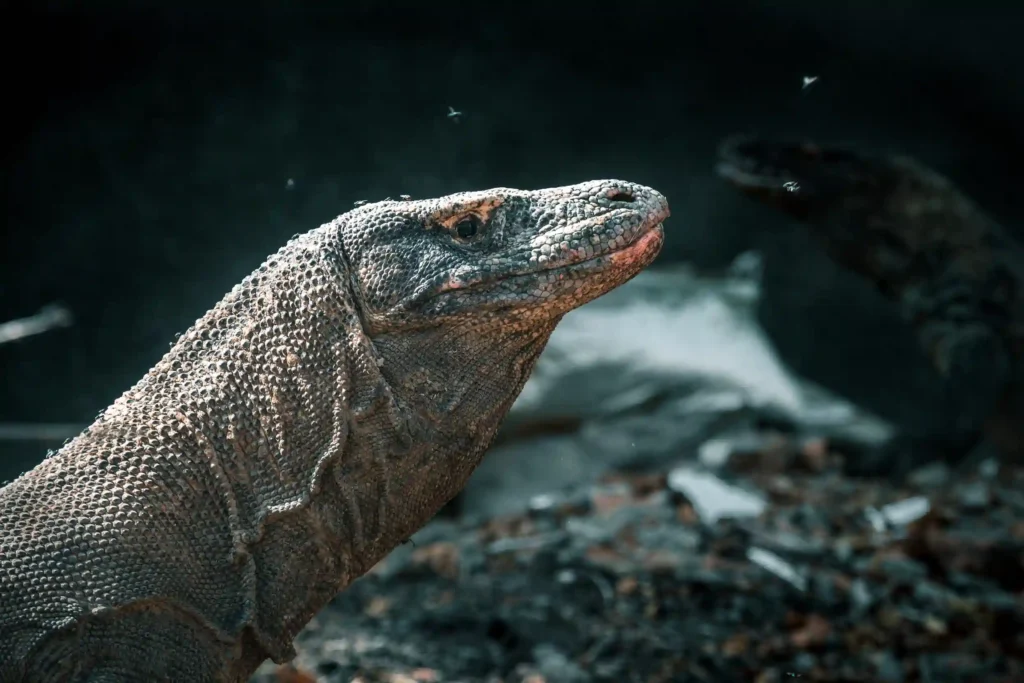
O Dragão de Komodo é um réptil único que só se encontra em Indonésia, principalmente em Parque Nacional de Komodo. Com até 10 pés de comprimento e pesando cerca de 200 libras, não é apenas o maior lagarto do mundo — é também um predador altamente eficiente.
Os comodos são caçadores de emboscada, que se valem da discrição para se aproximarem da presa antes de desferirem uma mordida venenosa. A sua saliva contém proteínas tóxicas que provocam paralisia e perda grave de sangue nas vítimas. Apesar da sua aparência robusta, os comodos são ágeis e rápidos em distâncias curtas, o que os torna caçadores eficazes. Prosperam nas savanas e nas florestas tropicais, e a sua dieta varia entre veados e búfalos-asiáticos.
Tigre: O feroz caçador às riscas
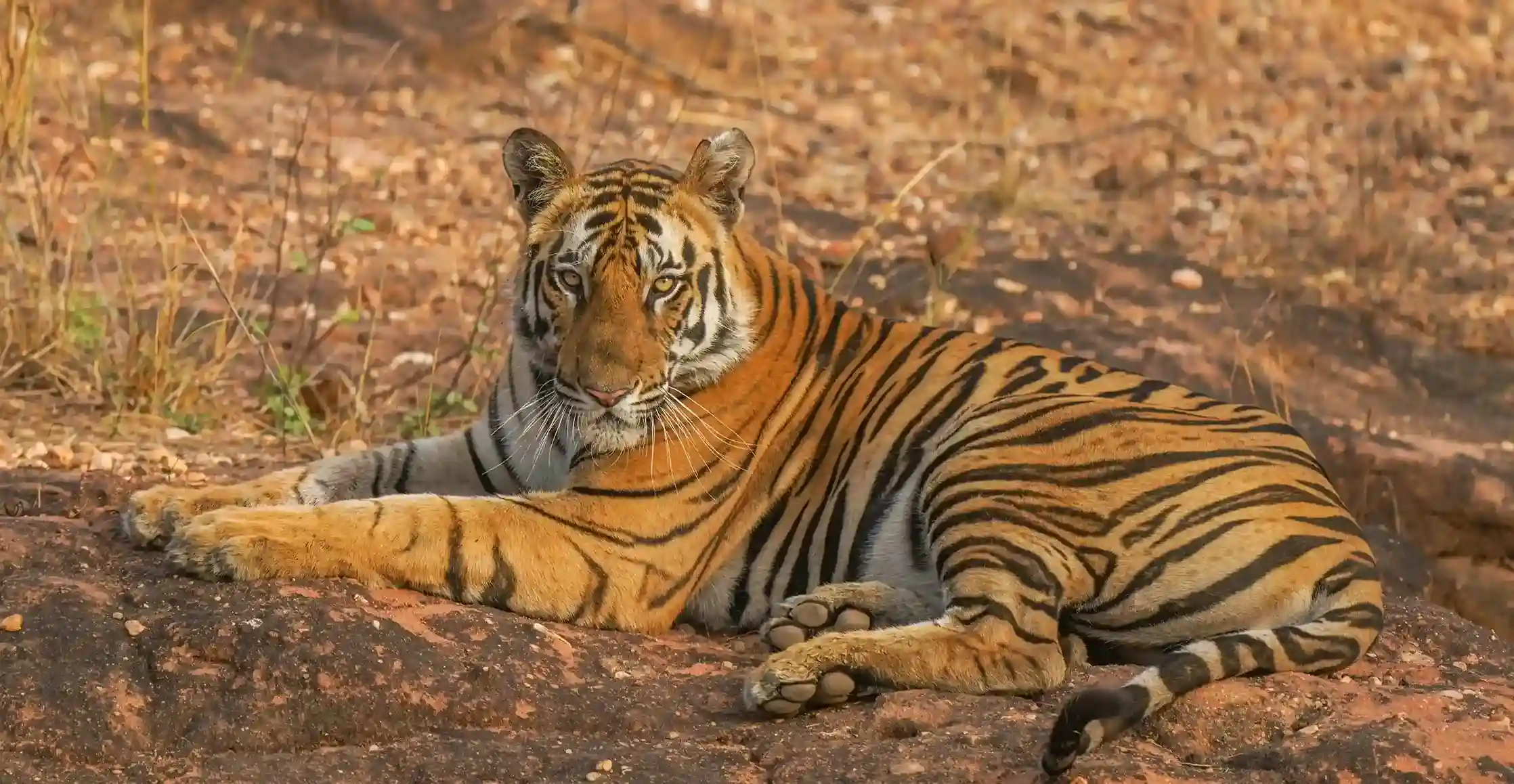
Os tigres são os felinos de maior porte do mundo, sendo os tigres-de-bengala e os tigres-siberianos as subespécies mais famosas. Estes predadores listrados podem pesar até 660 libras e atingir comprimentos superiores a 11 pés. Os tigres têm uma constituição física que lhes confere força, velocidade e discrição, o que os torna alguns dos caçadores mais eficazes do planeta.
Preferem caçar sozinhos, aproximando-se silenciosamente da presa antes de lançarem um ataque rápido e mortal. Com mandíbulas poderosas, garras afiadas e corpos musculados, os tigres conseguem abater presas muito maiores do que eles próprios.
Tigers inhabit a wide range of environments, from dense tropical jungles to snow-covered forests in Siberia, and it’s that northernmost population, the Siberian tiger, that grows into the largest cat on the planet. We’ll come back to that specific matchup once we’ve compared the Komodo dragon against tigers as a whole.
Komodo vs. Tiger: Uma comparação detalhada
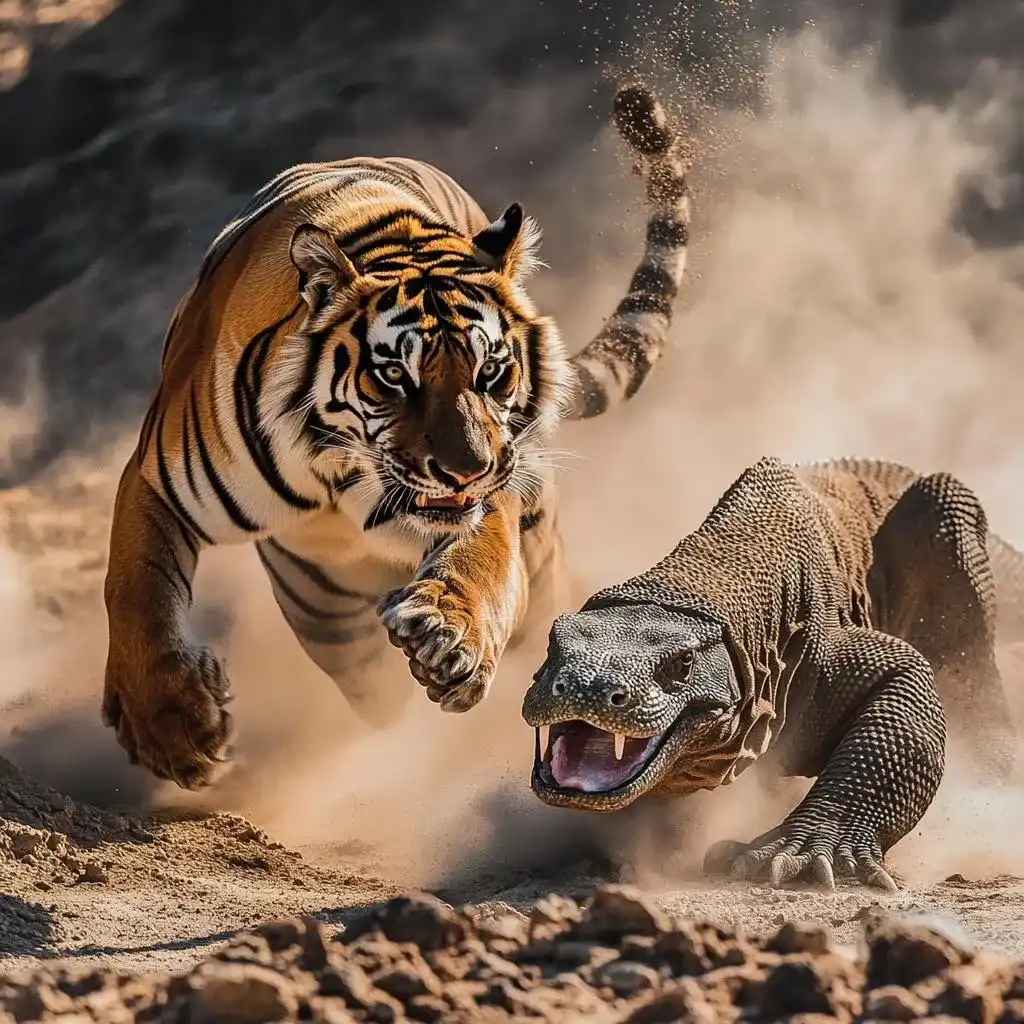
Tanto o lagarto-de- Dragão de Komodo o como o tigre são predadores de topo, mas os seus pontos fortes residem em áreas muito diferentes. Enquanto o lagarto-de- o recorre ao veneno, às táticas de emboscada e à resistência, o tigre domina graças à sua força física bruta, velocidade e agressividade.
| Categoria | Dragão de Komodo | Tigre |
| Dimensões e peso | Até 10 pés de comprimento, 200 libras | Até 11 pés de comprimento, 660 libras |
| Habitat | Savanas e florestas tropicais em Indonésia | Selvas, pradarias e florestas nevadas |
| Estilo de caça | Predador que ataca de emboscada com mordida venenosa | Predador que persegue e ataca de surpresa, dotado de uma força bruta |
| Pontos fortes | Veneno, escamas resistentes e paciência | Velocidade, agilidade e constituição muscular |
| Pontos fracos | Lento em longas distâncias, com menos força física | Suscetível a infeções ou veneno |
Dimensões e peso
O leopardo-malai ( Dragão de Komodo ) pode atingir até 3 metros de comprimento e pesa normalmente entre 70 e 90 quilogramas. Em comparação, os tigres são muito maiores, com um comprimento corporal de até 3,3 metros e um peso de até 300 quilogramas, dependendo da subespécie. No que diz respeito ao tamanho, os tigres têm claramente a vantagem.
Habitat
dragões de Komodo vivem em savanas tropicais e climas quentes, principalmente em Ilha de Komodo e nas áreas circundantes. Os tigres, por outro lado, têm uma área de distribuição muito mais ampla. Conseguem prosperar em selvas tropicais, florestas nevadas da Sibéria e em todos os ambientes intermédios. Os tigres são muito mais adaptáveis a diferentes ambientes.
Estilo de caça e alimentação
dragões de Komodo recorrem a táticas de emboscada, utilizando a sua mordida venenosa e a paciência para enfraquecer a presa. Os tigres, no entanto, caçam com força, velocidade e garras afiadas, derrubando animais muito maiores do que eles próprios — como veados, javalis e até búfalos. Os tigres são caçadores mais agressivos e ativos em comparação com os comodos.
Pontos fortes e pontos fracos
dragões de Komodo têm uma mordida mortal e uma pele resistente que lhes serve de proteção. No entanto, não são muito rápidos e não têm força física suficiente para vencer num confronto direto. Os tigres, por outro lado, são incrivelmente fortes, rápidos e capazes de dar saltos de grande distância, o que os torna adversários difíceis. Dito isto, os tigres continuariam a ser vulneráveis à mordida venenosa de um Dragão de Komodo.
Leia Mais: Dragão de Komodo vs Cat: Será que um jaguar consegue enfrentar o maior lagarto do mundo?
Dragão de Komodo vs. o tigre: quem venceria numa luta?
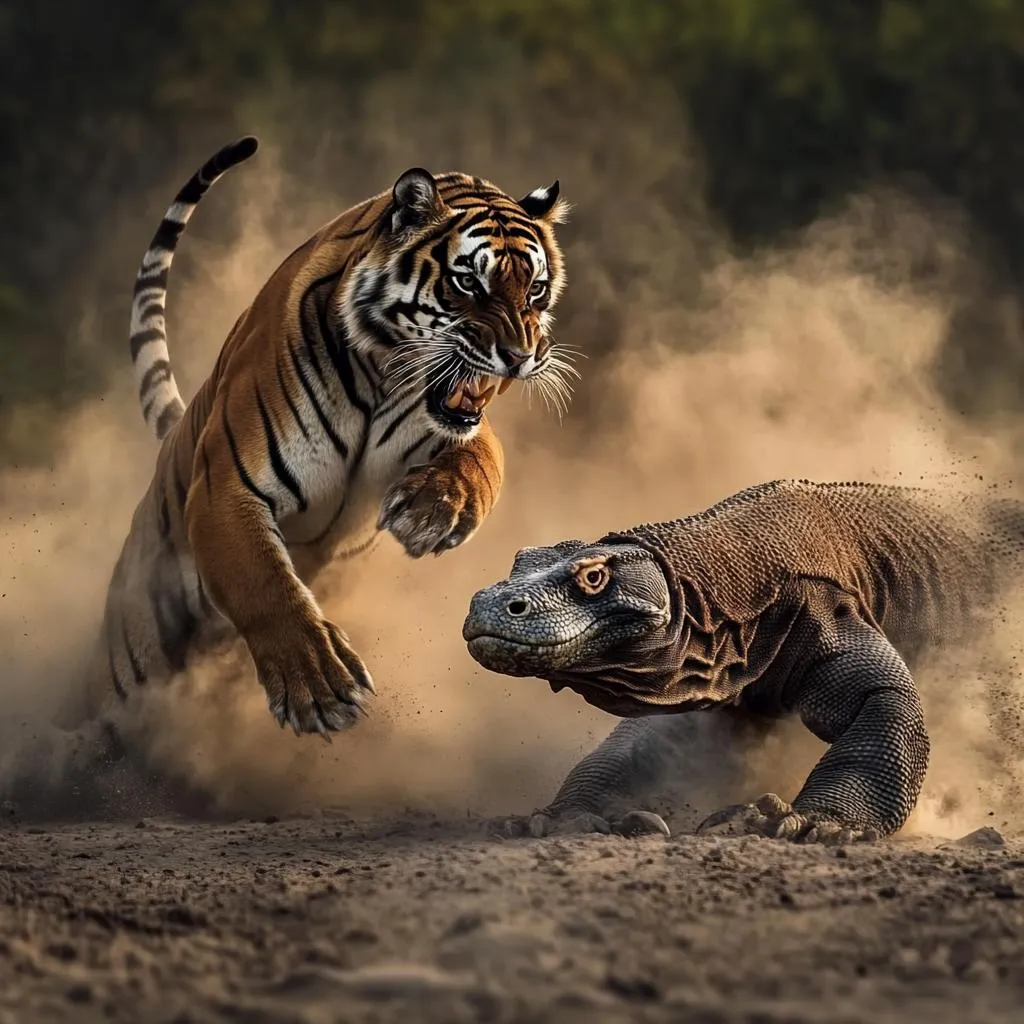
Numa luta hipotética, o resultado dependeria em grande medida dos seguintes fatores:
- Vantagem no combate corpo a corpo: O tigre provavelmente levaria a melhor devido ao seu tamanho, velocidade e força avassaladores. Com as suas garras e mandíbulas, um tigre poderia incapacitar um « Dragão de Komodo » em poucos minutos.
- Ameaça do veneno: Se o « Dragão de Komodo » conseguir morder, o veneno presente na sua saliva poderá, a longo prazo, enfraquecer e matar o tigre. No entanto, isso levaria horas ou até dias, e o dragão-de-Komodo poderá não sobreviver ao confronto inicial.
In most scenarios, the tiger’s superior physical abilities would give it the upper hand, but the Komodo’s venomous bite is a wildcard that cannot be ignored. That’s the picture with tigers in general. But if we swap in the largest tiger subspecies on Earth, the gap only widens further.
Dragão de Komodo vs. Tigre-siberiano: Confronto entre predadores na natureza

The Siberian tiger (Panthera tigris altaica), also known as the Amur tiger, is the largest tiger subspecies and an apex predator in its northern range. Adult males can reach lengths of up to 3.3 meters and weigh as much as 320 kilograms, giving them a tremendous advantage in raw strength over most predators in their habitat. Their thick, orange-and-white striped fur not only protects them from sub-zero temperatures but also provides natural camouflage in snowy forests.
Unlike the Komodo dragon, the Siberian tiger relies on stealth, patience, and explosive power to capture its prey, often targeting large ungulates such as elk, deer, or wild boar. Siberian tigers are solitary hunters, moving silently through dense forests while using keen eyesight and acute hearing to detect prey. Their combination of agility, strength, and strategic hunting techniques makes them one of the most formidable predators in the animal kingdom.
Komodo Dragon vs Siberian Tiger: A Complete Comparison
Comparing the Komodo dragon vs Siberian tiger gives fascinating insight into the different ways apex predators adapt to their environments. Let’s break it down by key aspects:
| Aspecto | Dragão de Komodo | Siberian Tiger |
| Tamanho e resistência | Up to 3m long, 70-90 kg; relies on ambush and venom | Up to 3.3m long, ~320 kg; very strong and muscular |
| Velocidade e agilidade | Slow on land, bursts of speed; good swimmer and climber | Extremely agile and fast; can sprint to ambush prey |
| Hunting Techniques | Ambush predator using stealth and venom | Solitary stalker using patience, camouflage, and power |
| Senses | Excellent sense of smell for detecting prey | Exceptional vision and hearing for hunting |
| Defensive Capabilities | Thick scales, powerful tail, venomous bite | Strength, sharp claws, and agility |
Tamanho e resistência
When it comes to sheer size, the Siberian tiger is the undisputed heavyweight. Adult males can weigh over four times a Komodo dragon’s average mass, giving them a massive weight advantage in any potential confrontation. The tiger’s muscular build, combined with powerful jaws and claws, enables it to overpower large prey effortlessly. The Komodo dragon, by contrast, relies on ambush tactics and its venomous bite rather than brute strength. While the dragon’s size is still intimidating within its own island ecosystem, the tiger’s strength and jaws clearly give it the upper hand here.
Velocidade e agilidade
While the Komodo dragon may appear slow and cumbersome at first glance, it can sprint in surprising bursts and is also an adept climber and swimmer. In contrast, Siberian tigers are incredibly agile for their size, capable of quick bursts of speed to ambush prey from a distance. Comparing the two, the tiger’s reflexes and mobility are superior, making it better equipped to respond to threats or kill prey efficiently. In a direct encounter, the Komodo dragon would struggle to keep up with the tiger’s nimble movements.
Hunting Techniques
The Komodo dragon is an ambush predator that relies heavily on stealth and its deadly bite. Its venomous bite contains toxins that can cause paralysis and severe blood loss in prey, making it an incredibly effective weapon, and after striking, it may follow its prey for hours or even days while the venom weakens it. The Siberian tiger’s hunting style instead combines patience, camouflage, and explosive power to kill prey in a single strike. Both predators are highly specialized for survival, just in remarkably different ways.
Senses
The Komodo dragon has a highly developed sense of smell, allowing it to locate carrion or live prey over long distances. Siberian tigers, on the other hand, have exceptional vision, especially in low light, and acute hearing that aids in stalking and precise attacks. Both sets of senses are perfectly tuned to their environments, but the tiger’s combination of multiple heightened senses makes it the more versatile hunter overall.
Defensive Capabilities
When it comes to defense, the Komodo dragon relies on its thick scales, tail, and venomous bite to fend off threats. The Siberian tiger, however, uses its immense strength, sharp claws, and agility to avoid or neutralize danger. Here again the tiger has a significant edge, thanks to its ability to both protect itself and intimidate potential predators. Even though the Komodo dragon is formidable in its own territory, its defenses would likely be insufficient against a tiger’s raw power and speed in a hypothetical clash.
Leia Mais: Dragão de Komodo s vs. Lion: Quem venceria?
Komodo Dragon vs Siberian Tiger: Who Would Win?
Scaling the matchup up to the largest tiger subspecies only confirms what the general comparison already suggested, just more decisively. In a direct confrontation, the odds favor the tiger even more heavily here: its superior size, strength, agility, and strategic hunting skills would likely lead to victory, and landing an effective bite on such a swift, powerful predator would be extremely difficult for the dragon. The dragon’s counterpunch is still real, since a single venomous bite causes rapid blood loss that no predator walks away from unharmed, but the tiger would end the fight long before venom becomes the deciding factor. The honest verdict, at any scale: the tiger wins, though the dragon makes it costly.
Of course, the two will never meet outside a hypothetical page like this one. One rules a frozen forest, the other a tropical savanna, and only one of them is a guaranteed sighting for travelers: a 3D2N Komodo tour from Labuan Bajo includes ranger-guided treks on both Komodo and Rinca Island, and ranger-guided dragon treks anchor every Komodo open trip and charter Komodo Luxury runs.
Conclusão
The Komodo dragon and tiger, right up to the mighty Siberian subspecies, are incredible predators, each a testament to nature’s ingenuity. Tigers dominate with strength, speed, and agility, and that advantage only grows more lopsided at the Siberian tiger’s scale, while the Komodo dragon’s venom and patience make it a formidable opponent in its own right, even if it would likely lose a direct confrontation at any size. Both animals deserve admiration for their unique adaptations, regardless of which one would win on paper.
Wild Komodo dragons live only within one Indonesian national park, so travelers can observe them reliably on a Komodo Island boat tour that lands on Komodo and Rinca under ranger escort. If you’re fascinated by the Komodo dragon and want to see this prehistoric predator in its natural habitat, there’s no better way than visiting Komodo National Park. Explore the beauty of Komodo Island with Komodo Luxury, offering exclusive Komodo Island Tour that combine comfort, adventure, and unforgettable memories.
Book your Komodo adventure today at Komodo Luxury and experience the wild like never before!