






Last updated: December 2025 · Prices & availability verified for the 2026/2027 season
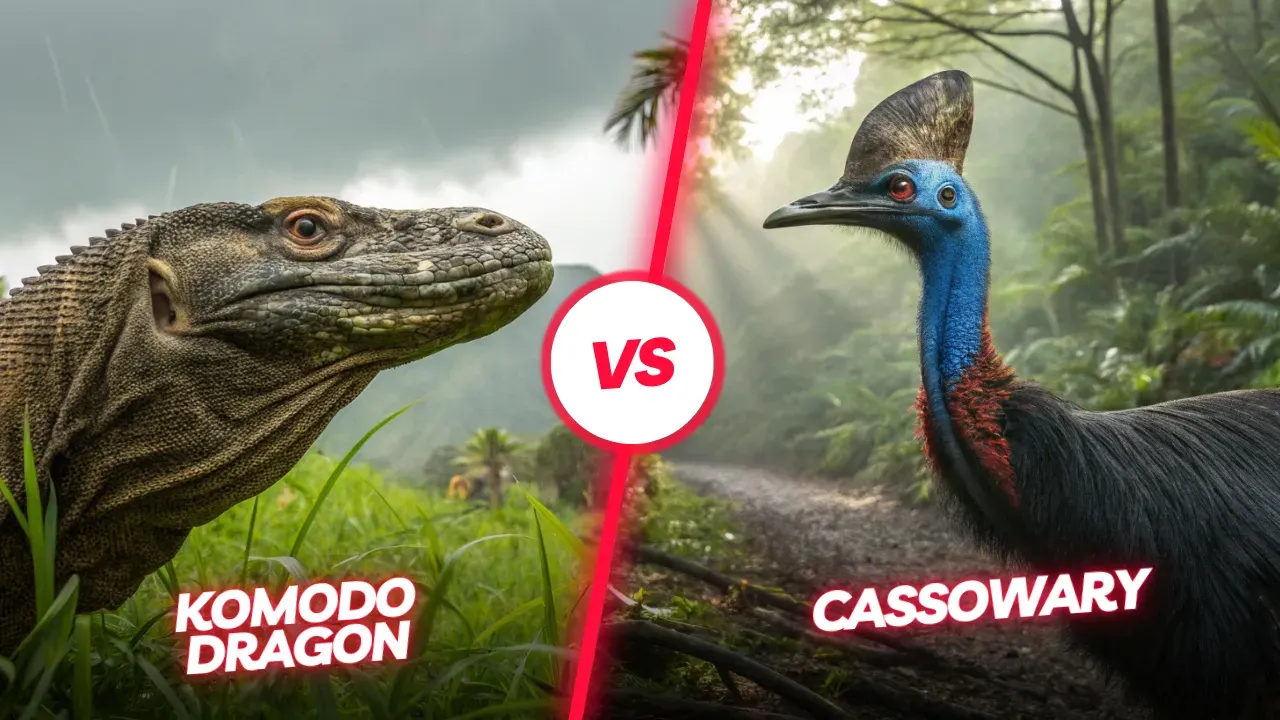
What happens when you pit a venomous, prehistoric lizard against a giant, flightless bird with dagger-like claws? It may sound like a fantasy battle, but both the Komodo dragon and the cassowary are very real and among the most dangerous animals on the planet. Despite living in different ecosystems, these two creatures have earned fearsome reputations for their size, power, and potential threat to humans.
So, which one is deadlier? Who would win in a face-off? In this article, we’ll break down the facts in the ultimate showdown: Komodo dragon vs cassowary. From their physical traits and behaviors to their role in the wild and human encounters, here’s everything you need to know, plus how you can meet one of them in the wild, safely and in luxury.
Komodo Dragon: Giant Lizard of Indonesia
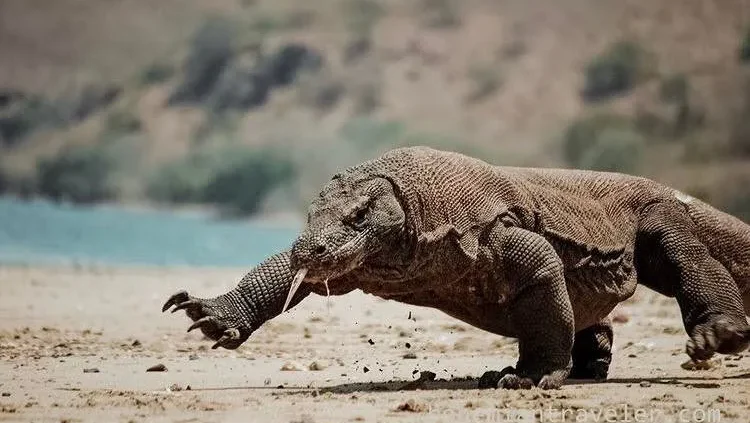
The Komodo dragon is the largest living lizard on Earth, found only on a few remote islands in Indonesia such as Komodo, Rinca, and Flores. With its massive body, rugged scales, and long muscular tail, it looks like a creature from another era. But it’s not just the appearance that makes this predator fearsome, its venomous bite and ambush hunting tactics allow it to take down prey much larger than itself. Despite its terrifying abilities, the Komodo dragon plays an important role in the ecosystem as a top predator. It’s also deeply respected by local communities, who view it as a symbol of balance between nature, culture, and tradition.
Cassowary: The World’s Most Dangerous Bird
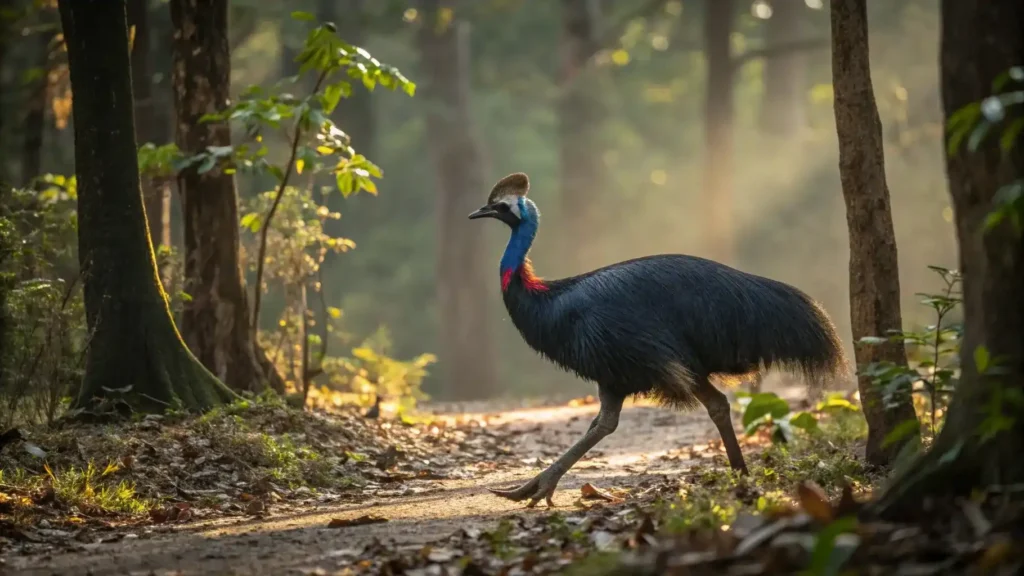
The cassowary is a striking, flightless bird native to the rainforests of Papua New Guinea, West Papua, and northern Australia. With its vivid blue skin, tall casque, and powerful legs, it looks both beautiful and intimidating. What makes it truly dangerous is the long, dagger-like claw on each foot, which it uses to defend itself when threatened. While cassowaries are shy by nature, they can become aggressive, especially if provoked or approached too closely. At the same time, they play a vital ecological role by dispersing seeds across the forest, helping maintain the health of tropical ecosystems.
Komodo Dragon vs Cassowary: A Complete Comparison
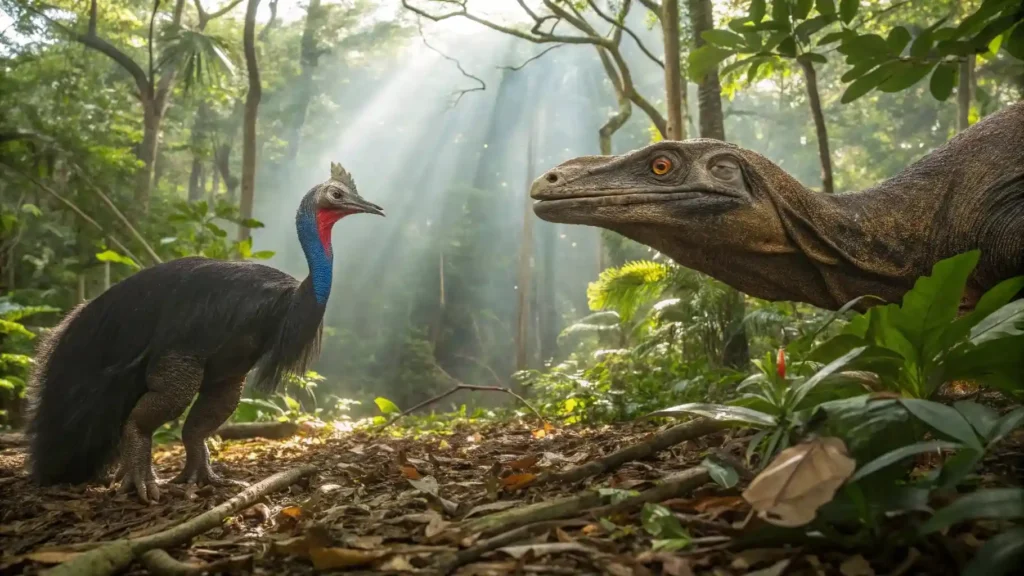
When it comes to danger, strength, and survival instincts, both the Komodo dragon and the cassowary are in a league of their own. But how do they really compare in terms of physical features, behavior, and interaction with humans? Let’s break it down point by point.
| Aspect | Komodo Dragon | Cassowary |
| Size & Weight | Up to 3 m; 70–90 kg | Up to 1.8 m; ±60 kg |
| Speed & Agility | Max 20 km/h; limited agility | Up to 50 km/h; agile, can jump 1.5 m |
| Natural Weapons | Venomous bite, claws, powerful jaws | Dagger-like claw, strong kick |
| Behavior Toward Humans | Rare but potentially fatal attacks | More frequent injuries; defensive reactions |
| Ecosystem Role | Apex predator; population control | Keystone species; seed disperser |
| Reproduction | Can reproduce asexually (parthenogenesis) | Males raise chicks; strong parenting role |
| Cultural Meaning | Mythical sibling to humans in Komodo folklore | Ceremonial and symbolic in PNG culture |
| Wild Observation | Easy to spot in Komodo National Park with guides | Difficult to spot; elusive in rainforest |
1. Size and Weight
The Komodo dragon is significantly larger than the cassowary in both length and body mass. It can grow up to 3 meters long and weigh around 70 to 90 kilograms, making it the heaviest lizard alive today. In contrast, the cassowary stands tall, reaching up to 1.8 meters, but weighs slightly less, around 60 kilograms on average. This difference in physical size gives the Komodo dragon a clear advantage in terms of raw bulk and strength.
2. Speed and Agility
While Komodo dragons are powerful, they are not particularly fast or agile. They can only sprint in short bursts at speeds up to 20 km/h, usually when ambushing prey. On the other hand, cassowaries are built for speed and maneuverability in dense rainforest terrain, capable of running up to 50 km/h and jumping over 1.5 meters high. Thanks to this agility, the cassowary can easily escape predators or strike swiftly when provoked.
Read more: How Fast Is a Komodo Dragon? Facts You Need to Know!
3. Natural Weapons
The Komodo dragon uses a combination of venom, sharp claws, and a powerful bite to bring down prey, often relying on stealth to ambush its target. Its venom prevents blood clotting, which causes the victim to weaken quickly. Meanwhile, the cassowary’s main weapon is its muscular legs and sharp, dagger-like inner claw, which can deliver deep, dangerous slashes. Although both have deadly traits, the Komodo’s offensive tactics make it more dangerous as a predator, while the cassowary excels in self-defense.
4. Behavior Toward Humans
Komodo dragons are relatively reclusive but may attack humans if they feel provoked or see an opportunity. Though such encounters are rare, they can be fatal due to the dragon’s venomous bite and size. Cassowaries, however, are more frequently involved in human injuries, especially when people try to feed or approach them in the wild. In this case, the cassowary poses a more common threat, while the Komodo dragon poses a deadlier one.
5. Role in the Ecosystem
Komodo dragons help maintain ecological balance by controlling populations of deer, wild boars, and smaller animals within their island habitats. As apex predators, they ensure that no single species dominates the environment. Cassowaries, meanwhile, serve a completely different ecological function as key seed dispersers, eating large fruits and spreading their seeds across the rainforest. Both creatures are vital to their ecosystems, even though they operate in very different ways.
6. Reproductive Uniqueness
One of the most remarkable traits of the Komodo dragon is its ability to reproduce asexually through parthenogenesis, allowing females to produce offspring without mating. This adaptation is especially useful on isolated islands where mates may be scarce. In contrast, cassowaries reproduce sexually, but what makes them special is the male’s role in parenting, from incubating the eggs to raising the chicks alone. While both exhibit unique reproductive behaviors, the Komodo stands out biologically, and the cassowary impresses behaviorally.
7. Cultural and Symbolic Meaning
In the Komodo region, dragons are deeply respected and seen as spiritual siblings to humans, thanks to local legends like the story of Putri Naga. This belief fosters a culture of protection and coexistence between villagers and dragons. Likewise, cassowaries hold strong cultural value in parts of Papua New Guinea, where they are featured in rituals, dances, and traditional beliefs. Despite their danger, both animals are honored symbols within their communities.
8. Ease of Observation in the Wild
Thanks to guided treks in Komodo National Park, visitors can safely observe Komodo dragons in their natural habitat with the help of trained rangers. These dragons are relatively easy to find in the open landscapes of the islands they inhabit. In contrast, cassowaries are elusive and prefer the dense cover of tropical rainforests, making sightings rare and unpredictable. For wildlife tourism, the Komodo dragon offers a far more accessible and controlled viewing experience.
Komodo Dragon vs Cassowary: Who Would Win?
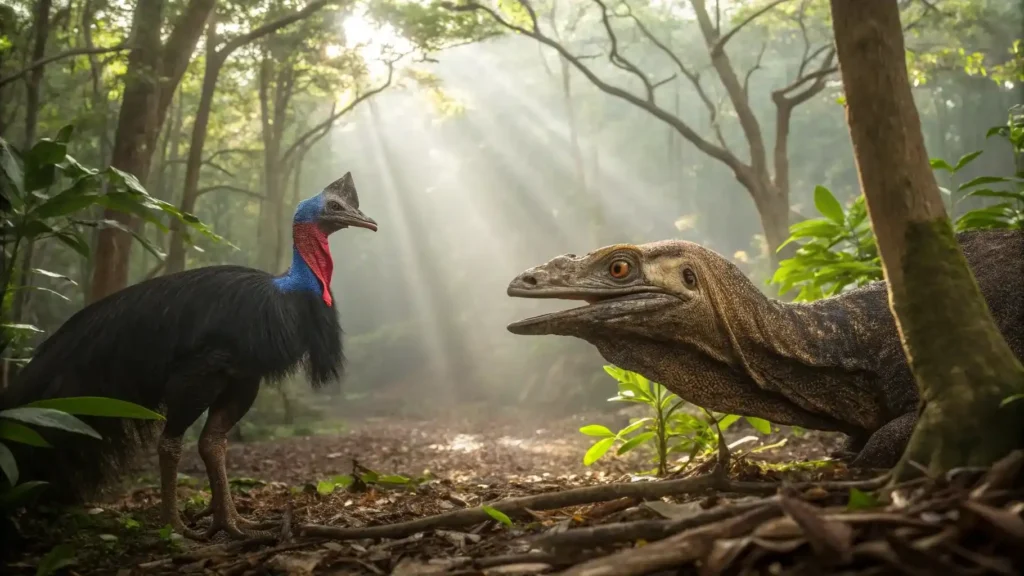
When imagining a head-to-head battle between a Komodo dragon and a cassowary, it’s easy to get caught up in the fantasy. Both are powerful, dangerous, and completely unique in their own right, but their fighting styles and natural instincts are worlds apart. The Komodo dragon is an ambush predator, relying on stealth, strength, and venom to wear down its prey. The cassowary, on the other hand, is built for defense and speed, striking fast with lethal kicks when provoked.
If a confrontation were to happen in an open area, the Komodo dragon would likely have the upper hand. Its venomous bite and muscular build could overwhelm the cassowary if it managed to land a successful ambush or hold its ground. However, in a dense rainforest, cassowary territory, the tables might turn. With its speed, agility, and ability to strike from below with sharp claws, the cassowary could deliver serious damage before the Komodo even had a chance to respond.
Still, it’s important to remember: these animals are not designed to fight each other. They thrive in completely different environments and play very different roles in their ecosystems. Instead of imagining them as opponents, perhaps it’s better to see them as two rare survivors of Earth’s evolutionary past, each impressive in its own way.
Read more: Best Time of Day to See Komodo Dragons
Find Komodo Dragon in the Wild with Komodo Luxury!
If you’re fascinated by the Komodo dragon and want to experience this living legend firsthand, the best way is to join Komodo Island Tour with Komodo Luxury. Offering exclusive private yacht trips and expert-guided tours, Komodo Luxury ensures you witness these incredible creatures safely and comfortably in their natural habitat.
From exploring Komodo National Park’s stunning islands to spotting dragons in the wild, every detail is tailored for a seamless luxury adventure. Whether you’re a wildlife enthusiast, an adventure seeker, or simply looking for a unique escape, Komodo Luxury provides an unforgettable journey that connects you closely to nature’s marvels.
Ready to meet the world’s largest lizard up close? Book your luxury Komodo adventure today and step into a world where dragons still roam.