





Last updated: August 2026 · Prices & availability verified for the 2026/2027 season
Komodo dragons today are found only on five Indonesian islands — Komodo, Rinca, Gili Motang, Nusa Kode, and parts of Flores — but they are not originally Indonesian at all. Fossil evidence published in 2009 by Scott Hocknull’s team, drawing on Queensland Museum material, shows the species evolved in Australia around four million years ago, then dispersed westward into the Lesser Sunda Islands, where fossils place Komodo dragons on Flores by roughly 1.4 million years ago. Everywhere else, the giants died out; the Indonesian islands became their last refuge.
The Short Answer: Born in Australia, Surviving in Indonesia
For most of the twentieth century, the dragon was assumed to be a product of its islands — a modest monitor that grew huge in isolation. The fossil record rewrote that story. Excavations in eastern Australia produced Varanus komodoensis fossils millions of years old, proving the species reached full size on a continent, among an entire radiation of giant monitors, long before it ever saw Flores. That finding also quietly undermines the tidy textbook tale of “island gigantism”: the Queensland fossils indicate dragons were already dragon-sized in Australia, so the islands preserved their bulk rather than produced it. Today’s dragons are best described as a relict giant: the last surviving member of an Australian dynasty, holding out on a handful of savanna islands.
The Evolutionary Timeline
| When | Event |
|---|---|
| ~4 million years ago | Komodo dragon lineage present in Australia (Hocknull et al. 2009; Queensland fossils, ~3.8–4 Ma) |
| ~1.4 million years ago | Fossils attributable to Komodo dragons on Flores — the lineage established in Wallacea |
| ~50,000–40,000 years ago | Giant relatives, including Megalania, vanish from Australia; the Komodo dragon becomes the last giant varanid |
| 1910 | Dutch officer J.K.H. van Steyn van Hensbroek investigates “land crocodile” reports on Komodo |
| 1912 | P.A. Ouwens formally describes Varanus komodoensis at Buitenzorg (Bogor) |
| 1915 | Dutch colonial authorities grant the species legal protection |
| 1980 / 1991 | Komodo National Park established; inscribed as UNESCO World Heritage |
Megalania: The Giant Cousin That Didn’t Make It
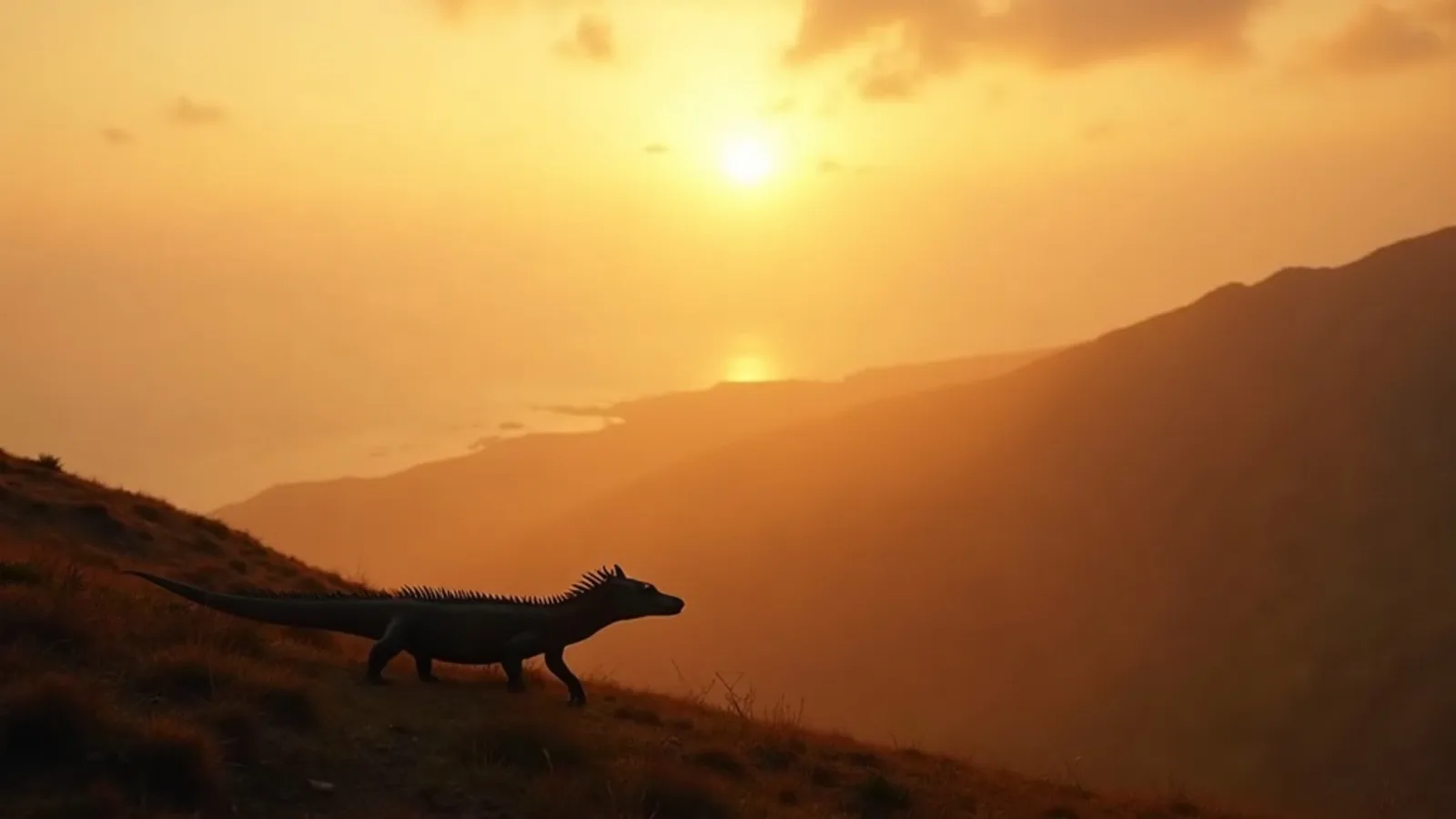
Australia’s Pleistocene savannas were ruled by Varanus priscus — Megalania — a monitor estimated at 5+ metres, the largest terrestrial lizard known to science. Komodo dragons belong to the same giant-monitor lineage: not descendants of Megalania, but close kin within one Australian radiation of huge varanids. When Australia’s megafauna collapsed in the late Pleistocene, Megalania went with it. The smaller, island-insured Komodo dragon survived — which is why scientists sometimes call Komodo National Park a living window into Ice Age Australia, the one place where the age of giant monitors never actually ended.
Their Closest Living Relative Is Australian Too
Genetic and morphological work identifies the lace monitor (Varanus varius) of eastern Australia as the dragon’s nearest living relative — a tree-climbing monitor a fraction of the dragon’s bulk. The split between the two lineages predates the dragon’s island chapter, one more line of evidence anchoring its family tree firmly in Australia.
Why Did They Survive Only in Indonesia?
The consensus explanation is isolation plus extinction elsewhere. During Pleistocene glacials, sea levels dropped by more than a hundred metres, narrowing the straits of Wallacea enough for a strong-swimming monitor to island-hop westward along the volcanic chain. Crucially, Wallacea’s deep channels never closed completely — which kept Asian big cats, wild dogs, and other mainland carnivores out. When seas rose again, populations on Flores and its satellites were cut off — and cut off, too, from the catastrophes that later swept the mainland. On their dry savanna islands the dragons kept what mattered: abundant deer and pig prey, no competing large carnivores, and no human hunting pressure heavy enough to erase them. Populations remain dynamic on the margins — the dragons of Padar Island went extinct in the twentieth century after prey collapsed, and the species is now listed as Endangered. How the modern population is counted and protected is covered in our complete Komodo dragon guide.
1910–1912: The West Finally Meets the Dragon
Rumours of a “land crocodile” (buaya darat) in the Lesser Sundas reached Dutch colonial officials for years before Lieutenant van Steyn van Hensbroek sailed to Komodo in 1910, secured a specimen, and sent skin and photographs to Pieter Antonie Ouwens, director of the zoological museum at Buitenzorg (today’s Bogor). Ouwens published the formal description in 1912, naming Varanus komodoensis — and within three years the colonial government had protected it, an unusually fast conservation response for the era. The expeditions that followed through the 1910s and 1920s carried the dragon into Western museums, zoos, and eventually cinema — but they were catching up to knowledge the islands already held. The people of Komodo, of course, had known the ora all along — and told a far older story about it, preserved in the Ora legend.
Standing Where the Story Ends — For Now
Walk the savanna of Komodo or Rinca today and you are watching the final population of a four-million-year Australian lineage going about its business — the closest thing on Earth to Pleistocene time travel. Nowhere else on the planet can you observe a megafaunal predator in the same landscape, at the same size, doing the same work it did an epoch ago. Our Komodo tour packages bring you there by private phinisi, with licensed rangers who know the dragons’ trails individual by individual. For how big those survivors grow, see our measured size data.
Frequently Asked Questions
Where do Komodo dragons come from originally?
Australia. Fossil research led by Scott Hocknull (2009) shows the species evolved there around four million years ago before dispersing to the Indonesian islands where it survives today.
Where do Komodo dragons live now?
Only on Komodo, Rinca, Gili Motang, Nusa Kode, and coastal western/northern Flores in Indonesia. The Padar Island population went extinct in the twentieth century.
Are Komodo dragons related to Megalania?
Yes — both belong to the same Australian lineage of giant monitors. Megalania (Varanus priscus) was far larger and died out with Australia’s megafauna; the Komodo dragon is the lineage’s only survivor.
What is the Komodo dragon’s closest living relative?
The lace monitor (Varanus varius) of eastern Australia, according to genetic and morphological studies.
Who discovered the Komodo dragon?
Western science credits Lieutenant van Steyn van Hensbroek’s 1910 investigation and P.A. Ouwens’s formal 1912 description at Buitenzorg (Bogor). Local communities had known and named the animal — ora — for centuries.
Are Komodo dragons dinosaurs?
No. They are monitor lizards (family Varanidae), a lineage unrelated to dinosaurs; their giant size evolved within the last several million years in Australia.