




Last updated: September 2026 · Prices & availability verified for the 2026/2027 season
Every season the same thing happens at the Loh Buaya jetty on Rinca. Two groups land ninety minutes apart. The first walks into a savanna where three dragons lie flat in the open, still soaking up heat. The second walks the identical loop and sees a tail under a stilt house. Nothing was arranged for either group. The difference was the clock.
Ninety minutes is also roughly the gap between a dawn tender from a boat moored inside the park and the first wave of day boats — the reason a well-timed Komodo boat tour is planned backwards from the ranger station’s opening hour.
That is the argument of this guide. Komodo dragons are wild animals inside a working national park, and what you see is decided by two things you can control: the hour you step ashore, and how your group behaves once it is there. Everything else is weather and luck. A private yacht charter in Komodo exists in large part to control the first one, because a boat already inside the park at dawn is not fighting a long crossing to reach the ranger station.
Why does the hour you land decide what you see?
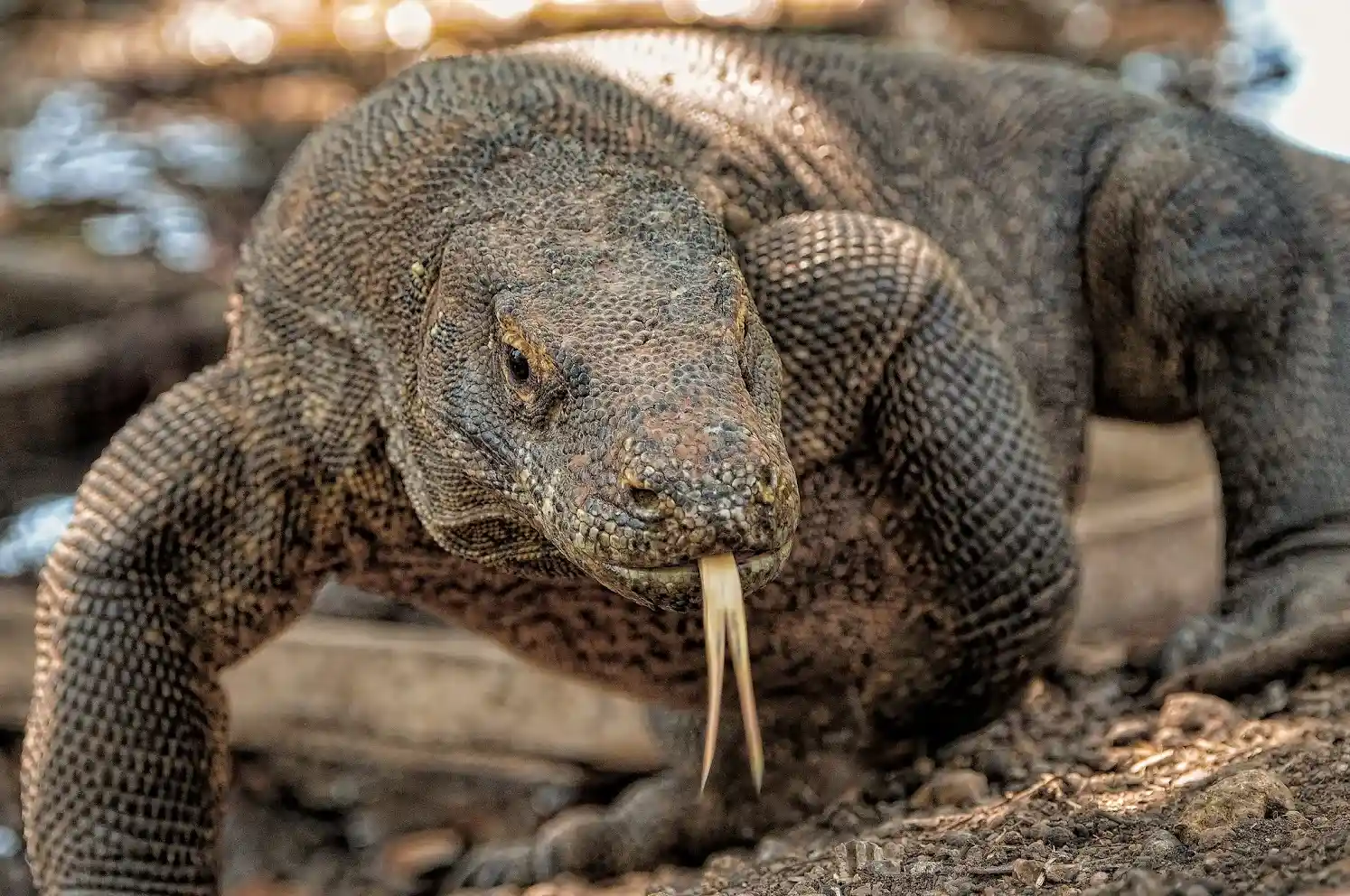
A Komodo dragon is an ectotherm. It cannot generate its own body heat, so after sunrise it lies in open ground to warm up, then moves off to patrol. That basking window is the reason morning landings work: sighting rates are highest from roughly 06:00 to 10:00, when the animals are exposed and slow.
By late morning the physics turn against you. Open savanna ground inside the park has been recorded above 50 °C on hot days, and a dragon that is warm enough stops posing. It moves into shade, under root systems, under the raised buildings at the ranger stations, or into a burrow. The animals are still there, simply out of sight, and no ranger will pull one into the open for a photograph.
A second, softer window opens in the late afternoon as the ground cools. It is real but harder to use, because most guests want the afternoon for Padar, Pink Beach or a dive. In practice the morning is the one worth protecting.
Protecting it is a scheduling problem, which is the strongest practical case for Komodo liveaboard itineraries that anchor inside the park overnight — or, for one group travelling together, a private yacht charter whose tender leaves the moment the station opens.
What do the rangers actually enforce?
You cannot walk any trail on Rinca or Komodo Island alone. Every trek is escorted, and the working ratio described consistently across the park is about one ranger to five visitors. Larger parties are split. This is not a formality; the ranger sets the pace, the route and the stopping distance, and the group walks in file behind him.
The rules that matter on the ground are short and they are enforced:
- Keep three to five metres of distance. That is the standard visitor guidance, and rangers hold the line in practice.
- Never run. Running reads as prey movement. A Komodo dragon can sprint far faster than you over short distances.
- No feeding, no touching, no provoking. Feeding wildlife is forbidden inside the park.
- Stay behind the ranger and stay together. Groups that spread out for photographs are the groups that get corrected.
- Declare an open wound or a period before you start. Rangers routinely ask. It is long-standing safety practice around a scent-driven predator rather than a published statute, and it costs nothing to mention quietly.
There is no universal minimum age. Families do go ashore, and the call is made between the ranger and your guide based on the child, the route and the day.
Why the ranger carries a forked stick
The forked wooden stick is a distance tool, not a weapon. It checks an approach and keeps an animal’s head away from the group, and it works because the ranger stands between you and the dragon. That geometry only holds if the group stays tight. Every ranger has a story about the guest who stepped around him for a better angle.
What responsible viewing means when the animal is wild
Rangers do not feed the dragons, and no legitimate operator arranges a baited sighting. If a boat promises a guaranteed close-up, ask exactly how that is produced. The honest version of this trip is that you arrive at the right hour, walk quietly, use a zoom lens instead of your feet, and accept that some mornings the savanna is empty. That is what a national park looks like when it works.
Rinca or Komodo Island: which ranger station?
Two stations take almost all visitors. Loh Buaya on Rinca sits in open savanna with elevated walkways around the station buildings, and is the closer of the two, with published hours of 06:00 to 18:00. Loh Liang on Komodo Island offers longer trekking options and Pink Beach nearby, but it is a considerably longer sail.
Distance shapes the decision. At phinisi cruising speed of 8 to 10 knots, Loh Buaya is roughly three hours from Labuan Bajo harbour and Loh Liang six or more; a fast speedboat cuts that to about an hour and about two to two and a half hours. Neither number is a problem if your boat is already anchored inside the park. Both are a problem if you start from the harbour at dawn.
| Loh Buaya (Rinca Island) | Loh Liang (Komodo Island) | |
|---|---|---|
| Sail time from Labuan Bajo, phinisi 8–10 kn | About 3 hours | 6 hours or more |
| Sail time by fast speedboat | About 1 hour | About 2–2.5 hours |
| Typical day-boat arrival | Around 08:30 | Late morning, often after a multi-stop run |
| Station hours | 06:00–18:00 | Daytime, ranger-led sessions |
| Terrain | Open savanna, raised walkways near the station | Longer trails, forest and ridge sections |
| Pairs naturally with | Kalong sunset, Padar the next morning | Pink Beach, Manta Point |
How charter timing beats the day-boat clock
Day boats out of Labuan Bajo leave in the dark and reach Loh Buaya at around 08:30, which is still a workable hour. Komodo Island is the harder one: after the longer crossing and one or two stops, day itineraries reach Loh Liang well into the morning, by which point the easy sightings have gone into shade.
A boat anchored inside the park the previous evening plays a different game. The tender leaves the swim platform as the station opens, and the crossing that would have cost you the morning happened overnight while everyone slept. On our routes that is typically 90 minutes to two hours more usable ranger-station time than a same-day run from the harbour.
It also thins the crowd, which matters for more than comfort: fewer people on a trail means less noise and animals behaving normally. That is the practical case for a Komodo liveaboard over a same-day return, and worth weighing before you compare a multi-day charter against a Komodo boat tour priced by the day.
Does the season change your odds?
It does, in ways most itineraries never mention. Mating runs roughly June to August, when males hold territory and spend more time in cover, and those are also the windiest weeks at sea. Nesting and egg-laying follow from about September to November, when females stay close to nest mounds. That makes them findable, and it is exactly the period when crowding does the most harm, so rangers hold groups further back. After nesting, the animals feed actively again.
The wider sailing season is April to November, when seas are calmest. None of this makes a sighting certain in any month; it moves the odds and the etiquette, not the outcome. Guests planning around a particular month usually want the pricing picture at the same time, which sits on the Komodo yacht charter pricing page.
Inside that window a multi-day Komodo sailing trip strings the dragon morning together with Padar and the manta channel, and guests starting from Bali can build the whole plan as a Komodo tour from Bali with one short flight.
Is it dangerous, and will you definitely see one?
Serious incidents involving guided visitors are rare. The record most often cited is 24 reported attacks on people between 1974 and 2012, five of them fatal, with the last fatality dated to 2009 and involving an unaccompanied local fisherman rather than a guided group. A 2017 bite involved a visitor who moved toward a feeding dragon against instructions. The pattern is consistent: risk sits with people who are alone or who ignore the ranger.
The bite is better understood than it used to be. Komodo dragons have venom glands in the lower jaw producing an anticoagulant effect, so the old “only mouth bacteria” story is incomplete. That changes nothing about your day. It is simply why the three-metre rule is not theatre.
And no, a sighting is not guaranteed, by us or anyone. Ranger stations are not enclosures. What an operator can promise is the right hour, a ranger-led walk, and enough time ashore that a slow start still has a second chance.
Where the ticket money goes, and why entry is dated
The Komodo dragon is listed as Endangered on the IUCN Red List, assessed in 2021. Park authority monitoring recorded 3,270 individuals across Komodo National Park in 2024, described as relatively stable. That stability is the product of active management, and visitor fees pay for part of it.
For 2026 the national park ticket is IDR 250,000 per international visitor per day (PP 36/2024 as displayed by the Balai) per person, about USD 40, and it is dated: valid for the calendar date printed on it, bought in advance rather than at the jetty, with visitor numbers managed day by day. This is the planning mistake we correct most often, because it means the dragon morning is fixed before you sail rather than decided over breakfast.
Booking behaviour reflects it. Enquiries typically reach us about two months before departure. Guests who want a specific week, a specific boat and a specific dated park entry are booking roughly two and a half months out.
How we plan a dragon morning
The operational version is unglamorous, and it is the whole trick:
- Anchor inside the park the evening before, not in Labuan Bajo.
- Tender ashore as the station opens, with park tickets already issued for that date.
- Brief on the deck before landing: walking order, distance, no running, no food ashore, cameras on silent.
- Water, closed shoes, hat, long trousers for the savanna grass.
- Short loop for families, longer loop for photographers, agreed with the ranger at the station.
- Back aboard before the mid-morning heat, with the rest of the day for Padar, Pink Beach or the manta channel.
Komodo Luxury has operated from Labuan Bajo since 2015 as PT Komodo Bahari Nusantara, with 9 owned and operated vessels plus more than 200 vetted partner yachts, so you book with the operator rather than a middleman. Guest feedback stands at 4.9 out of 5 from more than 1,500 verified guests across Google and TripAdvisor, and the listing holds TripAdvisor Travelers’ Choice for 2025 and 2026. Whole-boat charters run USD 1,800 to USD 30,000 per night, and most vessels marketing Komodo charters carry no published rate, so ours are quoted by our reservations desk in writing on request.
For the classic wooden option, see the luxury phinisi in Komodo page; if you are travelling as one group and want the schedule built around your dragon morning rather than a fixed departure, start with a private Komodo trip.
Before you book
Ask any operator three questions: where does the boat spend the night before the dragon walk, who buys the dated park ticket and for which date, and what happens if the savanna is quiet that morning. The answers tell you more than a brochure will.
If you would like us to check availability for a particular week, or to sanity-check an itinerary someone else has sent you, message us on WhatsApp at +62 811 3823 875 or write to [email protected]. We will tell you plainly whether the timing works.
Frequently Asked Questions
What time of day are Komodo dragons most active?
Early morning. Dragons are ectotherms, so they bask in the open after sunrise to warm up, which makes roughly 06:00 to 10:00 the strongest viewing window. By late morning they move into shade or burrows and sightings drop sharply. A softer second window opens in the late afternoon as the ground cools.
Do I have to walk with a ranger to see Komodo dragons?
Yes. Independent trekking is not permitted on Rinca or Komodo Island. Every walk is escorted, with a working ratio of roughly one ranger to five visitors, and larger parties are split. The ranger sets the route, the pace and the stopping distance, and the group walks in file behind him.
How close can you get to a Komodo dragon?
Visitor guidance is a minimum of three to five metres, and rangers enforce it in practice. Stay behind the ranger, keep the group tight and never step around him for a photograph. Use a zoom lens rather than your feet. Running is the one behaviour rangers react to immediately.
Rinca or Komodo Island: which is better for seeing dragons?
Both work, and neither guarantees a sighting. Loh Buaya on Rinca is closer, about three hours from Labuan Bajo at phinisi speed, with open savanna and station hours of 06:00 to 18:00. Loh Liang on Komodo Island offers longer trails but sits six hours or more away by sail.
Are the Komodo dragons fed or baited for tourists?
No. Feeding wildlife inside the national park is forbidden, and rangers do not bait dragons for visitors. The animals are free-roaming and hunt for themselves. Any operator promising a guaranteed close-up encounter should be asked exactly how that result is produced before you book.
Is a Komodo dragon sighting guaranteed?
No honest operator guarantees one. Ranger stations are not enclosures and the animals move. What raises your odds is landing in the first hours after the station opens, walking a longer loop when conditions allow, and having enough time ashore that a quiet start still has a second chance.
Are Komodo dragons venomous?
Yes. Komodo dragons have venom glands in the lower jaw that produce an anticoagulant effect, so the older explanation that the bite is purely bacterial infection is incomplete. Current science supports both venom and bacteria. In practice this is simply why the minimum-distance rule is taken seriously.
How much is the 2026 Komodo National Park ticket and when do I buy it?
The 2026 national park ticket is IDR 250,000 per international visitor per day (PP 36/2024 as displayed by the Balai), set under Government Regulation No. 36/2024 as displayed by the Balai (IDR 250,000 per international visitor per day, IDR 50,000 per Indonesian visitor per day), confirmed by our desk as its own line on your invoice, and it is a dated ticket valid only for the calendar date printed on it. It is purchased in advance rather than at the jetty. On a charter, we issue tickets for your confirmed landing date before you sail.
Travel status update: sailing from Labuan Bajo resumed the same day after the 15 August 2026 earthquake, and trips are running normally — see our live Labuan Bajo status page for first-hand updates.