






Última actualización: noviembre de 2025
The Komodo dragon, or Varanus komodoensis, is not just a giant lizard. It is the largest extant species of lizard, showcasing the incredible diversity of reptiles. This endemic animal of Indonesia carries an extraordinary evolutionary story, local cultural significance, and intriguing scientific mysteries. From the legends of the people of Flores to the debates among scientists about its origins, the Komodo dragon continues to be a symbol of the uniqueness of the Indonesian natural world. Let’s explore its long history and discover the best ways to witness it in its natural habitat!
Komodo Dragon History: When Was It First Discovered?
Although the Komodo dragon has lived for thousands of years in the Lesser Sunda Islands, it wasn’t until the early 20th century that the world learned about it. Adult Komodo dragons can reach a maximum length of 3 meters (10 feet) and weigh up to 150 kg (330 lb), making them an awe-inspiring sight. Local legends of the “ora” (the name for the Komodo dragon in the Manggarai language) reached the ears of the Dutch colonizers through a report by Lieutenant Steyn van Hensbroek in 1910. At that time, he heard tales of giant lizards on Komodo Island from local fishermen.
Not believing the stories, van Hensbroek decided to search for proof. He managed to spot an adult Komodo dragon and sent its skin to Peter Ouwens, the director of the Bogor Zoology Museum. Ouwens published the discovery in the scientific world in 1912 and named it Varanus komodoensis. Since then, the Komodo dragon has drawn global attention and was even dubbed “the last dinosaur” by the media.
Taxonomy & Scientific Name: Where Does the Komodo Dragon Fit?
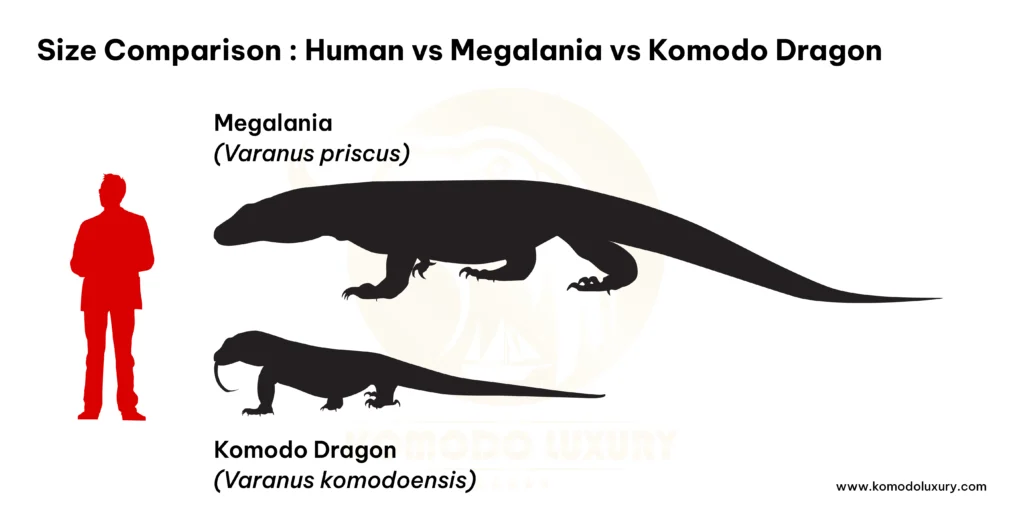
Comparación de tamaños: ser humano, Megalania, dragón de Komodo Komodo Luxury
The Komodo dragon belongs to the Varanidae family (monitor lizards), with close relatives like the Asian and Australian monitor lizards. Its scientific name, Varanus komodoensis, was given by Ouwens in honor of Komodo Island. These reptiles possess wide, flat heads, rounded snouts, and muscular tails, which contribute to their distinctive appearance. However, its taxonomy was once a subject of debate.
In the 1920s, scientists thought that the Komodo dragon was a subspecies of the extinct Australian giant lizard Megalania prisca, which went extinct about 50,000 years ago. However, DNA analysis has proven that the two are different, despite sharing a common ancestor. Today, the Komodo dragon is recognized as a unique species that evolved separately in Indonesia. As apex predators, they dominate their ecosystems, playing a crucial role in maintaining the balance of their habitats. Additionally, Komodo dragon saliva contains potentially harmful bacteria and possibly venomous properties, which play a crucial role in its hunting and predation strategies.
Read more: Komodo Dragon vs Megalania: Compating Two Giant Lizard of History
Evolutionary History: Where Did the Komodo Dragon Come From According to the Komodo Dragon’s Fossil Record?
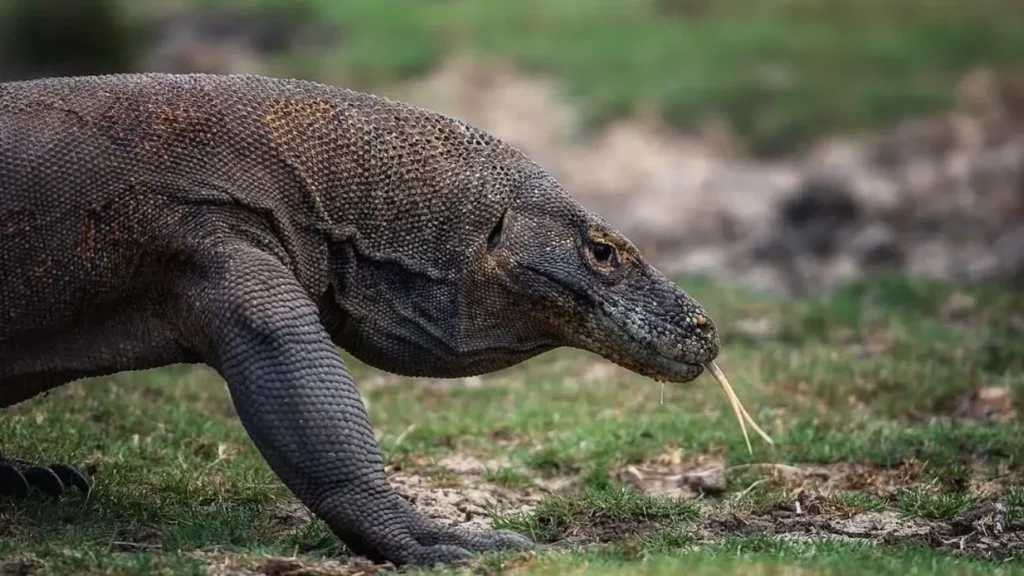
dragón de Komodo Isla de Komodo Komodo Luxury
Fossils and genetic studies have revealed the surprising evolutionary story of the Komodo dragon on the Indonesian island. Around 4 million years ago, its ancestors migrated from Australia to the Lesser Sunda Islands, using land bridges formed by the changing sea levels. On the islands of Flores, Rinca, and the surrounding areas, they evolved into apex predators. As the top of the food chain in their ecosystem, Komodo dragons play a crucial role in maintaining ecological balance by preying on a variety of animals. The diet of Komodo dragons mainly consists of Javan rusa (Rusa timorensis) and carrion, which sustains their role as dominant hunters. Their size adapted to the size of their prey, ranging from small lizards to ancient pygmy elephants (Stegodon).
Interestingly, a 2021 study by the Australian National University found that the modern Komodo dragon actually evolved in Indonesia, not directly “imported” from Australia. This opens up new debates about how Komodo dragons evolved to become the dominant predator on these islands. This opens up new debates about how this ancient creature managed to survive in such a harsh environment and become the dominant predator on these islands.
Komodo Dragon Origins: Is It Really From Australia?
Many scientists agree that the roots of the Komodo dragon trace back to Australia. The komodo dragon’s fossil record indicates that the species evolved in Australia and later spread to Indonesia. Studies and fossils found suggest that they lived alongside large animals, such as the marsupial lion, in Australasia. Then, about a million years ago, they crossed over to Indonesia, possibly due to land or sea level changes.
Some scientists believe that they began to thrive on the Indonesian islands, particularly in the Flores area and surrounding islands. However, there are many factors that make this theory fascinating. Their journey to Indonesia and how they managed to survive in such a harsh environment prove how uniquely adapted this species is. It also highlights that the evolutionary story of the Komodo dragon is different from many other species. The arrival of modern humans is believed to have impacted the Komodo dragon’s habitat, correlating with the decline of other large-bodied species.
Read more: Does the Komodo Dragon Live in Australia? Get the Facts and Explore Komodo Island!
Is the Komodo Dragon a Relative of Dinosaurs?
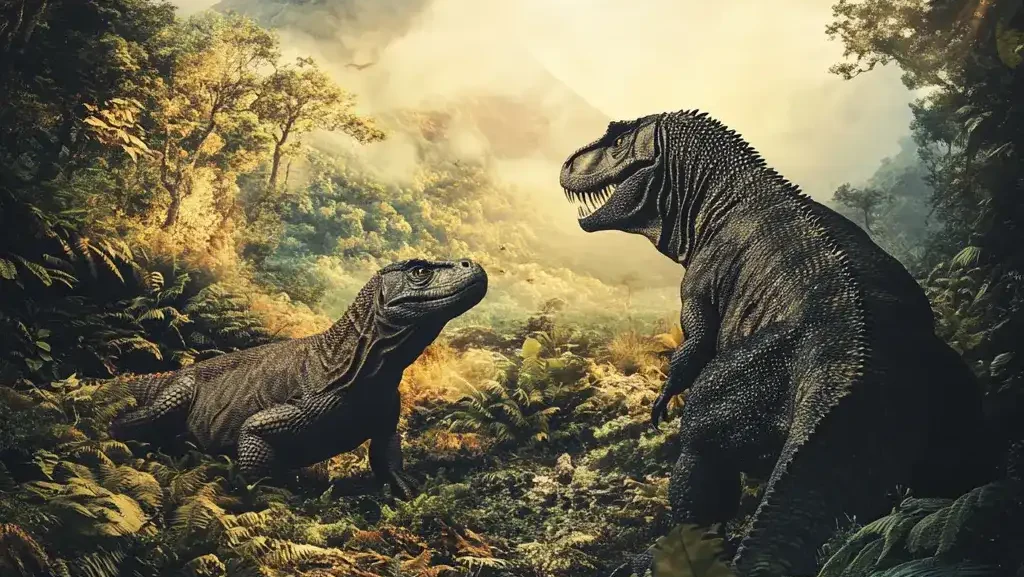
Komodo dragon vs Dinosaurus | Illustration | Komodo Luxury
Although often referred to as a “living dinosaur,” the Komodo dragon is not directly related to dinosaurs like the T-Rex or Brachiosaurus. Dinosaurs went extinct 66 million years ago, while the Varanidae family emerged only about 40 million years ago.
However, there are some adaptive similarities between Komodo dragons and dinosaurs. One example is their deadly bite, which contains harmful bacteria—similar to the idea of venom in dinosaurs. This phenomenon is known as convergent evolution, where two unrelated species develop similar traits due to similar environmental pressures. The venom of Komodo dragons also shows similarities to that of snakes, as both use venom as a hunting or defense mechanism against prey or threats. While the Komodo dragon isn’t a true dinosaur, it has evolved some survival traits that resemble those of ancient predators.
What Are the Myths and Cultural Significance of the Komodo Dragon?
While scientific studies reveal the Komodo dragon’s fascinating evolutionary history and its unique adaptations as an apex predator, there’s another side to this legendary creature, its deep-rooted place in local culture and folklore. For the Manggarai people of Flores, the Komodo dragon is more than just a giant lizard; it is a mystical being intertwined with human life and spirituality. According to their beliefs, Komodo dragons are considered twin siblings connected to humans, a bond that has encouraged a harmonious coexistence: locals traditionally avoid hunting the dragons, and in turn, the dragons rarely pose a threat to people.
This cultural perspective is part of the legend of the Komodo Dragon, where the giant lizard is also seen as a guardian of nature, capable of sensing bad intentions and maintaining the balance of the ecosystem. These myths have shaped local traditions, fostering respect for both the dragons and their environment. Today, these legends continue to captivate visitors, offering a unique perspective on how humans and Komodo dragons have coexisted for centuries, proving that the story of this giant lizard is as much cultural as it is evolutionary.
¿Cuáles son cinco datos interesantes sobre Dragones de Komodo?
While the Komodo dragon’s evolutionary history and cultural legends reveal its remarkable past and significance, there are also some fascinating biological and behavioral traits that make this giant lizard truly unique. Here are 5 interesting Komodo dragon facts that highlight their extraordinary adaptations and survival skills:
- El lagarto más grande del mundo: Dragones de Komodo adultos Dragones de Komodo alcanzar los 3 metros de longitud y pesar hasta 150 kg. Su enorme tamaño los convierte en los lagartos más grandes que existen en la actualidad y los hace fácilmente reconocibles.
- Depredador alfa: Dragones de Komodo en la cima de su cadena alimentaria, cazando ciervos y reptiles más pequeños, y alimentándose ocasionalmente de carroña. Sus poderosas extremidades, sus afiladas garras y sus agudos sentidos los convierten en cazadores muy eficaces en la naturaleza.
- Mordedura venenosa: estos lagartos tienen glándulas venenosas que liberan toxinas, y su saliva contiene bacterias nocivas. Esta combinación les ayuda a debilitar o inmovilizar a sus presas, lo que hace que la caza sea más eficaz.
- Partenogénesis: las hembras Dragones de Komodo reproducirse asexualmente sin necesidad de un macho, dando lugar a crías macho viables. Esta rara capacidad permite que las poblaciones se mantengan incluso en entornos aislados.
- Excepcional habilidad para nadar – Dragones de Komodo sorprendentemente bien, lo que les permite desplazarse entre las islas de su hábitat. Esta habilidad les ayuda a ampliar su territorio y a acceder a nuevos terrenos de caza por todo el archipiélago indonesio.
These Komodo Dragon facts provide a glimpse into their extraordinary biology and survival strategies, highlighting why they are considered one of the most impressive reptiles on the planet.
Read more: Komodo Dragon Myths vs Facts: You Won’t Believe What’s Actually True!
Komodo Dragon Habitat: Where Can Komodo Dragon Populations Be Found?
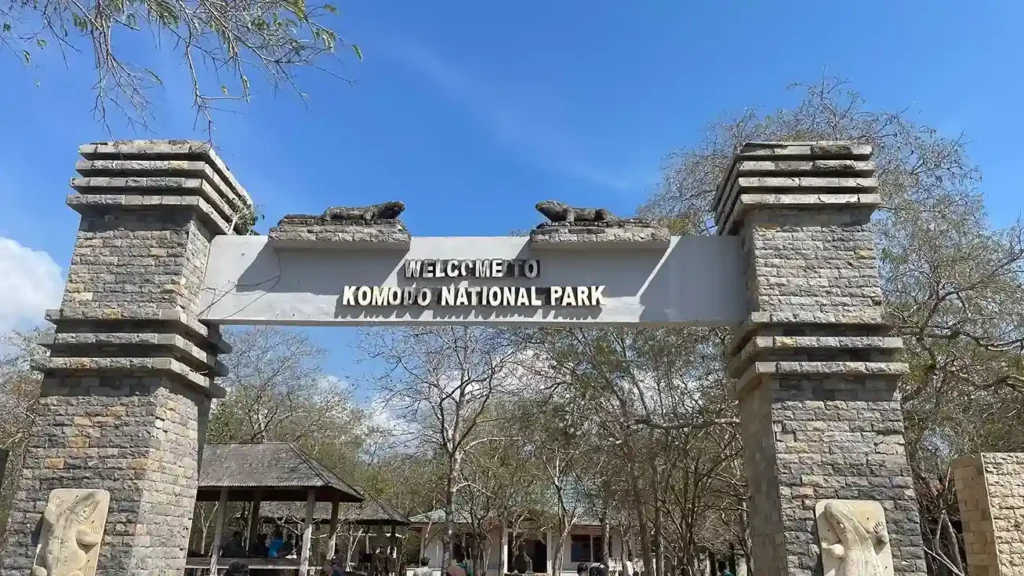
Parque Nacional de Komodo | Komodo Luxury
Komodo dragons live on five islands in Indonesia: Komodo, Rinca, Flores, Gili Motang, Nusa Kode, and Gili Dasami. They prefer dry savanna, tropical forest, and rocky coastlines. While they thrive in tropical forests, they can also be found in grasslands and scrubland habitats on these islands. The hot temperatures in the savanna help them hunt, as they rely on short bursts of speed to ambush their live prey in these environments.
Unfortunately, their natural habitat is threatened by climate change and human activities. Rising sea levels are a major threat to the habitat of Komodo dragons, further fragmenting and isolating their populations. However, efforts to protect them through Komodo National Park, a UNESCO World Heritage Site, have successfully preserved more than 80% of the world’s Komodo dragon population. This park is not just a sanctuary for the Komodo dragon, but also for other rare and endangered species.
Read more: Komodo Dragon Habitat: Where They Live and How to See Them
Conservation Status: Protecting the Komodo Dragon
The Komodo dragon is currently listed as a vulnerable species on the IUCN Red List, with its population facing threats from habitat loss, poaching, and human-wildlife conflict. Restricted to a few islands in Indonesia, the Komodo dragon’s population is fragmented and isolated, making conservation efforts crucial for its survival.
In response to these threats, the Indonesian government established the Komodo National Park in 1980, a UNESCO World Heritage Site that provides a sanctuary for over 1,700 Komodo dragons. The park’s efforts include habitat restoration, research, and education programs aimed at protecting the Komodo dragon and its environment. Additionally, the Komodo dragon is protected by international law under IUCN, which prohibits international trade of the species.
Conservationists and scientists are deeply concerned about the Komodo dragon’s future, emphasizing the importance of preserving its unique characteristics and adaptations. The loss of this iconic species would have significant ecological impacts, underscoring the need for continued conservation efforts. Protecting the Komodo dragon is not only about saving a single species but also about maintaining the biodiversity and natural habitats that are vital to our planet’s health. Interestingly, Komodo dragons can reproduce asexually through parthenogenesis, which results exclusively in male offspring.
Esto provoca una escasez de hembras y aumenta el riesgo de endogamia, lo que plantea retos adicionales para la genética de poblaciones y la supervivencia a largo plazo de la especie. Las investigaciones sobre Dragones de Komodo en cautividad Dragones de Komodo aportado datos valiosos sobre sus capacidades cognitivas y su adaptabilidad, aspectos fundamentales para comprender sus estrategias de supervivencia tanto en el medio natural como en entornos controlados. Una estrategia de supervivencia destacable es su capacidad para ingerir grandes cantidades de alimento en una sola comida, lo que les permite subsistir durante largos periodos en el medio natural.
Where Can You Safely See a Komodo Dragon in Komodo National Park?
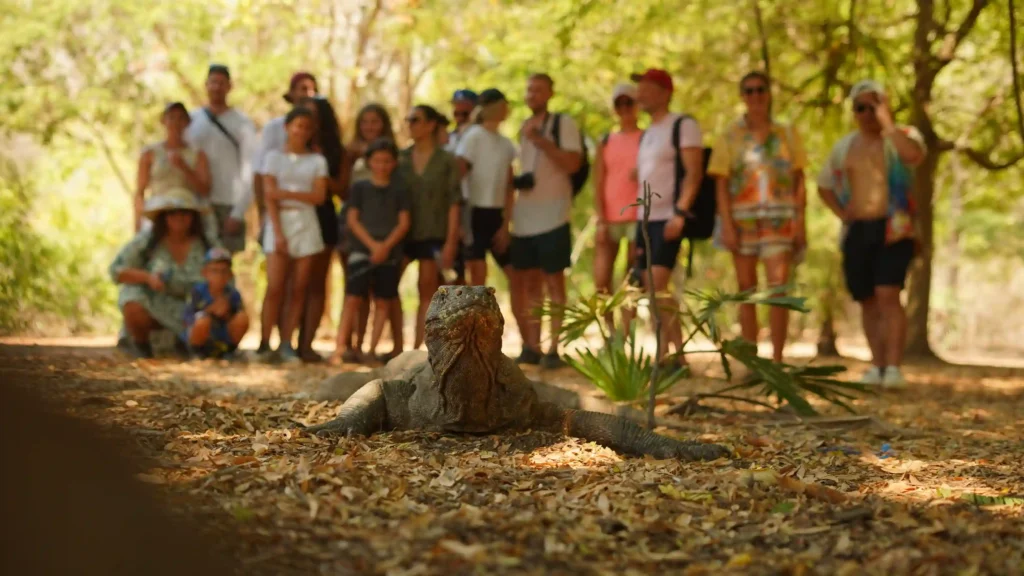
dragón de Komodo Isla de Komodo | Komodo Luxury
Although the Komodo dragon’s habitat is spread across several islands, the best places to see them safely are Komodo Island and Rinca Island. Both islands are part of the Komodo National Park, which is heavily protected. Here, visitors are accompanied by local guides who are experts in the behavior of Komodo dragons and ensure that you can observe them safely.
Gracias a la estricta normativa vigente, los visitantes pueden acercarse a los dragones sin temor a ser atacados, siempre y cuando respeten las normas. Estas dos islas cuentan con una población lo suficientemente numerosa de Dragones de Komodo, por lo que las posibilidades de encontrarse con uno son muy altas. Además, podrás disfrutar de impresionantes paisajes naturales, como hermosas playas y aguas cristalinas.
Leer Más: Isla de Komodo Rinca : ¿Cuál es la mejor para ver Dragones de Komodo?
Enjoy a Safe Adventure to See the Komodo Dragon with Komodo Luxury
For an adventure that’s not only exciting but also comfortable, Komodo Luxury offers complete tour packages to Komodo Island. Our tours include luxurious accommodations, experienced guides, and a strong focus on safety, allowing you to explore Komodo National Park with confidence.
One of the most iconic ways to experience this journey is through a luxury phinisi Komodo, where you can sail across the islands on a beautifully crafted traditional vessel combined with modern luxury amenities. This experience allows you to enjoy curated island routes, personalized service, and breathtaking ocean views, giving you a seamless way to explore the habitat of Komodo dragons while traveling in comfort and style.
Desde la Antigüedad hasta el turismo moderno
The Komodo dragon is a living testament to the wonders of evolution in Indonesia. From ancient migrations and unique adaptations to captivating cultural stories, the Komodo dragon deserves to be a national treasure. Seeing this “dragon” in person is not just an incredible experience, but also a valuable lesson in the power of nature and the biodiversity of Indonesia.
If you want to witness this once-in-a-lifetime experience, make sure to choose a trusted tour like , which combines safety, comfort, and education. Don’t miss out on the chance to see history unfold right in front of you. Book your Komodo Island tour today and witness the living history of the Komodo dragon!