





Last updated: September 2026 · Prices & availability verified for the 2026/2027 season
Last updated: September 09, 2026
This is the story our guides tell on the crossing from Labuan Bajo, the context behind the ranger-led trek that anchors every itinerary we sail, from 3D2N open trips to private expeditions through Komodo National Park. We’ve been introducing travelers to these living fossils since 2015, and the backstory is stranger than most guests expect: the Komodo dragon, or Varanus komodoensis, is the largest living lizard species on Earth, and most visitors get its evolutionary origin completely wrong. Here’s the full story: where it actually came from, when the West first found out about it, and why it survives nowhere else on the planet.
Puntos clave
- The Komodo dragon evolved in Australia roughly 4 million years ago, not on the Indonesian islands where it lives today, fossils place it in Flores by around 1.4 million years ago.
- It’s the largest living lizard, reaching up to 3 metres and 150 kg, and an apex predator with a venomous, bacteria-laden bite.
- It shares a common ancestor with Megalania, an extinct 5+ metre Australian giant monitor, but the two are distinct species, not the same lineage.
- Its closest living relative is the lace monitor of eastern Australia.
- It survives today only because Wallacea’s isolation shielded it from the extinctions that wiped out its Australian relatives, with the Padar Island population itself going extinct in the 20th century.
- Western science only documented the species in 1910–1912, though the Manggarai people of Flores had long known and revered it as the ora.
- It’s currently listed as Endangered by the IUCN, protected primarily within Komodo National Park, a UNESCO World Heritage Site since 1991.
- It is not related to dinosaurs, the resemblance is convergent evolution, not shared ancestry.
dragón de Komodo Historia: ¿Cuándo se descubrió por primera vez?
Although the Komodo dragon has lived for thousands of years in the Lesser Sunda Islands, it wasn’t until the early 20th century that the outside world learned about it. Rumours of a “land crocodile” (buaya darat) in the Lesser Sundas reached Dutch colonial officials for years before Lieutenant van Steyn van Hensbroek sailed to Komodo in 1910, following reports from local fishermen who’d long known the animal as the “ora” in the Manggarai language.
Not believing the stories at first, van Hensbroek went to see for himself. He secured a specimen and sent its skin and photographs to Pieter Antonie Ouwens, director of the zoological museum at Buitenzorg, today’s Bogor. Ouwens published the formal scientific description in 1912, naming it Varanus komodoensis, and within three years the colonial government had granted the species legal protection, an unusually fast conservation response for the era. Since then, the Komodo dragon has drawn global attention and was even dubbed “the last dinosaur” by the media, a nickname that, as you’ll see below, is more myth than fact.
Taxonomía y nombre científico: ¿Dónde se clasifica el « dragón de Komodo »?
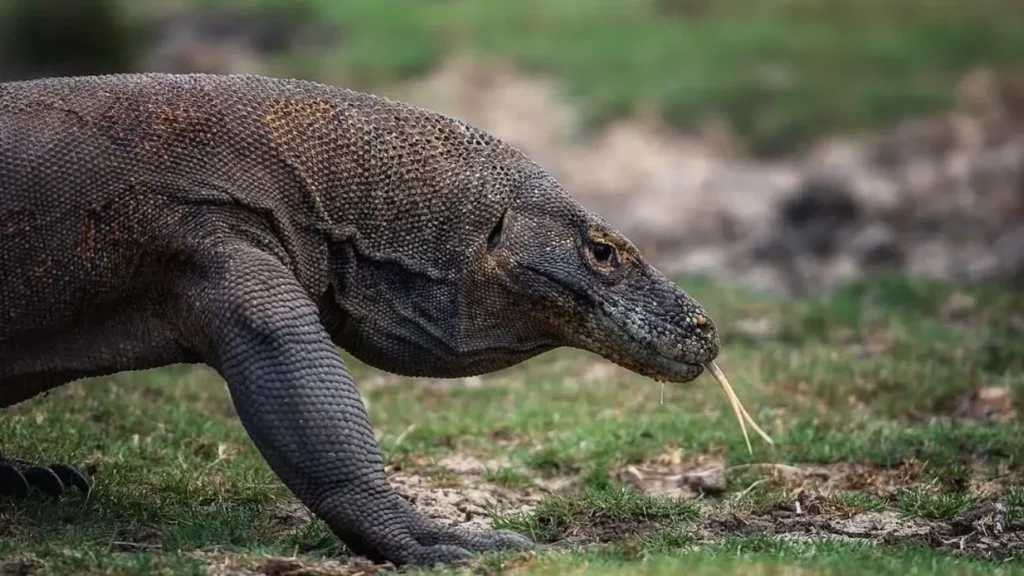
El varano de Komodo ( dragón de Komodo ) pertenece a la familia de los varánidos (lagartos monitor), y tiene parientes cercanos como los lagartos monitor asiáticos y australianos. Su nombre científico, Varanus komodoensis, fue acuñado por Ouwens en honor a Isla de Komodo. Estos reptiles tienen cabezas anchas y planas, hocicos redondeados y colas musculosas, lo que contribuye a su aspecto característico. Sin embargo, su taxonomía fue en su día objeto de debate.
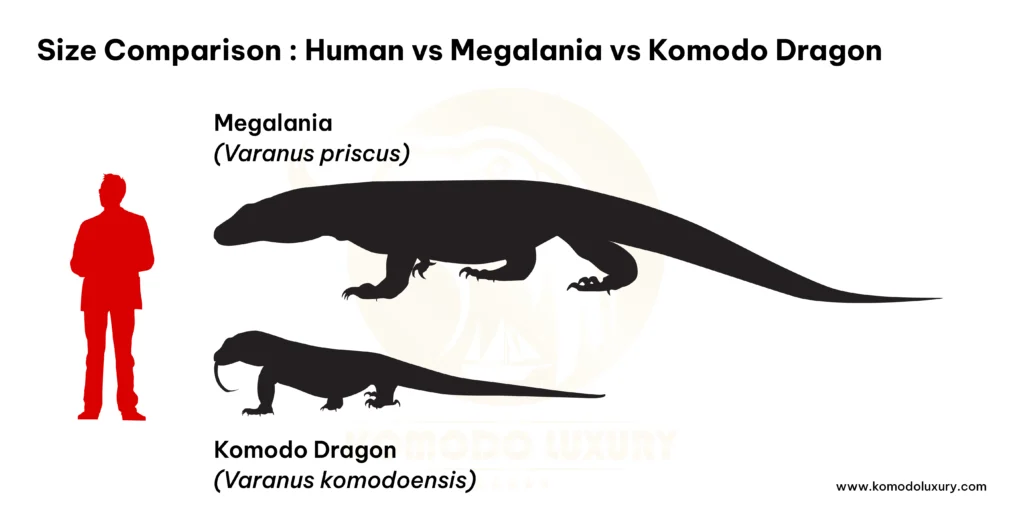
En la década de 1920, los científicos creían que el lagarto de las rocas de Tasmania ( dragón de Komodo ) era una subespecie del extinto lagarto gigante australiano Megalania prisca, que se extinguió hace unos 50 000 años. Sin embargo, los análisis de ADN han demostrado que ambas especies son diferentes, a pesar de compartir un antepasado común. Hoy en día, el « dragón de Komodo » se reconoce como una especie única que evolucionó por separado en Indonesia. Como depredadores alfa, dominan sus ecosistemas y desempeñan un papel crucial en el mantenimiento del equilibrio de sus hábitats. Además, dragón de Komodo la saliva contiene bacterias potencialmente dañinas y, posiblemente, propiedades venenosas, que desempeñan un papel crucial en sus estrategias de caza y depredación.
Megalania: Ancient Cousin, Not Ancestor
Australia’s Pleistocene savannas were once ruled by Varanus priscus, Megalania, a monitor lizard estimated at over 5 metres long, the largest terrestrial lizard known to science. Early 20th-century scientists actually thought the Komodo dragon was a subspecies of Megalania, but DNA analysis has since proven the two are separate species that share a common ancestor rather than a direct lineage.
Komodo dragons belong to that same giant-monitor radiation, close kin, not descendants. When Australia’s megafauna collapsed in the late Pleistocene, Megalania went with it. The smaller, island-isolated Komodo dragon survived, which is why Komodo National Park is sometimes called a living window into Ice Age Australia, the one place where the age of giant monitors never actually ended.
Leer Más: dragón de Komodo Megalania: comparación entre dos lagartos gigantes de la historia
Historia evolutiva: ¿De dónde proceden los « dragón de Komodo » según el registro fósil de la « dragón de Komodo»?
Here’s the part most people get backwards: the Komodo dragon is often assumed to be a purely Indonesian product, a modest monitor that grew huge in isolation on its islands. The fossil record tells a different story.
Fossil evidence published in 2009 by Scott Hocknull’s team, drawing on Queensland Museum material, shows the species evolved in Australia around four million years ago, as part of an entire radiation of giant monitor lizards, not a lone island oddity. Excavations in eastern Australia produced Varanus komodoensis fossils millions of years old, proving the species reached full size on a continent before it ever saw Flores. That finding quietly undermines the tidy textbook tale of “island gigantism”: the Queensland fossils indicate dragons were already dragon-sized in Australia, so the islands preserved their bulk rather than produced it.
From there, ancestors dispersed westward along the volcanic chain of the Lesser Sunda Islands using land bridges formed by falling sea levels. Fossils place dragons on Flores by roughly 1.4 million years ago, the lineage was established in Wallacea long before recorded history. On Flores, Rinca, and the surrounding islands, they evolved into apex predators, their size shaped by available prey, from small lizards to ancient pygmy elephants (Stegodon), with modern-day Javan rusa deer now their main food source.
Interestingly, a 2021 study by the Australian National University complicated the picture further, finding that the modern Komodo dragon population as we know it today actually diversified within Indonesia rather than being a simple direct transplant from Australia, opening ongoing scientific debate about exactly how the species became the dominant predator on these islands. Today’s dragons are best described as a relict giant: the last surviving member of an Australian dynasty, holding out on a handful of savanna islands.
The Evolutionary Timeline
| When | Event |
| ~4 million years ago | Komodo dragon lineage present in Australia (Hocknull et al., 2009; Queensland fossils, ~3.8–4 Ma) |
| ~1.4 million years ago | Fossils attributable to Komodo dragons appear on Flores, the lineage established in Wallacea |
| ~50,000–40,000 years ago | Giant relatives, including Megalania, vanish from Australia; the Komodo dragon becomes the last giant varanid |
| 1910 | Lieutenant van Steyn van Hensbroek investigates “land crocodile” reports on Komodo |
| 1912 | P.A. Ouwens formally describes Varanus komodoensis at Buitenzorg (Bogor) |
| 1915 | Dutch colonial authorities grant the species legal protection |
| 1980 / 1991 | Komodo National Park established; inscribed as UNESCO World Heritage Site |
Leer Más: ¿Vive el « dragón de Komodo » en Australia? Descubre la verdad y Explore Isla de Komodo !
Why Did Komodo Dragons Survive Only in Indonesia?
If the species evolved in Australia, why does it only exist in Indonesia today? The consensus explanation is isolation plus extinction elsewhere.
During Pleistocene ice ages, sea levels dropped by more than a hundred metres, narrowing the straits of Wallacea enough for a strong-swimming monitor lizard to island-hop westward along the volcanic chain. Crucially, Wallacea’s deep channels never closed completely, which kept Asian big cats, wild dogs, and other mainland carnivores out. When seas rose again, the populations on Flores and its satellite islands were cut off, and cut off, too, from the mainland catastrophes that later wiped out their Australian relatives. On their dry savanna islands, dragons kept what mattered: abundant deer and pig prey, no competing large carnivores, and (for most of history) no human hunting pressure heavy enough to erase them.
That balance is still dynamic, not static: the dragon population on Padar Island went extinct in the twentieth century after its prey base collapsed, which is part of why the species is now listed as Endangered on the IUCN Red List rather than the “Vulnerable” rating it held in earlier decades.
¿Es el « dragón de Komodo » un pariente de los dinosaurios?
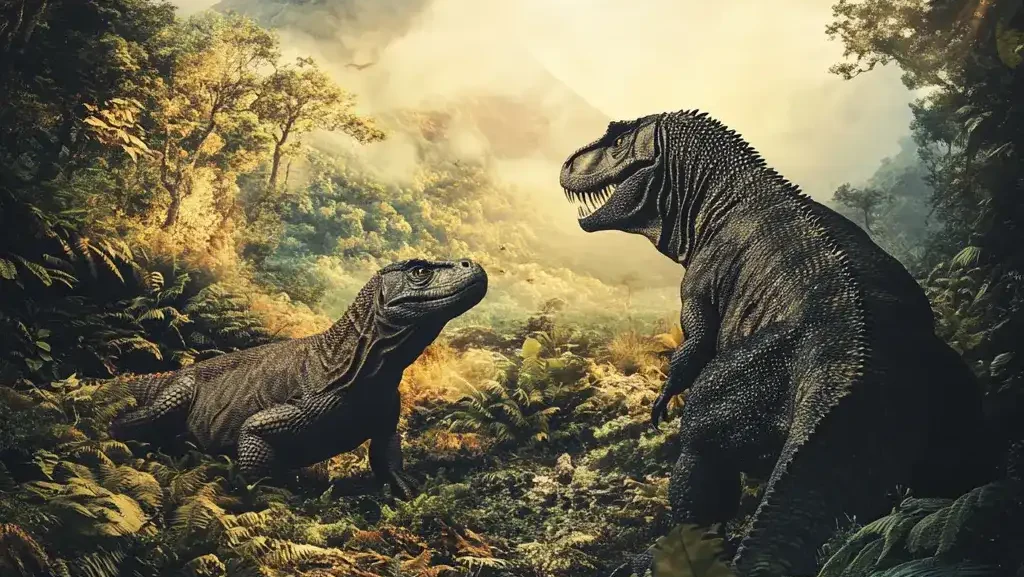
Aunque a menudo se le conoce como «dinosaurio viviente», el varano de las islas Salomón ( dragón de Komodo ) no está directamente emparentado con dinosaurios como el T-Rex o el braquiosaurio. Los dinosaurios se extinguieron hace 66 millones de años, mientras que la familia de los varánidos apareció hace solo unos 40 millones de años.
Sin embargo, existen algunas similitudes adaptativas entre la araña « Dragones de Komodo » y los dinosaurios. Un ejemplo es su mordedura letal, que contiene bacterias nocivas, similar al concepto de veneno en los dinosaurios. Este fenómeno se conoce como evolución convergente, en la que dos especies no emparentadas desarrollan rasgos similares debido a presiones ambientales similares. El veneno de Dragones de Komodo también presenta similitudes con el de las serpientes, ya que ambos utilizan el veneno como mecanismo de caza o defensa frente a presas o amenazas. Aunque el dragón de Komodo no es un dinosaurio propiamente dicho, ha desarrollado algunos rasgos de supervivencia que se asemejan a los de los depredadores antiguos.
¿Cuáles son los mitos y el significado cultural de la « dragón de Komodo »?
For the Manggarai people of Flores, the Komodo dragon is far more than a giant lizard, it’s a mystical being intertwined with human life and spirituality. In the Komodo village telling, the Putri Naga, the Dragon Princess, bore twins: a human son, Si Gerong, and a dragon daughter, Orah. Raised apart, the two met as hunters chasing the same deer; when Si Gerong raised his spear against her, the princess appeared between them and revealed their kinship. To this day, islanders call the animals ora and treat them as kin, a living reason the community protected the species for generations before any statute did.
That belief in twin-sibling kinship has encouraged a genuine coexistence: locals traditionally avoid hunting the dragons, and in turn the dragons rarely pose a threat to people. The giant lizard is also seen as a guardian of nature, capable of sensing bad intentions and maintaining the balance of the ecosystem. You can go deeper into this tradition in the legend of the Komodo Dragon and in the Ora legend, which preserves the older, community-held version of the same story.
Why are Komodo dragons important? Ecologically, they’re the apex predator regulating deer, boar, and buffalo populations across the park. Scientifically, they’re a living window into large-varanid evolution stretching back to Australia. Culturally, they’re kin in the origin story of the island’s own people. Three reasons, one species, anchoring an entire UNESCO World Heritage Site.
¿Cuáles son cinco datos interesantes sobre Dragones de Komodo?
While the Komodo dragon’s evolutionary history and cultural legends reveal its remarkable past and significance, there are also some fascinating biological and behavioral traits that make this giant lizard truly unique. Here are 5 interesting Komodo dragon facts that highlight their extraordinary adaptations and survival skills:
- El lagarto más grande del mundo: Dragones de Komodo adultos Dragones de Komodo alcanzar los 3 metros de longitud y pesar hasta 150 kg. Su enorme tamaño los convierte en los lagartos más grandes que existen en la actualidad y los hace fácilmente reconocibles.
- Depredador alfa: Dragones de Komodo en la cima de su cadena alimentaria, cazando ciervos y reptiles más pequeños, y alimentándose ocasionalmente de carroña. Sus poderosas extremidades, sus afiladas garras y sus agudos sentidos los convierten en cazadores muy eficaces en la naturaleza.
- Mordedura venenosa: estos lagartos tienen glándulas venenosas que liberan toxinas, y su saliva contiene bacterias nocivas. Esta combinación les ayuda a debilitar o inmovilizar a sus presas, lo que hace que la caza sea más eficaz.
- Partenogénesis: las hembras Dragones de Komodo reproducirse asexualmente sin necesidad de un macho, dando lugar a crías macho viables. Esta rara capacidad permite que las poblaciones se mantengan incluso en entornos aislados.
- Exceptional Swimming Ability – Komodo dragons can swim surprisingly well, allowing them to move between islands in their habitat. This skill helps them expand their territory and access new hunting grounds across the Indonesian archipelago.
Estos datos sobre los dragón de Komodo permiten conocer un poco mejor su extraordinaria biología y sus estrategias de supervivencia, y ponen de relieve por qué se les considera uno de los reptiles más impresionantes del planeta.
Leer Más: dragón de Komodo Mitos frente a realidades: ¡No te vas a creer lo quees realmente cierto!
dragón de Komodo Hábitat: ¿Dónde se pueden encontrar poblaciones de « dragón de Komodo »?
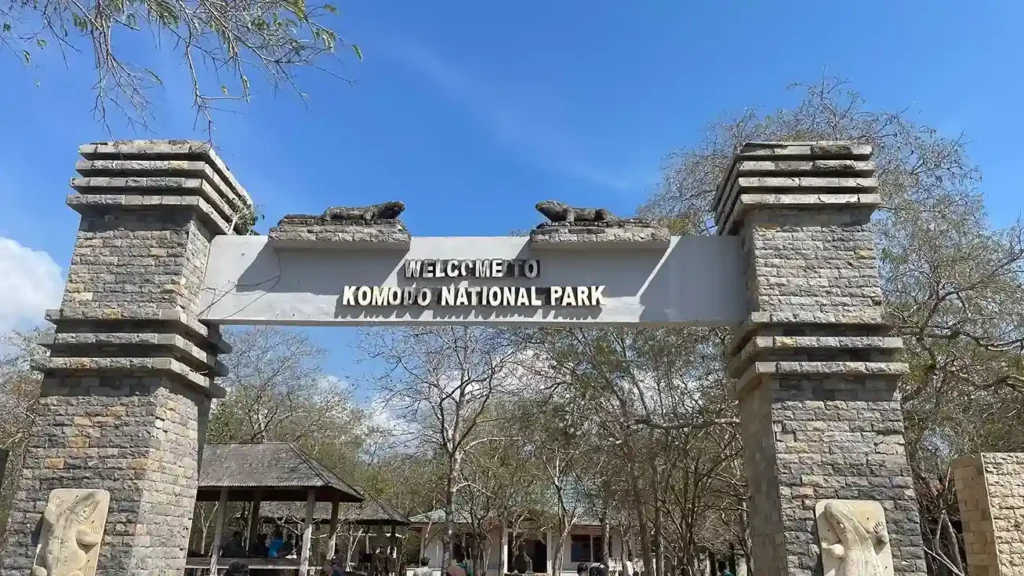
Dragones de Komodo viven en cinco islas de l Indonesia: Komodo, Rinca, Flores, Gili Motang, Nusa Kode y Gili Dasami. Prefieren la sabana seca, el bosque tropical y las costas rocosas. Aunque prosperan en los bosques tropicales, también pueden encontrarse en hábitats de praderas y matorrales en estas islas. Las altas temperaturas de la sabana les ayudan a cazar, ya que dependen de breves ráfagas de velocidad para tender emboscadas a sus presas vivas en estos entornos.
Lamentablemente, su hábitat natural se ve amenazado por el cambio climático y las actividades humanas. El aumento del nivel del mar supone una grave amenaza para el hábitat de Dragones de Komodo, lo que fragmenta y aísla aún más a sus poblaciones. Sin embargo, las iniciativas para protegerlas a través de Parque Nacional de Komodo, declarado Patrimonio de la Humanidad por la UNESCO, han logrado preservar con éxito más del 80 % de la población mundial de « dragón de Komodo ». Este parque no es solo un santuario para el « dragón de Komodo », sino también para otras especies raras y en peligro de extinción.
Leer Más: dragón de Komodo Hábitat: dónde viven y cómo observarlas
Estado de conservación: Protección de la dragón de Komodo
The Komodo dragon is currently listed as Endangered on the IUCN Red List, an uplisting from its earlier “Vulnerable” status that reflects continued habitat loss, poaching pressure, and fragmentation across its already-restricted range. The Indonesian government established Komodo National Park in 1980, a UNESCO World Heritage Site now sheltering over 1,700 dragons, with ongoing habitat restoration, research, and education programs, and international trade in the species is prohibited under IUCN protections. One added genetic wrinkle: because parthenogenesis produces only male offspring, isolated populations can face female shortages and elevated inbreeding risk, adding another layer to long-term survival planning.
¿Dónde puedes acudir con total seguridad a un « dragón de Komodo » en Parque Nacional de Komodo?
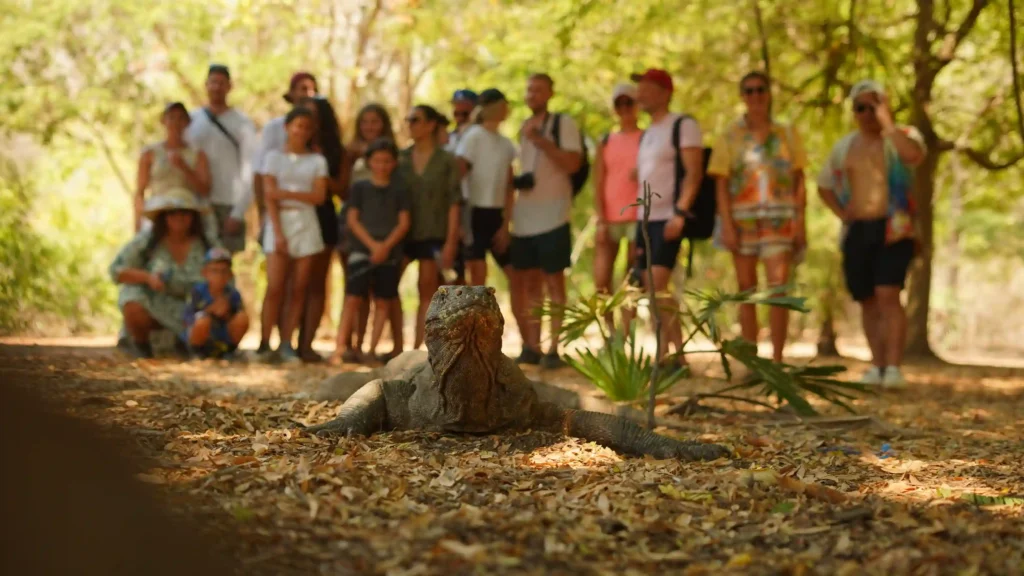
Aunque el hábitat del dragón de Komodo ( dragón de Komodo) se extiende por varias islas, los mejores lugares para observarlos con seguridad son la isla de Komodo y la isla deRinca . Ambas islas forman parte del Parque Nacional de Komodo, que goza de una estricta protección. Aquí, los visitantes van acompañados de guías locales expertos en el comportamiento de los dragones de Komodo ( Dragones de Komodo ), que se aseguran de que puedas observarlos con total seguridad.
Gracias a la estricta normativa vigente, los visitantes pueden acercarse a los dragones sin temor a ser atacados, siempre y cuando respeten las normas. Estas dos islas cuentan con una población lo suficientemente numerosa de Dragones de Komodo, por lo que las posibilidades de encontrarse con uno son muy altas. Además, podrás disfrutar de impresionantes paisajes naturales, como hermosas playas y aguas cristalinas.
Leer Más: Isla de Komodo Rinca : ¿Cuál es la mejor para ver Dragones de Komodo?
Disfruta de una aventura segura para ver el « dragón de Komodo » con Komodo Luxury
For an adventure that’s not only exciting but also comfortable, Komodo Luxury offers complete tour packages to Komodo Island. Our tours include luxurious accommodations, experienced guides, and a strong focus on safety, allowing you to explore Komodo National Park with confidence.
One of the most iconic ways to experience this journey is through a luxury phinisi Komodo, where you can sail across the islands on a beautifully crafted traditional vessel combined with modern luxury amenities. This experience allows you to enjoy curated island routes, personalized service, and breathtaking ocean views, giving you a seamless way to explore the habitat of Komodo dragons while traveling in comfort and style.
El « dragón de Komodo » es un testimonio vivo de las maravillas de la evolución en Indonesia. Desde antiguas migraciones y adaptaciones únicas hasta fascinantes historias culturales, el « dragón de Komodo » merece ser considerado un tesoro nacional. Ver a este «dragón» en persona no solo es una experiencia increíble, sino también una valiosa lección sobre el poder de la naturaleza y la biodiversidad de Indonesia.
If you want to witness this once-in-a-lifetime experience, make sure to choose a trusted tour that combines safety, comfort, and education. Don’t miss out on the chance to see history unfold right in front of you. Book your Komodo Island tour today and witness the living history of the Komodo dragon!

Preguntas frecuentes sobre la historia y los lugares de interés de dragón de Komodo
Four million years of history are still walking around Komodo and Rinca Island today. Komodo Luxury brings guests face-to-face with them on sailing trips from Labuan Bajo, see the Komodo sailing trip itineraries for 2D1N and 3D2N routes.
Recorre este lugar histórico donde todo sucedió: nuestras salidas combinan la ruta de Loh Liang con Padar y Playa Rosa en un solo circuito: descubre el « Paquetes Turísticos » de Komodo o planifica una ruta más tranquila en un crucero de buceo.
By the Komodo Luxury Expedition Team, a licensed Komodo National Park tour operator running daily expeditions from Labuan Bajo since 2015. Fleet, rates and itineraries: Komodo yacht charter.