




Last updated: September 2026 · Prices & availability verified for the 2026/2027 season
Last updated: September 10, 2026
Everything in this guide is field-checked on the ranger-guided dragon treks that anchor every itinerary we sail — from the 3D2N open trip to two-week private expeditions through Komodo National Park.
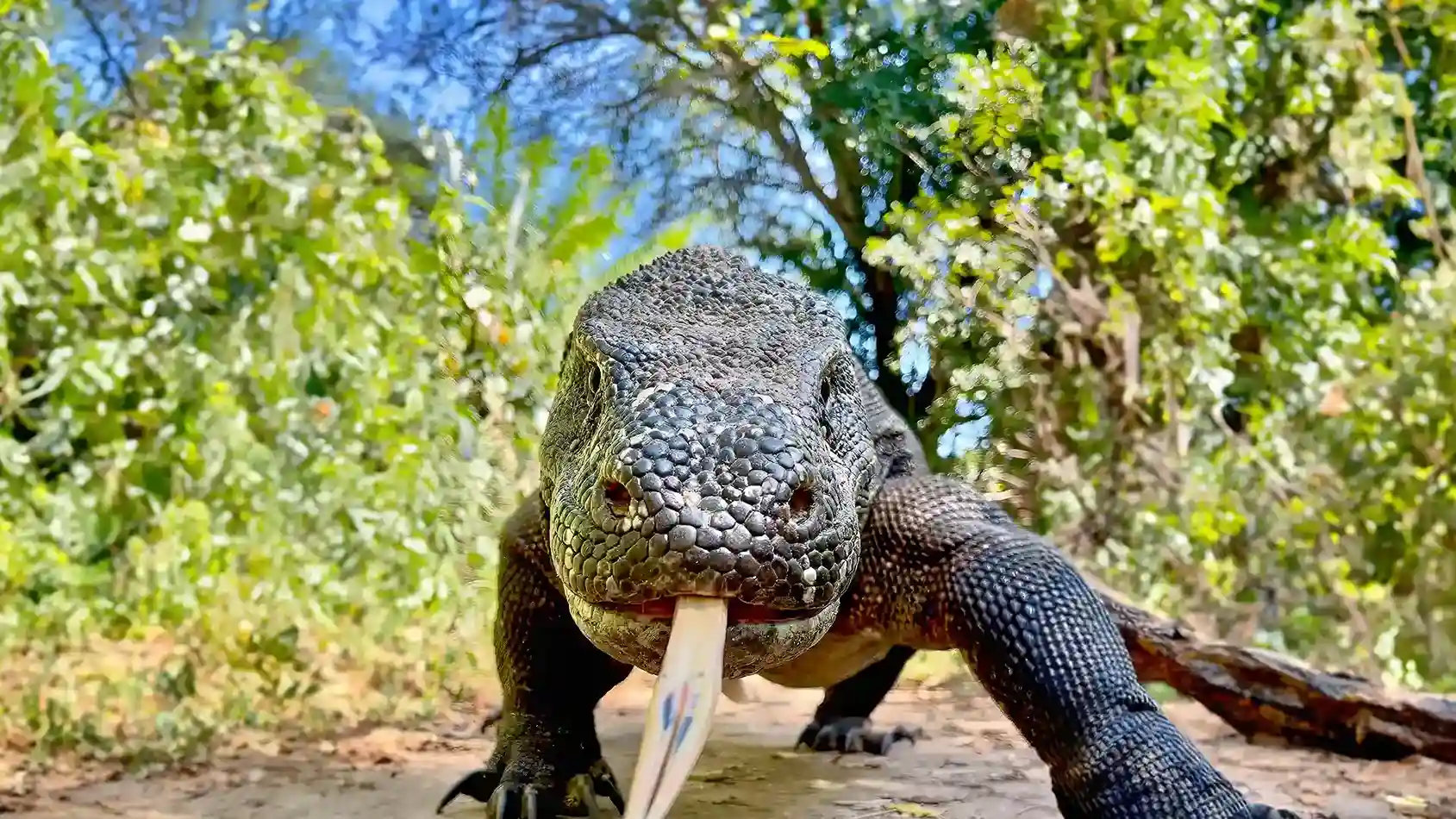
Komodo dragon (Varanus komodoensis) is not just the world’s largest living lizard—it’s a living relic from prehistoric times, a venomous apex predator, and one of Indonesia’s most extraordinary natural treasures. Found exclusively on a handful of Indonesian islands, these ancient reptiles have captivated scientists, conservationists, and travelers for over a century.
As operators of luxury Komodo Island tours with 10 years of experience, we at Komodo Luxury have guided thousands of visitors safely through encounters with these magnificent creatures in their natural habitat. This comprehensive guide draws from our first-hand experience, scientific research, and collaboration with Komodo National Park rangers to provide you with everything you need to know about Komodo dragons.
Key Takeaways
- The Komodo dragon is the world’s largest living lizard, with a verified record of 3.13 m and 166 kg, though most adults average 2.5–3 m and 70–90 kg.
- It has a confirmed venom gland (Fry et al., 2009) that secretes anticoagulant toxins, not just bacteria-laden saliva, as long believed.
- It’s found on only five Indonesian islands (Komodo, Rinca, Flores, Gili Motang, Nusa Kode), the result of millions of years of geographic isolation after its ancestors migrated from Australia.
- The IUCN’s 2021 reassessment moved it from Vulnerable to Endangered, counting roughly 1,383 mature individuals across eight fragmented subpopulations.
- Human attacks are rare and largely preventable, the recorded fatality count over decades is in the single digits, provided visitors follow ranger guidance and keep a safe distance.
Komodo Dragon at a Glance
| Attribute | Data |
|---|---|
| Scientific name | Varanus komodoensis (family Varanidae, order Squamata) |
| Average adult size | Males 2.59 m / 79–91 kg; females 2.29 m / 68–73 kg (Guinness data) |
| Largest verified specimen | 3.13 m, 166 kg (Smithsonian National Zoo record) |
| Top speed | 18–20 km/h in short bursts |
| Lifespan | ~30 years in the wild; documented captives to ~33 years |
| Wild range | Komodo, Rinca, Gili Motang, Nusa Kode, and western/northern Flores |
| Population | ~1,383 mature individuals (IUCN 2021); ~3,400 counted incl. juveniles |
| Conservation status | Endangered (IUCN Red List, reassessed 2021); protected in Indonesia since 1915 |
| Described to science | 1912, by P.A. Ouwens, after 1910 field reports |
Why Komodo Dragons Matter
Komodo dragons represent more than just a tourist attraction. They are:
- Evolutionary marvels with a lineage stretching back millions of years
- Apex predators that maintain ecosystem balance in their island habitats
- Conservation priorities listed as Vulnerable on the IUCN Red List
- Cultural icons deeply embedded in local Manggarai traditions
- Scientific wonders that continue to reveal new insights about reptilian biology
Whether you’re planning a visit to Komodo National Park, researching for academic purposes, or simply fascinated by these “living dinosaurs,” this guide provides authoritative, experience-based information you won’t find anywhere else.
What is a Komodo Dragon?
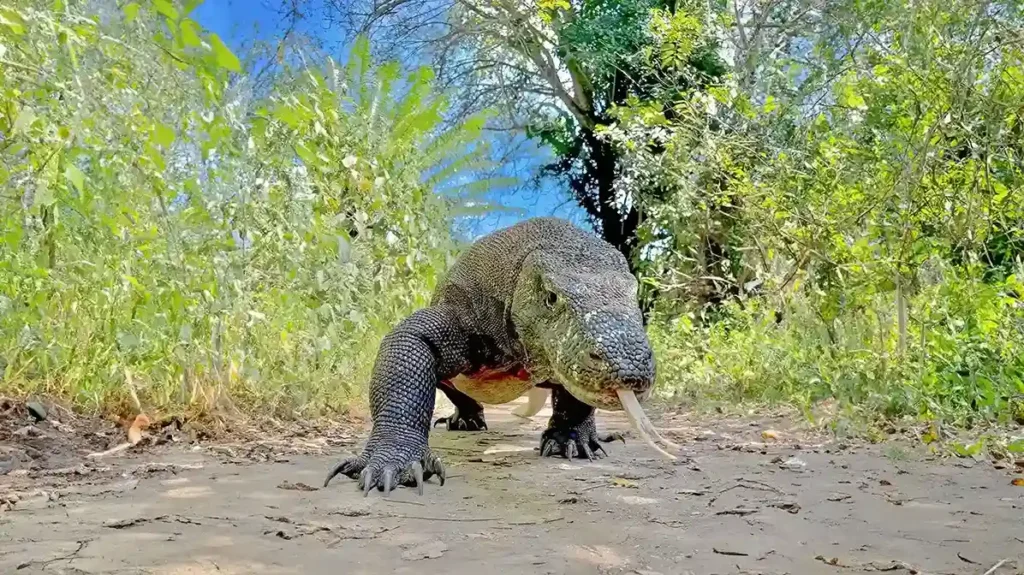
Komodo dragons belong to the family Varanidae, which includes all monitor lizards. Here’s their complete taxonomic classification:
| Taxonomic Rank | Classification |
| Kingdom | Animalia |
| Phylum | Chordata |
| Class | Reptilia |
| Order | Squamata |
| Family | Varanidae |
| Genus | Varanus |
| Species | V. komodoensis |
Common names include Komodo dragon, Komodo monitor, and ora (the local name).
Komodo Dragon Facts
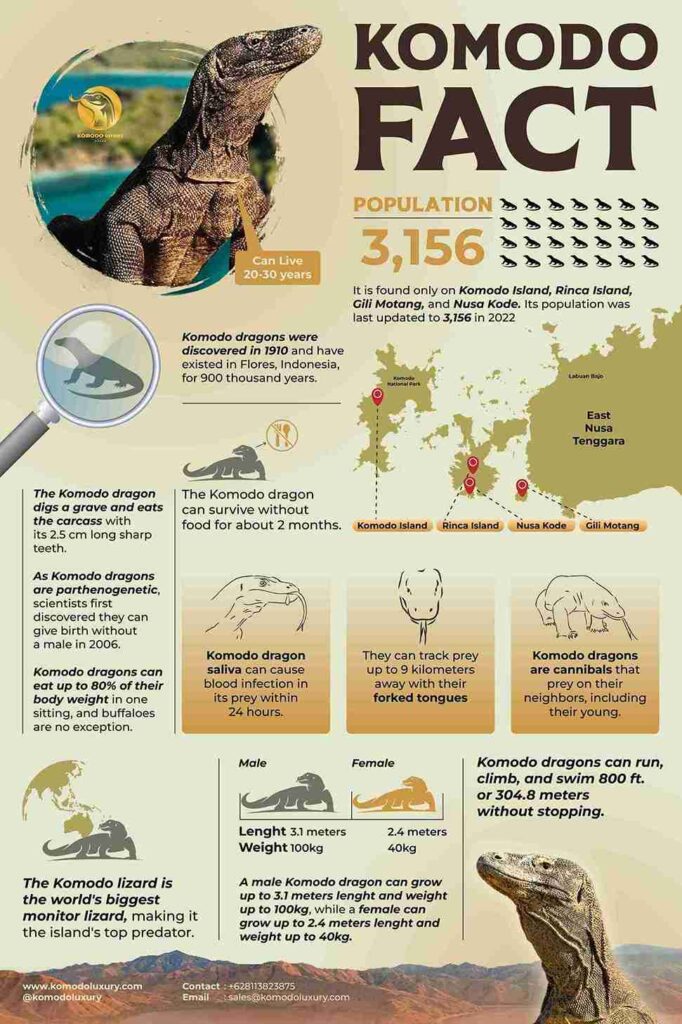
Here’s a glance at the essentials of Komodo dragon facts:
- Largest living lizard on Earth
- Maximum length: 3 meters (10 feet), average: 2-2.5 meters
- Maximum weight: 150 kg (330 lbs), average: 70-90 kg
- Lifespan: 30-50 years in the wild
- Conservation status: Vulnerable (IUCN Red List)
- Wild population: Approximately 5,700
- Diet: Carnivorous (deer, wild boar, water buffalo, carrion)
- Venom: Yes, contains anticoagulant proteins
- Speed: Up to 20 km/h in short bursts
- Swimming ability: Can swim up to 400 meters between islands
- Reproduction: Sexual and asexual (parthenogenesis)
Komodo Dragon Size & Physical Characteristics
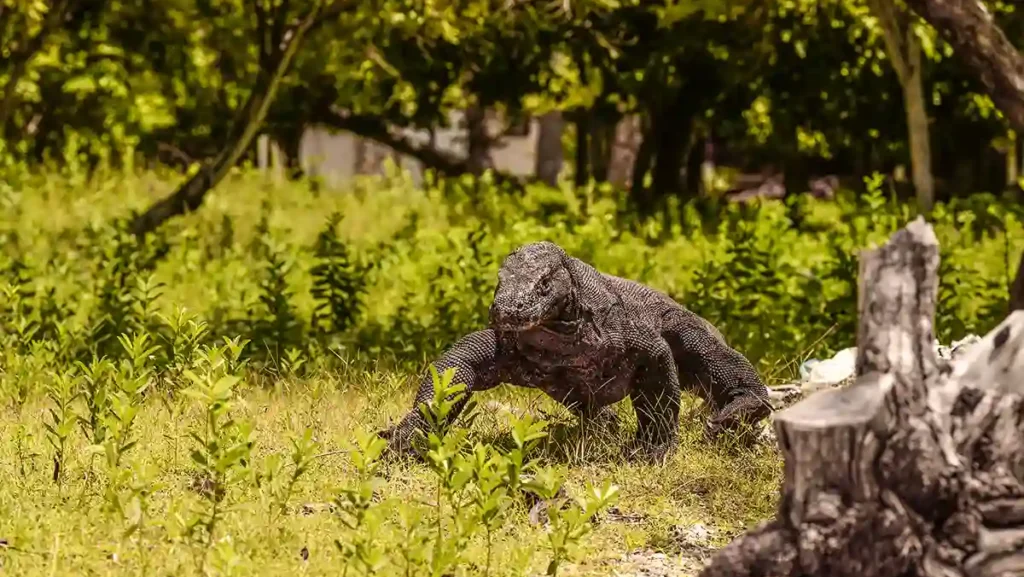
How Big Are Komodo Dragons?
Komodo dragons are the largest lizards on the planet, but, how big are komodo dragon? Adult males typically grow to lengths of 2.5 to 3 meters (8.2 to 10 feet), while females are slightly smaller, averaging 2 to 2.5 meters (6.6 to 8.2 feet).
Size Breakdown by Age and Sex
| Age/Sex Category | Average Length | Average Weight | Maximum Recorded |
| Adult Male | 2.5-3 meters | 80-90 kg | 3.13 meters, 166 kg |
| Adult Female | 2-2.5 meters | 60-70 kg | 2.5 meters, 90 kg |
| Juvenile (1-3 years) | 0.5-1.5 meters | 2-10 kg | – |
| Hatchling | 35-40 cm | 80-100 g | – |
The largest Komodo dragon ever recorded was an impressive 3.13 meters in length and weighed 166 kg.
Physical Characteristics
Komodo dragons have a muscular, robust build, ideal for their predatory lifestyle. Key features include:
- Head: Large, flat, and wide, with a rounded snout. Houses powerful jaw muscles and venom glands.
- Teeth: Sharp, serrated, and curved backward (up to 60 teeth).
- Tongue: Long, yellow, forked, and used for chemoreception, similar to snakes.
- Skin: Tough, armored scales called osteoderms, with coloration ranging from gray to brown with yellow-orange flecks.
- Claws: Long, sharp claws used for digging and climbing.
- Tail: Muscular, used for balance, defense, and swimming propulsion.
Expert Note from Komodo Luxury: In our 10+ years guiding tours, we’ve observed that Komodo dragons on Rinca Island tend to be slightly smaller than those on Komodo Island, likely due to differences in prey availability and territory size.
Komodo Dragon History & Evolution
The Komodo dragon history stretches back millions of years across Indonesia’s islands, yet the Western world only discovered these ancient creatures in 1910. Dutch Lieutenant Steyn van Hensbroek first heard tales of giant lizards from local fishermen on Komodo Island and led an expedition to capture one — an event that marked the beginning of global scientific fascination with the Komodo dragon.
Komodo Dragon Timeline of Discovery
- 1910: Dutch Lieutenant Steyn van Hensbroek heard local fishermen’s stories about giant lizards called “ora” on Komodo Island. Initially skeptical, he organized an expedition and successfully shot an adult Komodo dragon, preserving its skin as proof.
- 1912: Peter Ouwens, director of the Bogor Zoological Museum in Java, published the first scientific description of the species in the Bulletin du Jardin Botanique de Buitenzorg. He named it Varanus komodoensis after Komodo Island.
- 1926: The first Komodo dragons were captured alive and sent to Western zoos, sparking global fascination with these “living dragons.”
- 1980: Komodo National Park was established by the Indonesian government to protect the species and its habitat.
- 1991: UNESCO designated Komodo National Park as a World Heritage Site, recognizing its global conservation importance.
Evolutionary Origins
Komodo dragon ancestors are believed to have originated in Australia around 4 million years ago, migrating to Indonesia through land bridges during periods of lower sea levels. They evolved island gigantism, growing larger in size due to the absence of large predators and abundant prey.
Are Komodo Dragons Related to Dinosaurs?
While Komodo dragons resemble dinosaurs in many ways, they are not dinosaurs. They belong to the monitor lizard family and share a common ancestor with extinct species like Megalania, a giant monitor lizard from Australia. Komodo dragons are modern reptiles, not direct descendants of dinosaurs.
The Megalania Question
For decades, scientists believed Komodo dragons were directly related to Megalania prisca (Varanus priscus), a giant monitor lizard that lived in Australia until approximately 50,000 years ago and could reach up to 7 meters in length.
However, modern DNA analysis has disproven this theory. While Komodo dragons and Megalania share a common ancestor, they evolved separately:
- Megalania evolved and remained in Australia, growing to enormous sizes
- Komodo dragons migrated to Indonesia and evolved independently, developing unique characteristics suited to island ecosystems
Why the “Living Dinosaur” Nickname?
Despite not being dinosaurs, Komodo dragons earned the “living dinosaur” nickname due to:
- Ancient appearance: Their prehistoric-looking body structure and scales
- Size: Being the largest living lizards evokes images of giant reptiles from the past
- Predatory behavior: Their hunting style resembles what scientists believe some carnivorous dinosaurs employed
- Evolutionary age: They represent an ancient reptilian lineage, even if not dinosaurian
Convergent Evolution with Dinosaurs
Interestingly, Komodo dragons have developed some similar traits to carnivorous dinosaurs through convergent evolution—the independent evolution of similar features in unrelated species:
- Venomous/toxic bite: Similar to theories about some theropod dinosaurs
- Predatory strategies: Ambush hunting and tracking wounded prey
- Social hierarchy: Dominance behaviors during feeding
Scientific Accuracy Note: While Komodo dragons share ecological roles and some behavioral traits with extinct predators, they are modern reptiles, not living fossils or dinosaur descendants.
Komodo Dragon Habitat & Distribution
Where Do Komodo Dragons Live?
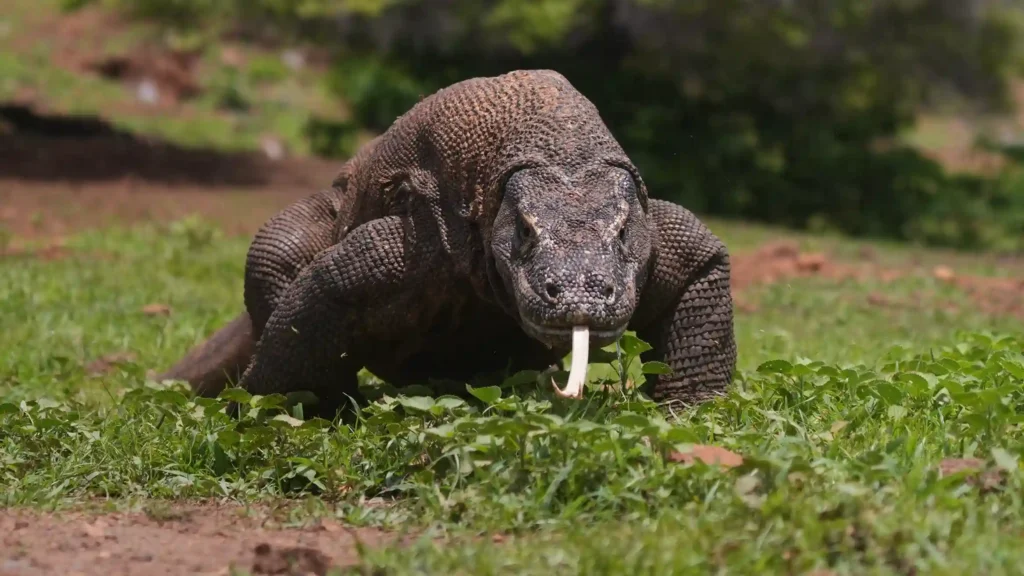
When people ask, “What Island Do Komodo Dragons Live On?”, the answer is as fascinating as the creatures themselves. These remarkable reptiles are endemic to Indonesia, found only on Komodo, Rinca, Flores, Gili Motang, and Nusa Kode Islands. Each island offers a slightly different landscape — from dry savanna grasslands to tropical forests and rocky hillsides — creating the perfect environment for the Komodo dragon to thrive in the wild.
Why Are Komodo Dragons Only Found in Indonesia?
The exclusive distribution of Komodo dragons in Indonesia is due to the islands’ geographic isolation and unique environmental conditions. This isolation allowed them to evolve into the apex predators of their ecosystems, free from competition with larger carnivores like tigers and crocodiles.
The exclusive distribution of Komodo dragons in Indonesia is due to the islands’ geographic isolation and unique environmental conditions. This isolation allowed them to evolve into the apex predators of their ecosystems, free from competition with larger carnivores like tigers and crocodiles.
This is also what makes exploring Indonesia, especially Komodo National Park, such a unique experience, you’re not just visiting a destination, but stepping into one of the last untouched habitats of these ancient creatures. If you want to experience it in a more exclusive and seamless way, you can explore Komodo and beyond through a Luxury Cruise Indonesia, where you’ll enjoy curated itineraries, private onboard experiences, and access to remote islands that most travelers never get to see.
Komodo Dragon Biology & Abilities
Are Komodo Dragons Venomous?
Yes, Komodo dragons are venomous. For many years, people believed their deadly bite was due to the bacteria in their saliva. However, recent studies have revealed that Komodo dragons have venom glands located in their lower jaw. This venom contains proteins that prevent blood clotting, causing severe bleeding and eventually leading to the death of their prey.
The venom of a Komodo dragon is just one part of what makes their bite so dangerous. Combined with their powerful jaws, a bite from a Komodo can quickly incapacitate their prey. Even if an animal escapes, it will likely collapse shortly after due to blood loss.
The Venom Discovery
For over 50 years, scientists believed Komodo dragon saliva contained deadly bacteria (including Pasteurella multocida) that caused fatal infections in bitten prey. While bacteria are present, venom is the primary killing mechanism.
What’s in Komodo Dragon Venom?
Komodo venom contains a cocktail of toxic proteins that work synergistically:
| Venom Component | Function | Effect on Prey |
| Anticoagulants | Prevents blood clotting | Causes continuous bleeding |
| Hypotensive compounds | Lowers blood pressure | Induces shock and weakness |
| Pain-inducing agents | Stimulates pain receptors | Discourages escape attempts |
| Muscle contractility inhibitors | Disrupts muscle function | Causes paralysis and collapse |
How Venom Works:
- Initial bite: Venom injected through serrated teeth creates deep lacerations
- Anticoagulation: Blood cannot clot, causing severe hemorrhaging
- Hypotension: Blood pressure drops rapidly, weakening prey
- Shock: Combined effects lead to hypovolemic shock
- Death: Prey typically dies within hours to days from blood loss
Safety Note: While Komodo venom is dangerous to prey animals, it’s rarely fatal to humans with proper medical treatment. In 50+ years of recorded data, only 5 human deaths have occurred from Komodo bites—usually from delayed treatment in remote areas.
Can Komodo Dragons Sense Blood?
Yes, Komodo dragons can detect blood and carrion from extraordinary distances—up to 9.5 kilometers (6 miles) away under optimal wind conditions. Komodo dragons possess a highly specialized chemosensory system that makes them one of nature’s most efficient scent trackers.
What They Can Detect:
- Fresh blood from wounded animals
- Decomposing flesh (carrion)
- Reproductive pheromones (during mating season)
- Territorial scent markers from other dragons
- Prey species identification (deer vs boar vs buffalo)
Is it dangerous to visit Komodo Island while menstruating?
No. This is a persistent myth not supported by science or field experience.
Why menstrual blood is different:
- Chemical composition: Menstrual fluid contains endometrial tissue, cervical mucus, and hormones—chemically distinct from wound blood
- Oxygen levels: Menstrual blood has lower oxygen levels than fresh arterial blood
- Prey association: Komodo dragons are conditioned to hunt specific prey species; human scent patterns don’t trigger hunting behavior
- Field evidence: Thousands of menstruating women have safely visited Komodo National Park without incident
Expert Testimony from Komodo Luxury: In our 10+ years operating tours, we’ve guided hundreds of menstruating guests without any dragon-related incidents. Park rangers confirm this is not a concern with proper safety protocols.
Can Komodo Dragons Swim?
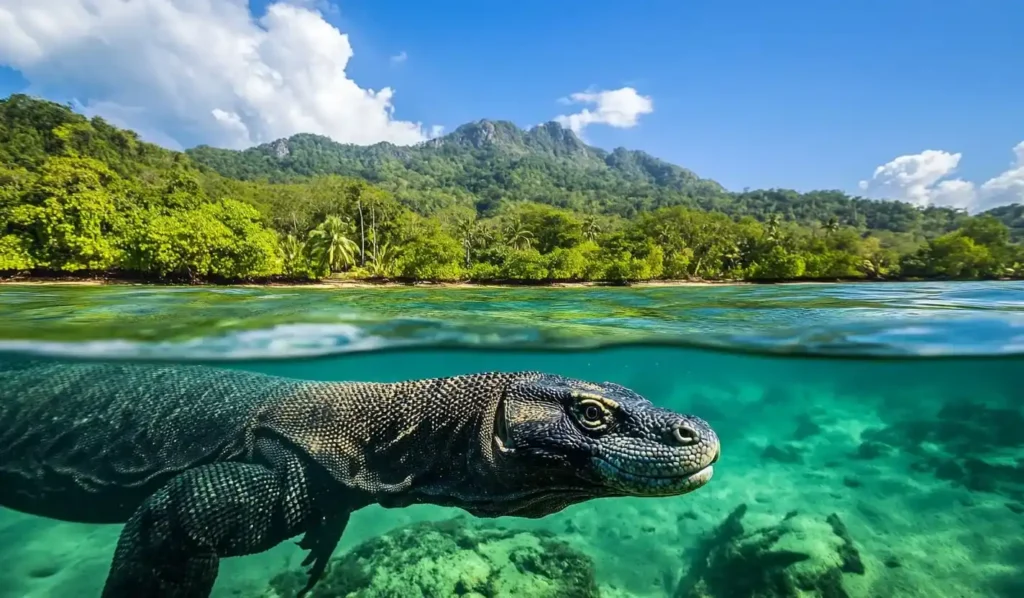
Yes, Komodo dragons are excellent swimmers. Despite their massive size and terrestrial reputation, they are surprisingly proficient in water. Komodo dragons employ a sinusoidal swimming motion similar to crocodiles:
- Body and tail move in wavelike motions (lateral undulation)
- Legs tucked close to body to reduce drag
- Head remains above water for breathing
- Can dive underwater briefly when necessary
Can Komodo Dragons Fly?
No, Komodo dragons cannot fly. This is one of the most common misconceptions about these reptiles, likely stemming from the “dragon” part of their name. The confusion comes from several sources:
- Name association: The word “dragon” evokes mythical flying creatures
- Cultural confusion: Flying lizards (Draco volans) DO exist in Indonesia and Southeast Asia—but they’re small gliding lizards, not Komodo dragons
- Media portrayal: Fantasy fiction sometimes depicts Komodo dragons with exaggerated abilities
Note: If you’re interested in flying lizards, Indonesia is home to the amazing Flying Dragon (Draco volans), a small lizard with wing-like skin flaps that can glide up to 60 meters between trees!
How Fast Can a Komodo Dragon Run?
Despite their massive size, Komodo dragons are surprisingly fast. They can run up to 20 kilometers per hour over short distances. This speed helps them chase down prey when necessary, although they usually prefer ambushing rather than prolonged chases.
Due to their slow metabolism, Komodo dragons rarely rely on their speed for long periods. Instead, they are patient hunters, using stealth and ambush tactics to catch their prey. When the opportunity arises, they will burst into action and overpower their target with a sudden, powerful attack.
Komodo Diet & Hunting Behavior
What Do Komodo Dragons Eat?
When it comes to what Komodo dragon eat, these ancient predators are obligate carnivores, meaning their diet consists entirely of meat. They’re opportunistic feeders with a surprisingly wide range of prey — from small birds and monkeys to wild boars and even water buffalo, depending on what’s available in their territory.
Primary Prey Species
| Prey Type | Percentage of Diet | Hunting Method |
| Timor Deer (Rusa timorensis) | 40-50% | Ambush |
| Wild Boar (Sus scrofa) | 20-30% | Ambush/pursuit |
| Water Buffalo (Bubalus arnee) | 10-15% | Ambush (adults), opportunistic (calves) |
| Carrion (dead animals) | 15-20% | Scavenging |
| Smaller mammals & birds | 5-10% | Opportunistic |
| Other Komodo dragons | 5-10% | Cannibalism |
Are Komodo Dragon Cannibalism?
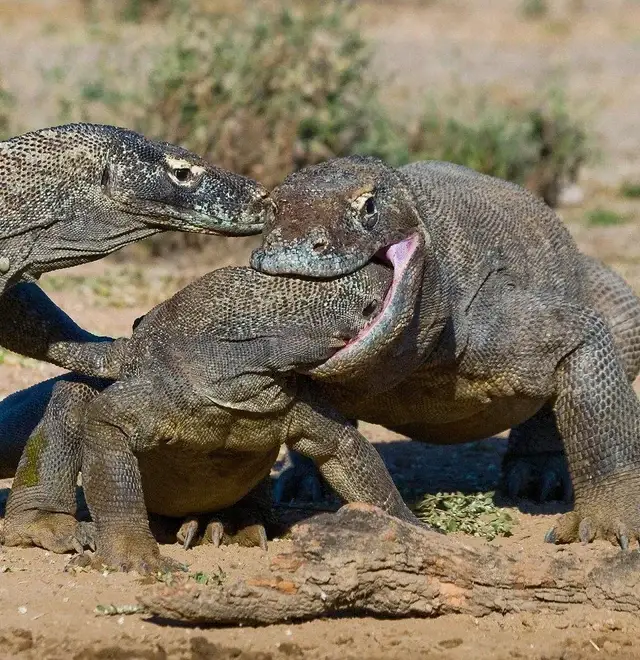
Yes, Komodo dragons are cannibalistic. Adult dragons regularly prey on juveniles and smaller adults, making cannibalism a significant survival challenge for young dragons.
Cooperative Hunting Behavior
While typically solitary, Komodo dragons occasionally display coordinated hunting when targeting large prey:
- Multiple dragons converge on water buffalo or large deer
- Sequential biting: Different dragons bite prey in waves
- Herding: Dragons position themselves to drive prey toward cliffs or water
- Feeding hierarchy: Largest males eat first, smaller dragons wait their turn
Research Note: This cooperative behavior is debated among scientists. Our observations suggest it’s more “coincidental aggregation” than true cooperation, but the result—successful takedown of large prey—is the same.
Can a Komodo Dragon Eat a Whole Human?
Physically, yes—Komodo dragons CAN consume a human body. However, human predation is extremely rare and typically involves deceased individuals, not active hunting.
Critical Safety Information: ALL recorded fatalities occurred when proper safety protocols were not followed. With experienced rangers and adherence to park rules, Komodo dragon encounters are remarkably safe.
What Can Kill a Komodo Dragon?
While the Komodo dragon is at the top of the food chain in its environment, it still faces threats. The biggest threats to adult Komodo dragons are other Komodo dragons, as they can be highly territorial and cannibalistic. However, humans pose the most significant danger, through habitat destruction and illegal poaching.
Climate change and habitat loss due to human activities are growing concerns for the future survival of Komodo dragons. This is why conservation efforts, such as those in Komodo National Park, are critical for protecting the species.
How Many Komodo Dragons Are Left?
The IUCN’s 2021 reassessment — the year the species moved from Vulnerable to Endangered — counted about 1,383 mature individuals across eight subpopulations, none exceeding 500 adults. Park census summaries describe roughly 1,400 adults plus 2,000 juveniles (~3,400 counted animals), while older UNESCO documentation cites totals up to ~5,700 when all age classes and unsurveyed areas are estimated. The threats are habitat loss on Flores, prey decline, and climate-driven contraction of low-lying savanna. The species has been legally protected in Indonesia since 1915, and today the strongest protection is the intact prey base and ranger patrols of Komodo National Park — funded in large part by regulated tourism.
Cultural Significance
Komodo Dragons in Manggarai Culture
The Komodo dragon (called “ora” in the local Manggarai language) holds profound cultural and spiritual significance for indigenous communities on Flores, Komodo, and Rinca Islands.
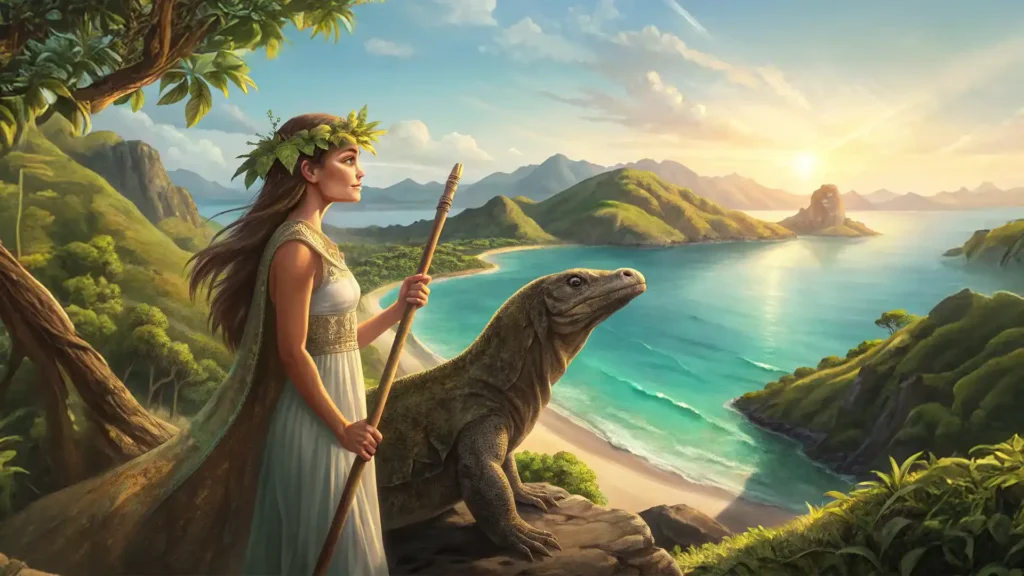
According to Manggarai folklore about Komodo dragon, humans and Komodo dragons are twin siblings. The most common version of this legend tells of a woman who gave birth to twins: one human child and one Komodo dragon egg. Both were raised together, and the human child promised to always protect their dragon sibling and its descendants.
Field Testimony: Park rangers from Komodo village have shared stories of ancestors who claimed to communicate with dragons, warning them before hunts to avoid certain areas. Whether literal or metaphorical, these traditions fostered centuries of successful coexistence.
Komodo Safety & Visiting Guidelines
Standing face-to-face with the legendary Komodo dragon is one of the most thrilling experiences you can have in Indonesia. But remember — behind their calm, ancient gaze lies the instinct of a powerful predator.
To make your visit unforgettable and safe, every traveler must understand the rules, behavior, and precautions when exploring Komodo Island. Whether it’s your first time or your tenth, these safety guidelines will help you experience the magic of Komodo responsibly — always accompanied by certified rangers and a trusted Komodo tour operator.
Komodo Dragon Attack Protocol
If you ever encounter an aggressive Komodo dragon, follow these steps carefully:
✅ DO:
- Stay calm – Panic increases the chance of falling and triggers a chase response.
- Back away slowly – Avoid sudden movements; maintain eye contact.
- Make yourself appear larger – Raise your arms or open your jacket.
- Use your walking stick – Keep it between you and the dragon; rangers provide one for each visitor.
- Call for ranger assistance – Rangers are trained to handle dragon behavior.
- Move to higher ground if possible – Komodo dragons rarely pursue uphill.
❌ DON’T:
- Run – It activates their chase instinct; Komodos can sprint up to 20 km/h.
- Turn your back – Loss of eye contact is seen as weakness.
- Get too close for photos – Always maintain at least 3–5 meters distance.
- Lie down or crouch – Makes you appear smaller and vulnerable.
- Kick or strike the dragon – This provokes defensive aggression.
- Scream or shout – Loud noises can startle and irritate them.
Mandatory Park Regulations
These are official Komodo National Park rules that must be followed by every visitor:
- Always visit the islands with certified rangers (minimum of two per group).
- Stay on designated trails at all times.
- Maintain a 3–5 meter distance from all Komodo dragons.
- Keep food in airtight containers — never open them outdoors.
- Menstruating women are not allowed to enter the island (park regulation).
- Children under 10 years old are not permitted on Komodo Island.
- Closed-toe shoes are mandatory (boots highly recommended).
- Wear long pants for extra protection.
- No flash photography — it may startle the dragons.
- Always stay with your group; do not wander off alone.
Best Practices from Komodo Luxury
Follow these expert recommendations to make your Komodo Island adventure safe and comfortable.
Before Your Trek:
- Hydrate well – The tropical heat is intense.
- Apply sunscreen and wear a hat – Protect yourself from direct sunlight.
- Bring a camera with a zoom lens – Capture great shots safely from a distance.
- Empty your pockets – Avoid dropping items that may attract attention.
- Use the restroom before trekking – There are no facilities on the trails.
- Listen carefully to the safety briefing – Rangers share vital safety information.
During Your Trek:
- Walk calmly and quietly – Avoid loud noises or sudden movements.
- Stay in a single-file line – Follow the ranger’s lead precisely.
- Keep children between adults and hold their hands.
- Avoid touching vegetation – Snakes and insects may be present.
- Never leave the trail — not even for photos.
- Immediately alert rangers if you spot a dragon nearby.
After an Encounter:
- Do not turn around to take pictures — keep facing forward and move calmly.
- Wait for the ranger’s “all clear” signal before relaxing.
- Report any unusual dragon behavior to help improve safety protocols.
Stay Safe with a Trusted Komodo Dragon Tour
Even though Komodo dragons live near local villages, they remain wild and unpredictable animals. That’s why visiting with certified Komodo rangers and a trusted tour operator — like Komodo Luxury — is the safest and most responsible way to explore Komodo Island.
Experience the thrill of meeting the world’s largest lizard up close — safely, responsibly, and with peace of mind.
How to Visit Komodo Dragons
Where to See Komodo Dragons Safely
Komodo National Park is home to one of the most extraordinary wildlife experiences on Earth — encountering the legendary Komodo dragon in its natural habitat. Whether you choose Komodo Island or Rinca Island, it’s important to visit these creatures with safety and respect, guided by experts who know how to navigate the terrain and the behavior of the dragons.
Komodo Island vs Rinca Island: Which to Choose?
Both Komodo Island and Rinca Island offer unforgettable opportunities to see the Komodo dragon, but there are key differences that might influence your decision.
| Factor | Komodo Island | Rinca Island |
| Dragon Density | Moderate-High | Very High |
| Crowds | Higher | Lower |
| Boat Distance | 4 hours from Labuan Bajo | 2 hours from Labuan Bajo |
| Landscape | Savanna, gentle hills | Dramatic hills, steeper |
| Facilities | Better developed | More rustic |
| Photography | Excellent | Excellent |
| Best For | First-time visitors | Return visitors, photographers |
Best Time to Visit Komodo Dragons
Visiting the Komodo dragons in their natural habitat is an experience of a lifetime, but timing your visit can make a significant difference in what you’ll see and how comfortable your experience will be. The best time to visit is during the dry season, from April to December, when clear skies and warm temperatures provide ideal conditions for trekking and dragon sightings. July to September is peak season, with higher dragon activity but also more tourists, so booking early is recommended. If you prefer fewer crowds, April, May, and October to December offer a great balance of good weather and less tourist traffic.
What to Pack for Your Komodo Dragon Tour
Essential Items:
Clothing:
- Sturdy hiking boots or trail shoes (closed-toe mandatory)
- Long pants (for trekking protection)
- Lightweight, breathable shirts (long-sleeve recommended for sun protection)
- Shorts and swimwear (for boat and beach time)
- Wide-brimmed hat (sun protection essential)
- Light windbreaker (boat breezes)
Personal Items:
- Sunglasses (UV protection)
- Reef-safe sunscreen (SPF 50+) – CRITICAL in equatorial sun
- Insect repellent (dengue risk in Indonesia)
- Personal medications
- Personal first aid supplies
- Reusable water bottle (reduce plastic waste)
Photography:
- Camera with telephoto lens (200-400mm ideal)
- Extra batteries and memory cards
- Smartphone with waterproof case
- GoPro or action camera (snorkeling)
- Power bank (charging limited on boats)
Optional but Recommended:
- Water shoes (rocky beaches)
- Personal snorkel mask (hygiene preference)
- Small daypack (for trekking)
- Field guide to Indonesian wildlife
- Headlamp (boat cabins)
What NOT to Bring:
- ❌ Drones (prohibited in Komodo National Park without special permit)
- ❌ Single-use plastics (park policy)
- ❌ Open food containers (attracts dragons)
Komodo Dragon Encyclopedia: Go Deeper
This pillar guide anchors our Dragon Encyclopedia. Each cluster article below goes deeper, with measured data and named sources:
- Komodo dragon size — measured length and weight data, the 3.13 m / 166 kg record, and human-scale comparisons
- Komodo dragon facts — the field-checked list, from parthenogenesis to bone-armoured skin
- Komodo dragon lifespan and life cycle — from a 7–8-month incubation to ~30-year-old giants
- Where Komodo dragons come from — the Australian fossil record and the million-year journey to Flores
- Komodo dragon mythology and the Ora legend — the Dragon Princess, twin siblings, and the culture of coexistence
Planning to meet one? Check current Komodo National Park entrance fees, see the ranger stations on Rinca Island, and pair the trek with Padar Island and Pink Beach on one sailing route.
Conclusion: The Legacy of the Komodo Dragon
The Komodo dragon stands as one of Earth’s most extraordinary evolutionary achievements—a testament to the power of island isolation, adaptation, and survival. As the world’s largest living lizard, a venomous apex predator, and a cultural icon of Indonesia, it represents far more than a tourist attraction.
Your Role in Komodo Dragon Conservation
- Visit Responsibly: Choose tour operators committed to safety, conservation, and local community support. Companies like Komodo Luxury that employ local rangers, follow strict protocols, and contribute to conservation funding make tourism a force for protection, not harm.
- Spread Awareness: Share accurate information about Komodo dragons, their conservation status, and the threats they face. Combat misinformation and sensationalized myths with facts grounded in science and first-hand experience.
- Support Conservation: Contribute to organizations working to protect Komodo dragons and their habitats. Even small donations to the Komodo Survival Program or local conservation initiatives make meaningful impacts.
- Reduce Your Carbon Footprint: Climate change is the single greatest threat to Komodo dragon survival. Individual actions to reduce greenhouse gas emissions contribute to global efforts to slow sea level rise and protect island ecosystems.
Book Your Komodo Dragon Adventure
There’s nothing quite like standing just meters away from a Komodo dragon — the world’s largest living lizard — watching it move through the wild landscapes of Komodo National Park. It’s raw, real, and unforgettable.
With Komodo Luxury, you can explore this incredible destination safely and comfortably. Each Komodo Island tour is guided by certified local rangers who know the terrain and behavior of these ancient creatures better than anyone. You’ll not only witness the dragons up close but also discover the park’s hidden gems — from pink-sand beaches to turquoise bays and coral reefs teeming with life.
Choose between an open trip 3D2N Komodo, perfect for meeting other travelers, or a private Komodo dragon tour designed just for you. Either way, everything is taken care of — from the boat, meals, and guides to personalized experiences that let you explore at your own pace.
This isn’t just another trip; it’s a chance to walk alongside one of nature’s most fascinating predators, on an island that feels untouched by time.
Ready to experience Komodo the right way? Book your Komodo Island tour or Komodo dragon tour with Komodo Luxury today — and let us take you closer to the wild, safely and in style.

Frequently Asked Questions
This species profile is written by Komodo Luxury, a yacht charter operator based in Labuan Bajo whose crews observe wild dragons on Komodo and Rinca Island regularly. To see them yourself, browse the Komodo Island tour packages — shared cruises, day trips and private phinisi charters.
See also: Komodo boat charter fleet.
Read the guide, then meet the subject. Dragon trekking is included on all our Komodo tour packages; serious wildlife itineraries get extra trail time on a Komodo liveaboard.
By the Komodo Luxury Expedition Team — a licensed Komodo National Park tour operator running daily expeditions from Labuan Bajo since 2015. Fleet, rates and itineraries: Komodo yacht charter.
Visiting them: the Rinca Island guide covers Loh Buaya’s walkway; the Komodo Island guide covers Loh Liang and the maps.
Is the Komodo Dragon Dangerous to Humans?
Yes, a Komodo dragon can be dangerous to humans — but attacks are rare. Komodo National Park records list about 24 attacks on people between 1974 and 2012, five of them fatal — roughly one recorded incident every 18 months across four decades of visits. The danger is real, though: an adult dragon sprints at up to 20 km/h in short bursts, and research led by Bryan G. Fry (PNAS, 2009) confirmed a true venom gland whose anticoagulant toxins lower blood pressure and prevent clotting.
- Sprint speed: up to 20 km/h — faster than most people over 20 metres.
- Bite: about 148 newtons (D’Amore et al., 2011) — modest force, but paired with roughly 60 serrated teeth and venom.
- Safety rule: every visit inside the park requires a licensed ranger; keep at least 5 metres’ distance and never approach a feeding or nesting dragon.
Go deeper: can a Komodo dragon eat a whole human, how dangerous Komodo dragons really are, and monitor lizard vs Komodo dragon. To meet dragons safely with licensed rangers, compare our Komodo tour packages or book a private Komodo boat tour.
Komodo Dragon Encyclopedia: The Complete Article Directory
This is the full index of the Komodo Dragon Encyclopedia — 91 field-checked articles on Varanus komodoensis, written and reviewed by the Komodo Luxury team in Labuan Bajo. The species is listed as Endangered on the IUCN Red List, with roughly 3,400 dragons counted in the wild (2023 census), so every ranger-guided visit that follows park rules directly funds their protection. Start with the essential guides, then explore any question below.
Start Here: The Essential Guides
- How Big Are Komodo Dragons? Size, Length & Weight
- Seeing Komodo Dragons in the Wild: Visitor Guide
- Komodo Dragon Lifespan & Life Cycle
- Where Are Komodo Dragons From? Origin & Evolution
- The Ora Legend: Komodo Dragons in Myth
- Komodo Dragon Facts: The Field-Checked List
Size, Speed & Anatomy
- Are Komodo Dragons Toothless?
- Can Komodo Dragons Fly?
- Can Komodo Dragons Jump?
- Can Komodo Dragons Sense Blood?
- Can Komodo Dragons Swim?
- Can a Komodo Dragon Climb a Tree?
- How Fast Is a Komodo Dragon?
- Komodo Dragon Digestive System
Venom, Bite & Safety
- Are Komodo Dragons Venomous?
- Can a Komodo Dragon Eat a Whole Human?
- How Dangerous Are Komodo Dragons?
- Komodo Dragon Venom vs Snake Venom
- Komodo Dragon vs Human: Attack History & Safety
- What to Do If a Komodo Dragon Chases You
Diet, Hunting & Behavior
- Can a Komodo Dragon Be Kept as a Pet?
- Does the Komodo Dragon Have Any Enemies?
- What Does a Komodo Dragon Eat?
Life Cycle & Breeding
- How Long Do Komodo Dragons Live?
- How Many Eggs Do Komodo Dragons Lay?
- Baby Komodo Dragons: Hatchlings, Eggs & Tree Years
- Where Are Komodo Dragons From?
- How to Travel to Komodo Dragon Island
- Komodo Dragon Mating Season
Habitat, Range & Conservation
- Are There Komodo Dragons in Labuan Bajo?
- Do Komodo Dragons Live in Australia?
- Do Komodo Dragons Live in Bali?
- Do Komodo Dragons Live on the Galápagos?
- How to Save Komodo Dragons: Conservation in Action
- Komodo Dragon Habitat: Where They Live
- Komodo Dragons at Pink Beach?
- What Other Animals Live on Komodo Island?
History, Evolution & Culture
- 5 Lizards That Look Like Komodo Dragons
- Is the Komodo Dragon Related to Dinosaurs?
- Komodo Dragon History & Evolution
- Komodo Dragon Myths vs Facts
- Komodo Dragon vs Megalania (Prehistoric Giant)
- Monitor Lizard vs Komodo Dragon
- Wildlife Wonders: Kangaroos to Komodo Dragons
Komodo Dragon vs Other Animals
- Komodo Dragon Vs: Every Matchup Compared
- Komodo Dragon vs Alligator
- Komodo Dragon vs Anaconda
- Komodo Dragon vs Bear
- Komodo Dragon vs Big Cats
- Komodo Dragon vs Bird
- Komodo Dragon vs Black Mamba
- Komodo Dragon vs Black Panther
- Komodo Dragon vs Blue Viper
- Komodo Dragon vs Cassowary
- Komodo Dragon vs Cheetah
- Komodo Dragon vs Coyote
- Komodo Dragon vs Crocodile
- Komodo Dragon vs Daboia Siamensis
- Komodo Dragon vs Dog
- Komodo Dragon vs Dolphin
- Komodo Dragon vs Electric Eel
- Komodo Dragon vs Elephant
- Komodo Dragon vs Giant Panda
- Komodo Dragon vs Goat
- Komodo Dragon vs Gorilla
- Komodo Dragon vs Hippo
- Komodo Dragon vs Hyena
- Komodo Dragon vs Kangaroo
- Komodo Dragon vs King Cobra
- Komodo Dragon vs Lion
- Komodo Dragon vs Orangutan
- Komodo Dragon vs Orca
- Komodo Dragon vs Polar Bear
- Komodo Dragon vs Puma
- Komodo Dragon vs Shark
- Komodo Dragon vs Tiger
- Komodo Dragon vs Turtle
- Komodo Dragon vs Water Buffalo
- Komodo Dragon vs Wild Boar
- Komodo Dragon vs Wolf
Plan Your Visit: Seeing Dragons in the Wild
- Best Place to See Komodo Dragons
- Best Time of Day to See Komodo Dragons
- Is Komodo National Park Open After the Earthquake?
- Komodo Dragon Season: Best Time to Visit
- Komodo Dragon Trekking: What the Trek Is Like
- Komodo Dragons: Singapore Zoo vs the Wild
- Komodo Island Luxury Boat Tours
- Komodo Island vs Rinca Island
- Rinca Island Trekking Tour
- Rinca Island: Dragons Without the Crowds
- Rinca Island: Exotic Home of the Komodo
- Seeing Dragons Responsibly: Ranger Rules & Charter Timing
Ready to meet a dragon in the wild? Every Komodo Luxury itinerary includes the ranger-guided dragon trek: compare Komodo boat tours, join a scheduled open trip, or book a private charter around Komodo National Park.