





Last updated: September 2026 · Prices & availability verified for the 2026/2027 season
Last updated: September 05, 2026
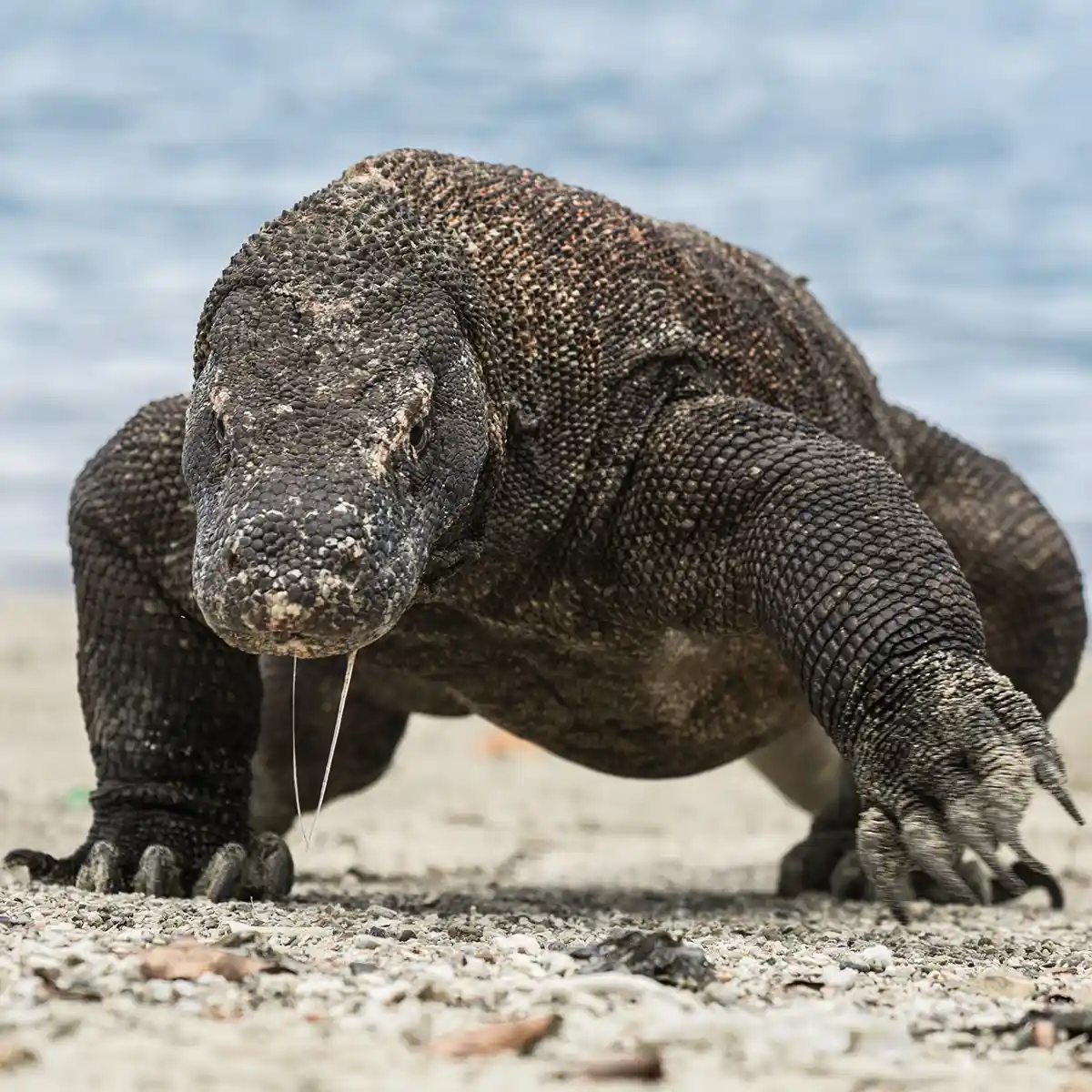
關於科莫多龍最引人入勝的事實包括:它是現存體型最大的蜥蜴,體長可達 3 公尺,體重約 70 公斤;它具有毒性,會利用特化的腺體來削弱獵物的抵抗力;而在野外,它僅棲息於印尼的科莫多島(科莫多國家公園 )及東努沙登加拉省(East Nusa Tenggara)的鄰近島嶼,這是它唯一的自然棲息地。
These are the facts our naturalist guides recite on deck the evening before dragon trekking, field-checked by the Komodo Luxury team, a Labuan Bajo operator whose crews have taken travelers to meet wild dragons since 2015, and woven into every itinerary we run, whether a shared 3D2N sailing trip or a ten-day private expedition.
The most interesting Komodo dragon facts are the ones that survive fact-checking: females can give birth without males (confirmed genetically in Nature), their killing tool is venom rather than “toxic bacteria,” their skin hides a suit of bone chain-mail, and an adult can eat up to 80% of its own body weight in one sitting. Here’s the quick summary, followed by our full field-checked list, each fact tied to the study or institution that verified it.
重點摘要
- Komodo dragons are the only known species where isolated females confirmed capable of virgin birth have also been documented breeding normally afterward, proven genetically in a 2006 Nature study.
- What actually kills prey is venom, not “toxic bacteria” as long believed, 2009 research identified real venom glands that cause uncontrolled bleeding and a dangerous drop in blood pressure.
- An adult can eat up to 80% of its own body weight in a single meal, made possible by loosely hinged jaws and a stomach that stretches enormously to hold it all at once.
- Juveniles spend their early years living in trees specifically to avoid being eaten by adults, since cannibalism is a normal and significant part of how the species behaves in the wild.
- The species is now classified as Endangered, with fewer than an estimated 3,500 individuals left in the wild, which is part of why responsible, well-guided tourism matters to their survival.
科莫多龍的相關知識
Here are the 17 facts that made the cut, each one checked against the original study, institution, or field record behind it, not just repeated from other lists.
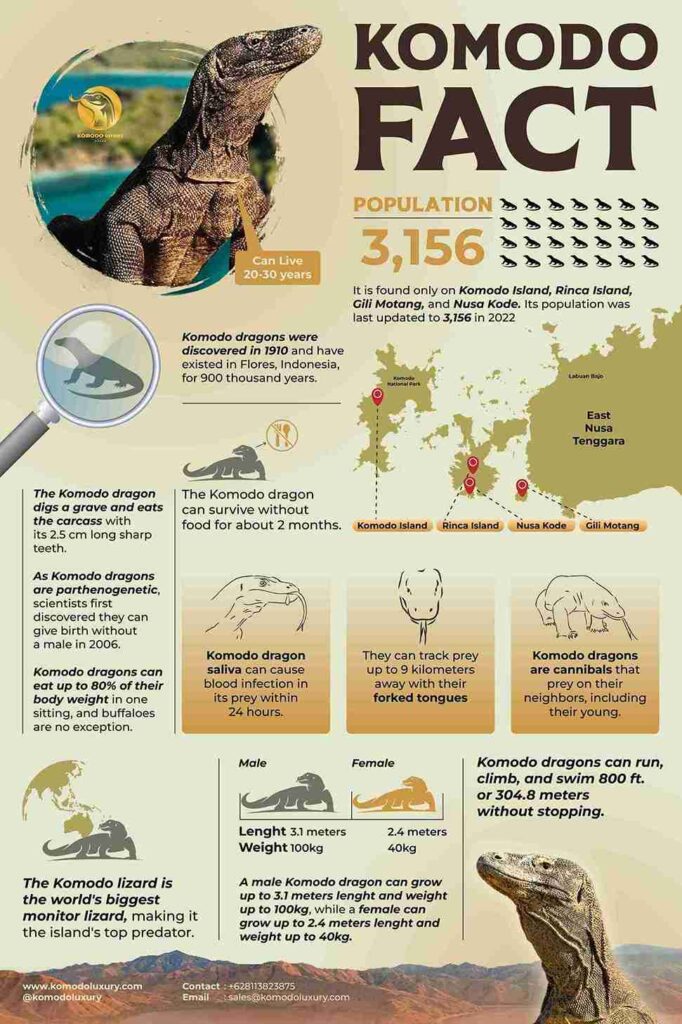
1. Females Can Reproduce Without a Male — Proven in Nature
In 2006, geneticists confirmed parthenogenesis — virgin birth — in two zoo females: Flora at Chester Zoo and Sungai at London Zoo, both isolated from males (Watts et al., Nature, 2006). Because dragons use ZW sex chromosomes, parthenogenetic offspring are always male — in theory letting a single stranded female found a new island population by later mating with her own parthenogenetic sons. At least six zoo cases had been recorded by 2010, and Flora herself went on to breed normally with a male afterwards, proving the two reproductive modes coexist in one animal.
2. The “Toxic Bacteria” Story Is a Myth — the Venom Is Real
A 2007 microbiology study found dragon mouths carry ordinary carnivore flora, and in 2009 Bryan Fry’s team demonstrated true lower-jaw venom glands producing anticoagulant, blood-pressure-crashing toxins (PNAS). The full mechanism is explained in our complete Komodo dragon guide.
3. They Can Eat Up to ~80% of Their Body Weight in One Meal
Zoological physiology summaries report adults consuming on the order of 80% of their own mass at a single carcass, helped by loosely articulated jaws and a hugely distensible stomach. After such a meal a dragon may bask for days to power digestion.
4. Their Skin Is Chain-Mail Made of Bone
High-resolution X-ray scans at the University of Texas at Austin (2019) revealed elaborate osteoderms — interlocking bony plates — sheathing adult dragons, densest around the neck and back. The armor’s likely purpose: defense against other Komodo dragons. Hatchlings have none; the armor grows in with age and combat.
5. They Smell Carrion from Kilometres Away
The forked tongue collects airborne molecules and delivers them to the Jacobson’s organ in the roof of the mouth, giving a stereo sense of smell that locates carcasses several kilometres downwind — commonly cited at 4 km or more in favourable wind.
6. Juveniles Live in Trees for Years
Young dragons climb within minutes of hatching and spend their early years aloft, hunting insects and geckos in the canopy. The reason is fact 7.
7. Cannibalism Is Routine, Not Rare
Adult dragons regularly eat smaller ones; field studies treat cannibalism as a significant, ordinary part of dragon ecology and the main selective force keeping juveniles arboreal until they are too big to swallow.
8. They Swim Between Islands
Dragons are strong swimmers recorded crossing kilometre-scale straits, sculling with that muscular tail — which is how one species came to occupy Komodo, Rinca, Gili Motang, Nusa Kode, and coastal Flores. Guests on liveaboard routes occasionally spot one paddling between islets, an unforgettable reminder that the park’s boundaries are the dragons’ highways.
9. They Sprint at 18–20 km/h
Over short ambush bursts a dragon outpaces a jogging human — the reason rangers brief every guest before a trek. They tire quickly, but the first ten metres belong to the dragon.
10. They Have a “Third Eye” on Top of the Skull
Like many lizards, dragons carry a parietal (pineal) eye — a light-sensing organ on the crown that helps regulate daily rhythms and basking behaviour. It senses light, not images.
11. The Tail Is a Weapon in Its Own Right
As long as the body and heavily muscled, the tail delivers strikes capable of knocking down prey and rivals, doubles as a swimming propeller, and counterbalances the lunge.
12. Bite Force Is Modest — Strategy Does the Killing
A crocodile of similar size bites far harder. The dragon instead combines sixty serrated teeth, a slashing bite, venom, and patience — wounding large prey and tracking it by scent until it collapses.
13. An Adult Male Can Outweigh a Human — Records Reach 166 kg
Typical wild males run about 70 kg, and the verified record specimen weighed 166 kg at 3.13 m long. Full male/female tables and the human comparison live in our Komodo dragon size guide.
14. They Can Live Around 30 Years
Institutions cite ~30 years in the wild; the best-documented captives reached their early thirties. Stage-by-stage detail — from a 7–8-month incubation to senior males — is in the Komodo dragon lifespan article.
15. Science Only Met Them in 1912 — Locals Always Knew
Dutch reports of “land crocodiles” in 1910 led P.A. Ouwens to describe the species in 1912; Indonesia protected it by law as early as 1915. The people of Komodo Island had lived beside the ora for centuries and tell a very different story about it — see the Ora legend. And the deeper backstory is stranger still: fossils place the lineage’s origin in Australia — covered in where Komodo dragons come from.
16. They Dig Up Graves — and Locals Adapted
One of the more chilling documented Komodo dragon facts, recorded since Walter Auffenberg’s field studies: dragons will excavate shallow graves to scavenge human remains. Communities on Komodo and western Flores adapted generations ago by siting cemeteries on hard clay ground and mounding rocks over burial sites — a practice you can still see today, and a reminder to treat local customs with respect when visiting.
17. Some Individuals Are Playful
Contrary to their fearsome reputation, individual Komodo dragons in captivity have shown documented play-like behaviour — manipulating buckets, shoes, and other objects and interacting with familiar keepers. Zoo keepers describe distinct personalities from animal to animal. It is not universal, but it shows a behavioural range far wider than the “living weapon” image suggests.
科莫多龍的保育現況
除了這些引人入勝的特徵之外,科莫多龍的未來確實充滿不確定性。2021年,國際自然保護聯盟(IUCN)在其《瀕危物種紅色名錄》中,將該物種的保護等級從「易危」重新歸類為「瀕危」。據估計,目前野外僅存不到3,500隻個體,分佈於科莫多島、林卡島、弗洛雷斯島以及東努沙登加拉省的幾個較小島嶼上。
最嚴重的長期威脅是氣候變遷。據預測,全球氣溫上升與海平面上升將導致這些龍類賴以生存的低窪沿海棲地縮小,而部分模型顯示,其適居範圍可能在未來幾十年內急劇萎縮。棲地流失、野火、牠們獵食的鹿類遭盜獵,以及人類活動的侵占,都為本已規模微小且棲地支離破碎的族群帶來了額外壓力。
令人鼓舞的是,馬拉巴爾大猩猩保護區(科莫多國家公園)——成立於1980年,並於1991年被列為聯合國教科文組織世界遺產——不僅提供強有力的法律保護,還配備專職護林員巡邏,並實施謹慎管理的觀光活動,藉此為持續進行的保育工作籌措資金。世界各地動物園實施的圈養繁殖計畫,則進一步為該物種提供了防止滅絕的保障。
這就是為什麼負責任的旅遊至關重要。選擇由專業嚮導帶領、對環境影響較小的遊覽方式,能直接支持那些致力於保護全球最大蜥蜴的護林員、研究人員及當地社區,確保後代子孫仍能親眼見證這種遠古掠食者在野外繁衍生息。
See the Facts Walk Past You
Every fact above can be observed on a ranger-guided trek in Komodo National Park: the tongue-flick, the armored gait of a big male, juveniles watching from the trees. Our Komodo tour packages combine licensed rangers at Loh Liang and Loh Buaya with private phinisi charters, so the observation happens on your schedule, not a crowd’s.
科莫多島 科莫多龍科莫多島 造訪科莫多島
以上是科莫多龍 的一些科莫多龍 應該知道的事實。科莫多龍 對於保護這種瀕危物種至關重要。牠們雖然看起來很凶猛,但早已習慣與人類共存。只要有科莫多島的當地專家導遊——科莫多巡護員——陪同,你的安全便有保障。
若想真正體驗科莫多龍奇妙之處,請科莫多島 獨家推出的科莫多島之旅。無論您偏好私密行程、團體共遊,還是全天冒險之旅,我們皆提供多種量身打造的行程選擇,滿足每位旅客的需求。
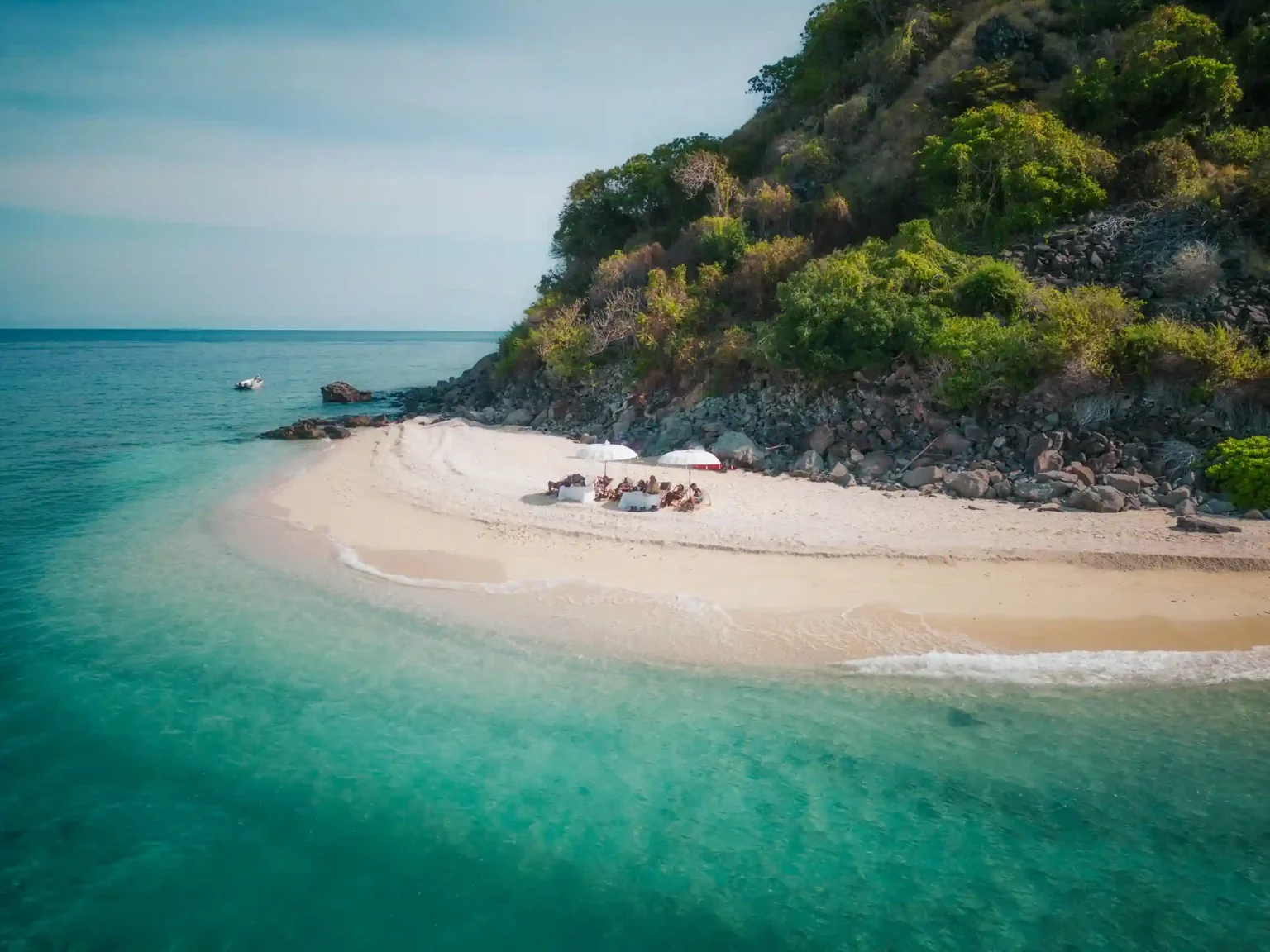
對於追求隱私與專屬體驗的旅客,我們的私人帆船之旅讓您以自己的步調享受奢華,非常適合家庭、情侶或朋友同行。 您亦可選擇參加我們的公開/共享行程——這對獨自旅行者或小型團體而言是絕佳選擇,讓您能與志同道合的探險者一同享受經濟實惠卻不失奢華的冒險,更有機會親眼目睹科莫多龍。若您時間有限,我們的單日行程將在一天內帶您遍覽所有亮點,從科莫多龍徒步探險到在原始水域浮潛,應有盡有。




One thought on “Komodo Dragon Facts: The Field-Checked List”
感謝您這篇精彩的文章。