




Last updated: September 2026 · Prices & availability verified for the 2026/2027 season
Last updated: September 05, 2026
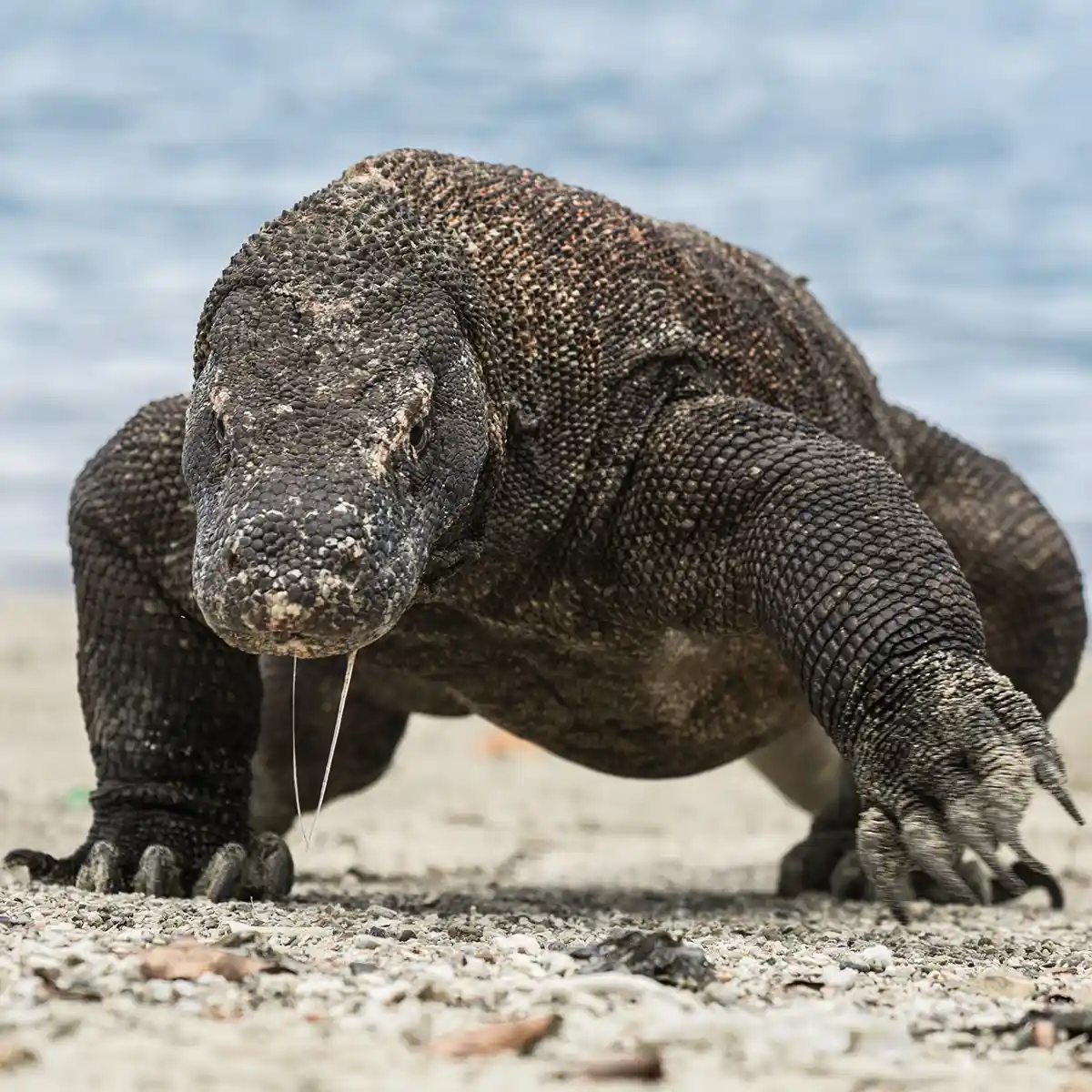
De meest fascinerende feiten over de komodovaraan zijn dat het de grootste levende hagedis ter wereld is, met een lengte tot wel 3 meter en een gewicht van ongeveer 70 kilogram; dat hij giftig is en speciale klieren gebruikt om zijn prooi te verzwakken; en dat hij in het wild uitsluitend voorkomt op Indonesië’s Nationaal Park Komodo en de nabijgelegen eilanden van Oost-Nusa Tenggara, zijn enige natuurlijke leefgebied.
These are the facts our naturalist guides recite on deck the evening before dragon trekking, field-checked by the Komodo Luxury team, a Labuan Bajo operator whose crews have taken travelers to meet wild dragons since 2015, and woven into every itinerary we run, whether a shared 3D2N sailing trip or a ten-day private expedition.
The most interesting Komodo dragon facts are the ones that survive fact-checking: females can give birth without males (confirmed genetically in Nature), their killing tool is venom rather than “toxic bacteria,” their skin hides a suit of bone chain-mail, and an adult can eat up to 80% of its own body weight in one sitting. Here’s the quick summary, followed by our full field-checked list, each fact tied to the study or institution that verified it.
Belangrijkste punten
- Komodo dragons are the only known species where isolated females confirmed capable of virgin birth have also been documented breeding normally afterward, proven genetically in a 2006 Nature study.
- What actually kills prey is venom, not “toxic bacteria” as long believed, 2009 research identified real venom glands that cause uncontrolled bleeding and a dangerous drop in blood pressure.
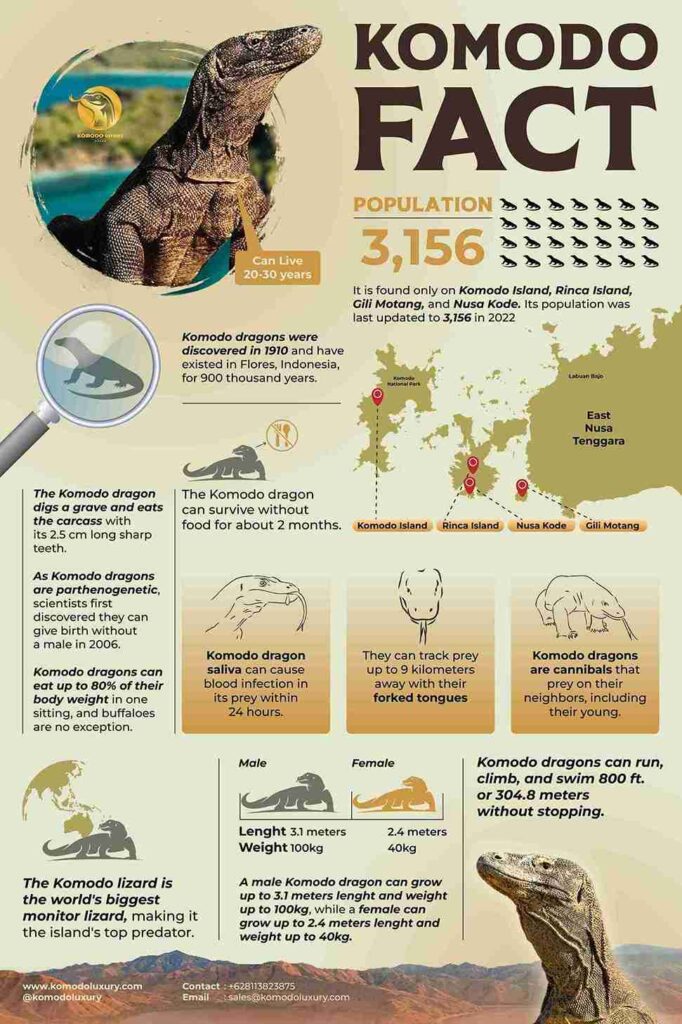
- An adult can eat up to 80% of its own body weight in a single meal, made possible by loosely hinged jaws and a stomach that stretches enormously to hold it all at once.
- Juveniles spend their early years living in trees specifically to avoid being eaten by adults, since cannibalism is a normal and significant part of how the species behaves in the wild.
- The species is now classified as Endangered, with fewer than an estimated 3,500 individuals left in the wild, which is part of why responsible, well-guided tourism matters to their survival.
komodovaraan
Here are the 17 facts that made the cut, each one checked against the original study, institution, or field record behind it, not just repeated from other lists.
1. Females Can Reproduce Without a Male — Proven in Nature
In 2006, geneticists confirmed parthenogenesis — virgin birth — in two zoo females: Flora at Chester Zoo and Sungai at London Zoo, both isolated from males (Watts et al., Nature, 2006). Because dragons use ZW sex chromosomes, parthenogenetic offspring are always male — in theory letting a single stranded female found a new island population by later mating with her own parthenogenetic sons. At least six zoo cases had been recorded by 2010, and Flora herself went on to breed normally with a male afterwards, proving the two reproductive modes coexist in one animal.
2. The “Toxic Bacteria” Story Is a Myth — the Venom Is Real
A 2007 microbiology study found dragon mouths carry ordinary carnivore flora, and in 2009 Bryan Fry’s team demonstrated true lower-jaw venom glands producing anticoagulant, blood-pressure-crashing toxins (PNAS). The full mechanism is explained in our complete Komodo dragon guide.
3. They Can Eat Up to ~80% of Their Body Weight in One Meal
Zoological physiology summaries report adults consuming on the order of 80% of their own mass at a single carcass, helped by loosely articulated jaws and a hugely distensible stomach. After such a meal a dragon may bask for days to power digestion.
4. Their Skin Is Chain-Mail Made of Bone
High-resolution X-ray scans at the University of Texas at Austin (2019) revealed elaborate osteoderms — interlocking bony plates — sheathing adult dragons, densest around the neck and back. The armor’s likely purpose: defense against other Komodo dragons. Hatchlings have none; the armor grows in with age and combat.
5. They Smell Carrion from Kilometres Away
The forked tongue collects airborne molecules and delivers them to the Jacobson’s organ in the roof of the mouth, giving a stereo sense of smell that locates carcasses several kilometres downwind — commonly cited at 4 km or more in favourable wind.
6. Juveniles Live in Trees for Years
Young dragons climb within minutes of hatching and spend their early years aloft, hunting insects and geckos in the canopy. The reason is fact 7.
7. Cannibalism Is Routine, Not Rare
Adult dragons regularly eat smaller ones; field studies treat cannibalism as a significant, ordinary part of dragon ecology and the main selective force keeping juveniles arboreal until they are too big to swallow.
8. They Swim Between Islands
Dragons are strong swimmers recorded crossing kilometre-scale straits, sculling with that muscular tail — which is how one species came to occupy Komodo, Rinca, Gili Motang, Nusa Kode, and coastal Flores. Guests on liveaboard routes occasionally spot one paddling between islets, an unforgettable reminder that the park’s boundaries are the dragons’ highways.
9. They Sprint at 18–20 km/h
Over short ambush bursts a dragon outpaces a jogging human — the reason rangers brief every guest before a trek. They tire quickly, but the first ten metres belong to the dragon.
10. They Have a “Third Eye” on Top of the Skull
Like many lizards, dragons carry a parietal (pineal) eye — a light-sensing organ on the crown that helps regulate daily rhythms and basking behaviour. It senses light, not images.
11. The Tail Is a Weapon in Its Own Right
As long as the body and heavily muscled, the tail delivers strikes capable of knocking down prey and rivals, doubles as a swimming propeller, and counterbalances the lunge.
12. Bite Force Is Modest — Strategy Does the Killing
A crocodile of similar size bites far harder. The dragon instead combines sixty serrated teeth, a slashing bite, venom, and patience — wounding large prey and tracking it by scent until it collapses.
13. An Adult Male Can Outweigh a Human — Records Reach 166 kg
Typical wild males run about 70 kg, and the verified record specimen weighed 166 kg at 3.13 m long. Full male/female tables and the human comparison live in our Komodo dragon size guide.
14. They Can Live Around 30 Years
Institutions cite ~30 years in the wild; the best-documented captives reached their early thirties. Stage-by-stage detail — from a 7–8-month incubation to senior males — is in the Komodo dragon lifespan article.
15. Science Only Met Them in 1912 — Locals Always Knew
Dutch reports of “land crocodiles” in 1910 led P.A. Ouwens to describe the species in 1912; Indonesia protected it by law as early as 1915. The people of Komodo Island had lived beside the ora for centuries and tell a very different story about it — see the Ora legend. And the deeper backstory is stranger still: fossils place the lineage’s origin in Australia — covered in where Komodo dragons come from.
16. They Dig Up Graves — and Locals Adapted
One of the more chilling documented Komodo dragon facts, recorded since Walter Auffenberg’s field studies: dragons will excavate shallow graves to scavenge human remains. Communities on Komodo and western Flores adapted generations ago by siting cemeteries on hard clay ground and mounding rocks over burial sites — a practice you can still see today, and a reminder to treat local customs with respect when visiting.
17. Some Individuals Are Playful
Contrary to their fearsome reputation, individual Komodo dragons in captivity have shown documented play-like behaviour — manipulating buckets, shoes, and other objects and interacting with familiar keepers. Zoo keepers describe distinct personalities from animal to animal. It is not universal, but it shows a behavioural range far wider than the “living weapon” image suggests.
komodovaraan Beschermingsstatus
Afgezien van deze fascinerende eigenschappen gaat de komodo-varaan ( komodovaraan ) een werkelijk onzekere toekomst tegemoet. In 2021 heeft de Internationale Unie voor het behoud van de natuur (IUCN) de soort op haar Rode Lijst geherclassificeerd van ‘Kwetsbaar’ naar ‘Bedreigd ’. Naar schatting leven er nog minder dan 3.500 exemplaren in het wild, verspreid over Komodo, Rinca, Flores en enkele kleinere eilanden in Oost-Nusa Tenggara.
De grootste bedreiging op lange termijn is de klimaatverandering. Verwacht wordt dat de stijgende mondiale temperaturen en zeespiegel de laaggelegen kusthabitats waarvan deze draken afhankelijk zijn, zullen doen krimpen, en sommige modellen wijzen erop dat hun geschikte verspreidingsgebied de komende decennia sterk zou kunnen inkrimpen. Het verlies van leefgebied, bosbranden, stroperij van de herten waarop ze jagen, en de oprukkende menselijke activiteiten zetten de toch al kleine en versnipperde populatie nog verder onder druk.
Het is bemoedigend dat het Nationaal Park Komodo—opgericht in 1980 en sinds 1991 uitgeroepen tot UNESCO-werelderfgoed—zorgt voor krachtige wettelijke bescherming, toegewijde patrouilles van parkwachters en zorgvuldig beheerd toerisme, waarmee de lopende natuurbeschermingswerkzaamheden worden gefinancierd. Fokprogramma’s in dierentuinen over de hele wereld vormen een extra waarborg tegen uitsterven.
Daarom is verantwoord reizen zo belangrijk. Door te kiezen voor een goed begeleid bezoek met een minimale impact, steun je rechtstreeks de parkwachters, onderzoekers en lokale gemeenschappen die zich inzetten voor de bescherming van ’s werelds grootste hagedis, zodat ook toekomstige generaties dit oeroude roofdier nog in het wild kunnen zien gedijen.
See the Facts Walk Past You
Every fact above can be observed on a ranger-guided trek in Komodo National Park: the tongue-flick, the armored gait of a big male, juveniles watching from the trees. Our Komodo tour packages combine licensed rangers at Loh Liang and Loh Buaya with private phinisi charters, so the observation happens on your schedule, not a crowd’s.
Bezoek Komodo eiland via de komodovaraan -tour
Dit zijn enkele feiten over Komodovaranen die je moet weten. Het is van essentieel belang om deze bedreigde diersoort te helpen beschermen. Ze zien er misschien woest uit, maar ze zijn gewend om in de buurt van mensen te leven. Je bent veilig als je onder begeleiding bent van een Komodo Ranger, een lokale deskundige gids op Komodo eiland.
Om de betoverende schoonheid van Komodovaranen echt te beleven, ga je naar Komodo eiland voor onze exclusief Komodo-tour. Kies uit een breed scala aan opties die zijn afgestemd op de wensen van elke reiziger, of je nu de voorkeur geeft aan privacy, een gezamenlijke groepservaring of een avontuur van een hele dag.
Voor wie op zoek is naar privacy en een persoonlijke ervaring biedt onze privé- zeiltocht -tocht luxe op uw eigen tempo, ideaal voor gezinnen, stellen of vrienden. U kunt ook deelnemen aan onze open/gedeelde tour -tocht —perfect voor individuele reizigers of kleine groepen die op zoek zijn naar een betaalbaar maar luxueus avontuur met gelijkgestemde ontdekkingsreizigers, inclusief de kans om Komodovaranen te zien. Voor wie weinig tijd heeft, biedt onze eendaagse tour alle hoogtepunten in één dag, van komodovaraan -trekking tot snorkelen in ongerepte wateren.




One thought on “Komodo Dragon Facts: The Field-Checked List”
Bedankt voor het interessante artikel.