






Last updated: September 2026 · Prices & availability verified for the 2026/2027 season
Last updated: September 05, 2026
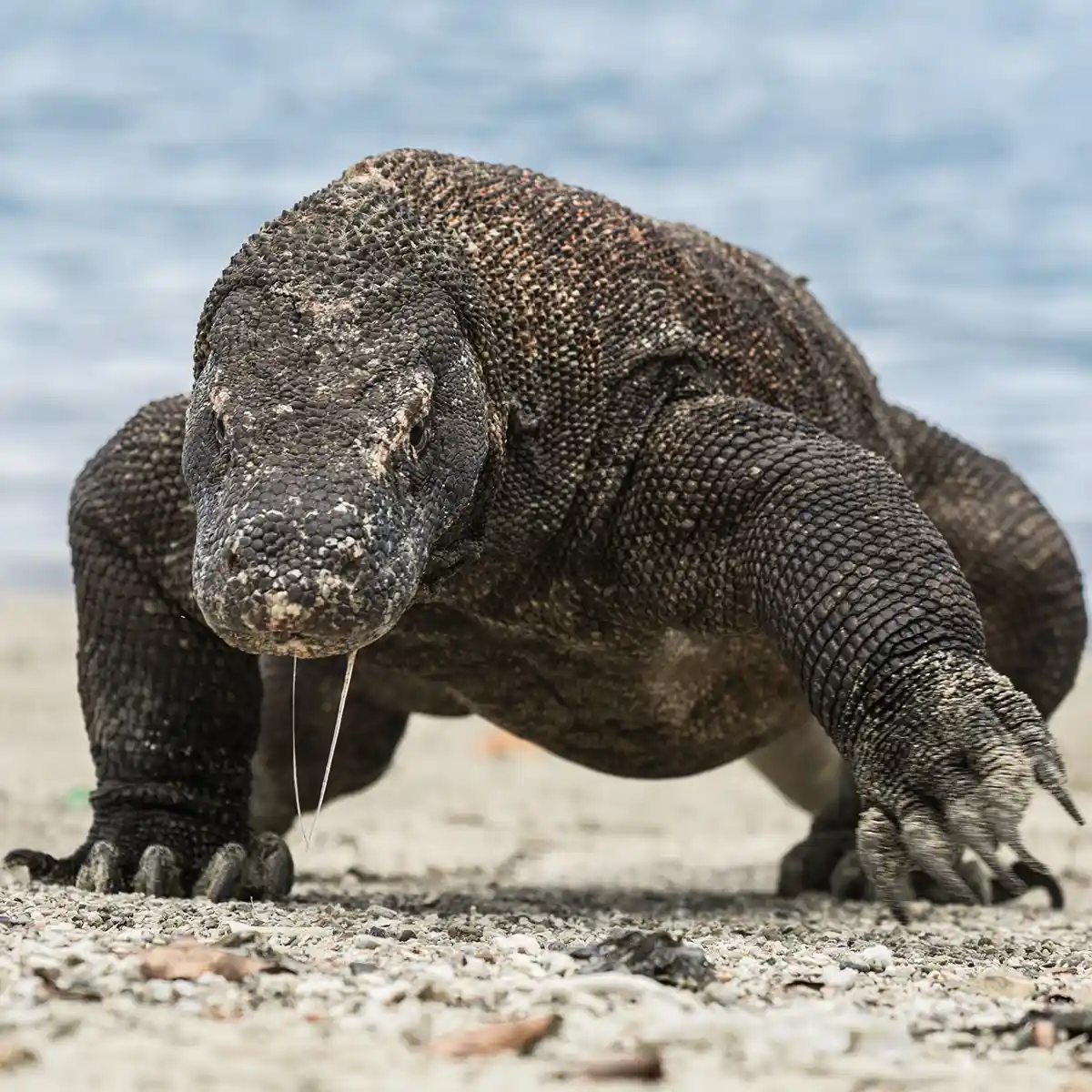
IndonesiaL e curiosità più affascinanti sull’ drago di Komodo sono che si tratta della lucertola vivente più grande del mondo, con una lunghezza che può raggiungere i 3 metri e un peso di circa 70 chilogrammi; è velenosa e utilizza ghiandole specializzate per indebolire la preda; inoltre, in natura vive esclusivamente nell’ Parco Nazionale di Komodo, in e nelle isole vicine di Nusa Tenggara Orientale, il suo unico habitat naturale.
These are the facts our naturalist guides recite on deck the evening before dragon trekking, field-checked by the Komodo Luxury team, a Labuan Bajo operator whose crews have taken travelers to meet wild dragons since 2015, and woven into every itinerary we run, whether a shared 3D2N sailing trip or a ten-day private expedition.
The most interesting Komodo dragon facts are the ones that survive fact-checking: females can give birth without males (confirmed genetically in Nature), their killing tool is venom rather than “toxic bacteria,” their skin hides a suit of bone chain-mail, and an adult can eat up to 80% of its own body weight in one sitting. Here’s the quick summary, followed by our full field-checked list, each fact tied to the study or institution that verified it.
Punti chiave
- Komodo dragons are the only known species where isolated females confirmed capable of virgin birth have also been documented breeding normally afterward, proven genetically in a 2006 Nature study.
- What actually kills prey is venom, not “toxic bacteria” as long believed, 2009 research identified real venom glands that cause uncontrolled bleeding and a dangerous drop in blood pressure.
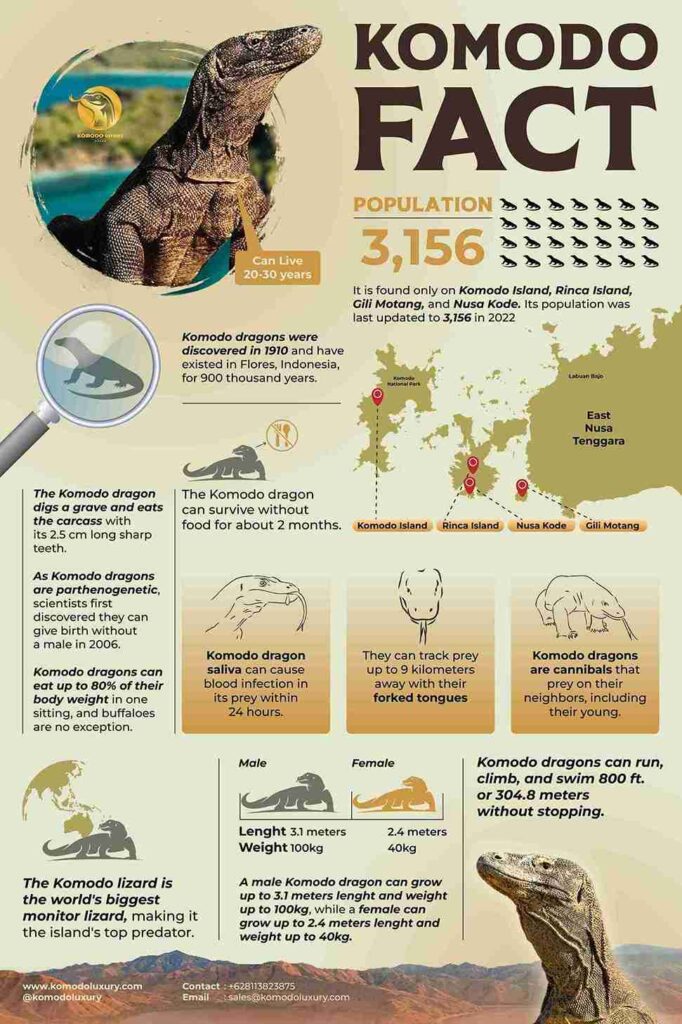
- An adult can eat up to 80% of its own body weight in a single meal, made possible by loosely hinged jaws and a stomach that stretches enormously to hold it all at once.
- Juveniles spend their early years living in trees specifically to avoid being eaten by adults, since cannibalism is a normal and significant part of how the species behaves in the wild.
- The species is now classified as Endangered, with fewer than an estimated 3,500 individuals left in the wild, which is part of why responsible, well-guided tourism matters to their survival.
drago di Komodo
Here are the 17 facts that made the cut, each one checked against the original study, institution, or field record behind it, not just repeated from other lists.
1. Females Can Reproduce Without a Male — Proven in Nature
In 2006, geneticists confirmed parthenogenesis — virgin birth — in two zoo females: Flora at Chester Zoo and Sungai at London Zoo, both isolated from males (Watts et al., Nature, 2006). Because dragons use ZW sex chromosomes, parthenogenetic offspring are always male — in theory letting a single stranded female found a new island population by later mating with her own parthenogenetic sons. At least six zoo cases had been recorded by 2010, and Flora herself went on to breed normally with a male afterwards, proving the two reproductive modes coexist in one animal.
2. The “Toxic Bacteria” Story Is a Myth — the Venom Is Real
A 2007 microbiology study found dragon mouths carry ordinary carnivore flora, and in 2009 Bryan Fry’s team demonstrated true lower-jaw venom glands producing anticoagulant, blood-pressure-crashing toxins (PNAS). The full mechanism is explained in our complete Komodo dragon guide.
3. They Can Eat Up to ~80% of Their Body Weight in One Meal
Zoological physiology summaries report adults consuming on the order of 80% of their own mass at a single carcass, helped by loosely articulated jaws and a hugely distensible stomach. After such a meal a dragon may bask for days to power digestion.
4. Their Skin Is Chain-Mail Made of Bone
High-resolution X-ray scans at the University of Texas at Austin (2019) revealed elaborate osteoderms — interlocking bony plates — sheathing adult dragons, densest around the neck and back. The armor’s likely purpose: defense against other Komodo dragons. Hatchlings have none; the armor grows in with age and combat.
5. They Smell Carrion from Kilometres Away
The forked tongue collects airborne molecules and delivers them to the Jacobson’s organ in the roof of the mouth, giving a stereo sense of smell that locates carcasses several kilometres downwind — commonly cited at 4 km or more in favourable wind.
6. Juveniles Live in Trees for Years
Young dragons climb within minutes of hatching and spend their early years aloft, hunting insects and geckos in the canopy. The reason is fact 7.
7. Cannibalism Is Routine, Not Rare
Adult dragons regularly eat smaller ones; field studies treat cannibalism as a significant, ordinary part of dragon ecology and the main selective force keeping juveniles arboreal until they are too big to swallow.
8. They Swim Between Islands
Dragons are strong swimmers recorded crossing kilometre-scale straits, sculling with that muscular tail — which is how one species came to occupy Komodo, Rinca, Gili Motang, Nusa Kode, and coastal Flores. Guests on liveaboard routes occasionally spot one paddling between islets, an unforgettable reminder that the park’s boundaries are the dragons’ highways.
9. They Sprint at 18–20 km/h
Over short ambush bursts a dragon outpaces a jogging human — the reason rangers brief every guest before a trek. They tire quickly, but the first ten metres belong to the dragon.
10. They Have a “Third Eye” on Top of the Skull
Like many lizards, dragons carry a parietal (pineal) eye — a light-sensing organ on the crown that helps regulate daily rhythms and basking behaviour. It senses light, not images.
11. The Tail Is a Weapon in Its Own Right
As long as the body and heavily muscled, the tail delivers strikes capable of knocking down prey and rivals, doubles as a swimming propeller, and counterbalances the lunge.
12. Bite Force Is Modest — Strategy Does the Killing
A crocodile of similar size bites far harder. The dragon instead combines sixty serrated teeth, a slashing bite, venom, and patience — wounding large prey and tracking it by scent until it collapses.
13. An Adult Male Can Outweigh a Human — Records Reach 166 kg
Typical wild males run about 70 kg, and the verified record specimen weighed 166 kg at 3.13 m long. Full male/female tables and the human comparison live in our Komodo dragon size guide.
14. They Can Live Around 30 Years
Institutions cite ~30 years in the wild; the best-documented captives reached their early thirties. Stage-by-stage detail — from a 7–8-month incubation to senior males — is in the Komodo dragon lifespan article.
15. Science Only Met Them in 1912 — Locals Always Knew
Dutch reports of “land crocodiles” in 1910 led P.A. Ouwens to describe the species in 1912; Indonesia protected it by law as early as 1915. The people of Komodo Island had lived beside the ora for centuries and tell a very different story about it — see the Ora legend. And the deeper backstory is stranger still: fossils place the lineage’s origin in Australia — covered in where Komodo dragons come from.
16. They Dig Up Graves — and Locals Adapted
One of the more chilling documented Komodo dragon facts, recorded since Walter Auffenberg’s field studies: dragons will excavate shallow graves to scavenge human remains. Communities on Komodo and western Flores adapted generations ago by siting cemeteries on hard clay ground and mounding rocks over burial sites — a practice you can still see today, and a reminder to treat local customs with respect when visiting.
17. Some Individuals Are Playful
Contrary to their fearsome reputation, individual Komodo dragons in captivity have shown documented play-like behaviour — manipulating buckets, shoes, and other objects and interacting with familiar keepers. Zoo keepers describe distinct personalities from animal to animal. It is not universal, but it shows a behavioural range far wider than the “living weapon” image suggests.
drago di Komodo Stato di conservazione
Al di là di queste affascinanti caratteristiche, l’ drago di Komodo a deve affrontare un futuro davvero incerto. Nel 2021 l’Unione Internazionale per la Conservazione della Natura (IUCN) ha riclassificato la specie nella Lista Rossa, passando dalla categoria “Vulnerabile” a quella “In pericolo ”. Si stima che in natura ne rimangano meno di 3.500 esemplari, distribuiti tra Komodo, Rinca, Flores e e alcune isole minori nel Nusa Tenggara Orientale.
La principale minaccia a lungo termine è rappresentata dal cambiamento climatico. Si prevede che l’aumento delle temperature globali e del livello del mare ridurrà gli habitat costieri a bassa quota da cui dipendono questi draghi, e alcuni modelli suggeriscono che il loro areale di distribuzione potrebbe ridursi drasticamente nei prossimi decenni. La perdita di habitat, gli incendi boschivi, il bracconaggio dei cervi di cui si nutrono e l’invasione dell’uomo esercitano un’ulteriore pressione su una popolazione già esigua e frammentata.
È incoraggiante che l’ Parco Nazionale di Komodo—istituito nel 1980 e dichiarato Patrimonio dell’Umanità dall’UNESCO nel 1991—offra una solida protezione giuridica, pattuglie di guardie forestali dedicate e un turismo gestito con attenzione, che contribuisce a finanziare le attività di conservazione in corso. I programmi di riproduzione in cattività negli zoo di tutto il mondo costituiscono un’ulteriore garanzia contro l’estinzione.
Ecco perché il turismo responsabile è importante. Scegliere un’escursione ben guidata e a basso impatto ambientale sostiene direttamente l’ ranger, i ricercatori e le comunità locali impegnate a proteggere la lucertola più grande del mondo, garantendo che le generazioni future possano ancora ammirare questo antico predatore che prospera in natura.
See the Facts Walk Past You
Every fact above can be observed on a ranger-guided trek in Komodo National Park: the tongue-flick, the armored gait of a big male, juveniles watching from the trees. Our Komodo tour packages combine licensed rangers at Loh Liang and Loh Buaya with private phinisi charters, so the observation happens on your schedule, not a crowd’s.
Visita il sito Isola di Komodo con il tour " drago di Komodo "
Ecco alcune informazioni su Draghi di Komodo che dovresti conoscere. È fondamentale contribuire alla protezione di questa specie in via di estinzione. Possono sembrare feroci, ma sono abituati a vivere vicino agli esseri umani. Sarai al sicuro se sarai accompagnato da un Komodo Ranger, una guida esperta del posto su Isola di Komodo.
Per vivere appieno la meraviglia di Draghi di Komodo, visita il sito Isola di Komodo con le nostre esclusivo Tour Komodo. Scegli tra una varietà di opzioni pensate su misura per soddisfare le esigenze di ogni viaggiatore, sia che tu preferisca la privacy, un’esperienza di gruppo condivisa o un’avventura di un’intera giornata.
Per chi è alla ricerca di privacy e di un’esperienza personalizzata, il nostro tour privato “ tour in barca a vela ” offre un’esperienza di lusso da vivere secondo i propri ritmi, ideale per famiglie, coppie o gruppi di amici. In alternativa, potete partecipare al nostro tour “open/crociera condivisa ”, perfetto per chi viaggia da solo o per piccoli gruppi che desiderano un’avventura lussuosa ma accessibile insieme ad altri esploratori che condividono gli stessi interessi, con la possibilità di vedere “ Draghi di Komodo ”. Per chi ha poco tempo a disposizione, il nostro tour “one-tour giornaliero ” copre tutte le attrazioni principali in un solo giorno, da “ drago di Komodo ” a “trekking ” fino a “ snorkeling ” in acque cristalline.




One thought on “Komodo Dragon Facts: The Field-Checked List”
Grazie per l'interessante articolo.