





Have you ever wondered what it would be like to compare the largest lizard on Earth with a fish that can generate electricity? On one side, we have the Komodo Dragon, an iconic predator roaming dry islands in Indonesia. On the other side, we have the Electric Eel, a freshwater creature capable of delivering high-voltage shocks that can knock out its prey—or even a larger animal. These interactions highlight how content can be tailored to showcase the unique adaptations of each species.
This might sound like a story straight out of a science-fiction novel, but both animals truly exist in our world. While the Komodo Dragon is found in the rugged islands of Komodo National Park, the Electric Eel thrives in the muddy waters of the Amazon River. Surprisingly, scientists and locals have also reported sightings of electric eels in several rivers in Indonesia, such as the Kapuas, Mahakam, and Seruyan. Even though these two creatures would never naturally cross paths, it’s still exciting to see how each has adapted to survive in harsh environments.
Komodo Dragon: The Rare Beast with a Deadly Bite
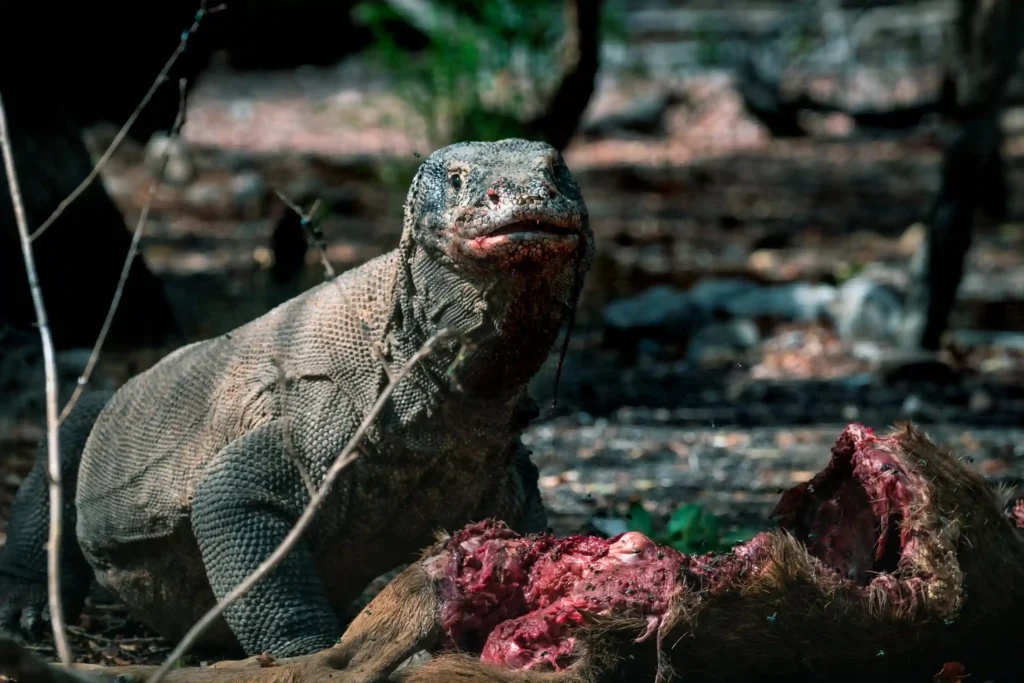
Komodo Dragon (Varanus komodoensis) is the world’s largest lizard, growing up to three meters (about ten feet) in length. These giants can weigh anywhere from 70 to 90 kilograms (150 to 200 pounds), sometimes even more for exceptionally large individuals. Native to the islands of Komodo and Rinca Island in Indonesia, they thrive in the hot and dry climate typical of the region.
Although they may seem slow or lazy at first glance, Komodo Dragons are skilled hunters. They rely on stealth and short bursts of speed to surprise their prey. One of their most notorious weapons is their bacteria- and toxin-laden saliva. When they bite a target—like a deer, wild boar, or buffalo—some scientists believe the mild venom and bacteria in their saliva will eventually weaken the animal. If the prey escapes initially, the dragon will often follow it until the animal collapses from infection or blood loss. Scientific data on their hunting methods and the effects of their venom and bacteria provide valuable insights into their predatory efficiency.
Electric Eel: The Freshwater Predator with a Shocking Secret

Electric Eel (Electrophorus electricus) is commonly mistaken for an eel, but it is actually a type of knifefish. It belongs to the family Gymnotidae and typically lives in the muddy waters of South American rivers such as the Amazon and the Orinoco. The water in these regions can be so murky that visibility is limited, which makes the Electric Eel’s ability to generate electricity incredibly useful for survival.
The eel’s habitat provides essential ecological services, such as maintaining water quality and supporting biodiversity.
Electric Eels can produce a shock up to 600 volts, and some research indicates that larger specimens might deliver bursts of 800 volts or more. To measure the voltage of an eel’s shock, scientists have developed various techniques that help in understanding the eel’s capabilities. To put that in perspective, 600 volts is enough to stun or incapacitate a human or a large mammal. They use this high-voltage shock to:
- Hunt Prey: By discharging electricity to stun fish, amphibians, or even small mammals before consuming them.
- Defend Themselves: Predators often think twice about attacking an Electric Eel once they’ve felt a strong jolt.
- Navigate Turbid Waters: Electric Eels also use low-voltage impulses to sense their surroundings in dark or muddy rivers. This is known as electrolocation.
While Amazonian rivers are the Electric Eel’s most famous habitat, there have been reports of their presence in Sungai Kapuas, Sungai Mahakam, and Sungai Seruyan in Indonesia (all of which are large rivers on the island of Borneo). How did they get there? Some theories suggest that people may have accidentally (or deliberately) introduced them, or the Eels might have found their way through interconnected waterways. Either way, it’s a testament to this species’ adaptability that we need to understand to fully grasp how they can survive in such distant habitats.
Read more: Komodo Dragon vs Blue Viper: The Battle of Two Venomous Reptiles
Komodo Dragon vs. Electric Eel: A Quick Comparison

Below is a handy table highlighting the differences and similarities between these two fascinating creatures:
| Aspekt | Komodovaranen | Electric Eel |
| Klassifikasjon | Reptile (largest lizard on Earth) | Knifefish (often called “eel,” but not a true eel) |
| Length | Up to 3 meters (10 feet) | Typically 1.5–2 meters (5–6.5 feet) |
| Vekt | 70–90 kg (150–200 lbs) or more | 10–20 kg (22–44 lbs) |
| Habitat | Dry islands in Nusa Tenggara, Indonesia | Freshwater rivers: Amazon, Orinoco, plus sightings in Kapuas, Mahakam, and Seruyan |
| Main Defense | Toxic saliva, sharp claws, thick skin | Powerful electric shock—often 600 volts or more |
| Kosthold | Carnivorous (deer, wild boar, buffalo, carrion) | Carnivorous (fish, amphibians, crustaceans) |
| Jaktmetode | Surprise attacks, bites, and stalking prey until it weakens | Shocking prey with electric discharges |
| Life Span | 20–30 years (in the wild) | Around 15 years (in the wild)Around 15 years (in the wild) |
| Spekter | Komodo, Rinca, Flores, Gili Motang, Nusa Kode | South America (Amazon, Orinoco), plus introduced sightings in parts of Indonesia |
| Unique Trait | “Living dinosaur” appearance; venomous bite | Electric organ for shock and electrolocation |
Physical Appearance
The Komodo Dragon looks like a living relic from prehistoric times, with thick scales and a bulky frame. Its color often matches the dry, rocky environment of its island habitat. Meanwhile, the Electric Eel has a sleek, elongated body. It’s quite flexible, allowing it to slip through underwater vegetation and around submerged obstacles with ease.
For a more engaging experience, you can explore various videos showcasing the unique appearances and interactions of these fascinating creatures.
Størrelse og vekt
Komodo Dragons generally outweigh Electric Eels. A large dragon can easily surpass 90 kilograms, which is much heavier than your average Electric Eel. Still, the Eel’s body can reach similar lengths—just in a slimmer, more hydrodynamic form. Over time, the sizes of both animals have evolved to suit their environments.
Jakt og fôring
- Komodo Dragon: Prefers a “sit-and-wait” strategy, ambushing deer, wild boar, or other animals. Once it bites, the toxins in its saliva may speed up the weakening process.
- Electric Eel: Relies on its electric pulses. It detects potential meals using electrolocation, then fires a strong shock to stun or kill its target. These hunting strategies are often highlighted in nature documentaries, similar to how ads use cookies to tailor content based on user preferences.
Forsvarsstrategier
Komodo Dragons have thick skin, sharp claws, a forceful tail, and that infamous toxic bite. Electric Eels deter predators with their shocking ability, capable of delivering jolt after jolt. In the water, these shocks spread through the surrounding area, which can be quite effective against threats. Data on these defense strategies is often collected and analyzed using cookies to enhance user experience and personalize content.
Habitat og utbredelse
- Komodo Dragon: Restricted to a few islands in Indonesia—this isolation is one reason they remain so distinct.
- Electric Eel: Primarily in South America, but sightings in Indonesian rivers have raised eyebrows and interest among wildlife experts due to the unique environmental settings.
Adaptations for Survival: Additional Information
Komodo Dragons control their body temperature by basking in the sun and seeking shade when it’s scorching. They have a keen sense of smell, used to locate carrion from miles away. Electric Eels can breathe air, which gives them an edge in oxygen-poor, murky rivers. Their electric organs are perfect for both offensive and defensive maneuvers, providing them with various survival options.
Les mer: Komodovaranen vs. Black Mamba: En sammenstøt mellom to dødelige rovdyr
Komodo Dragon vs Electric Eel: Who Would Win?
A Komodo dragon gets shocked by a stranded electric eel pic.twitter.com/ixBvEOYGD8
— 💪🎭..Rai ji..💪🎭 (@Vinod_r108) 9. februar 2025
It’s highly unlikely these two creatures would ever encounter each other naturally. But if they did, the battle’s outcome would depend almost entirely on where they met and how the fight would continue in different environments.
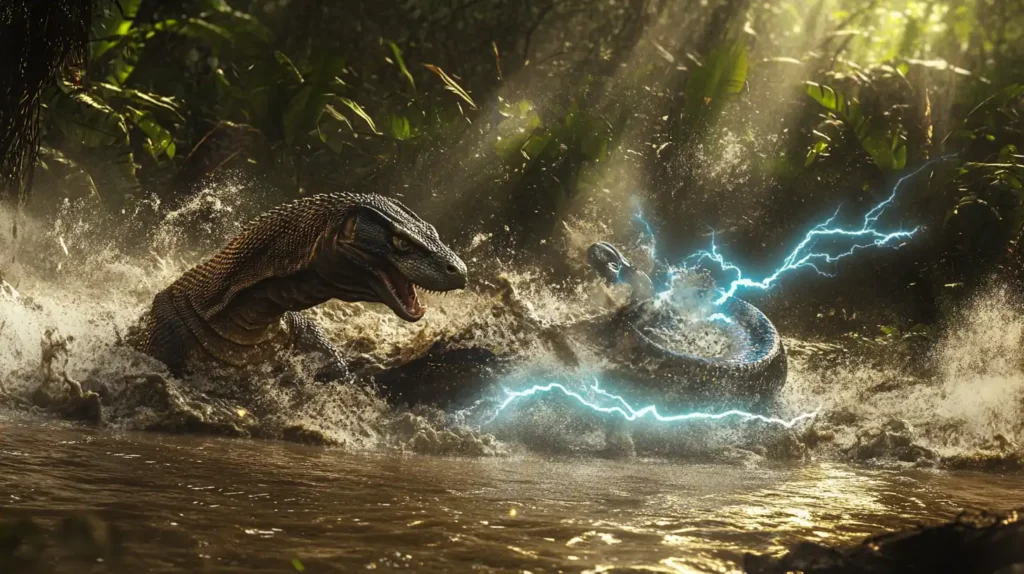
- On Land: The Komodo Dragon would dominate. Electric Eels need water to channel their electric shocks effectively. Outside of water, an Eel can still produce electricity, but not with the same range and force. Meanwhile, the dragon’s size, powerful jaws, and clawed limbs would give it the upper hand.
- In Water: The Electric Eel would have a serious advantage. Its electrical discharge spreads efficiently through water, likely incapacitating the dragon before it can deliver a lethal bite.
In reality, these creatures are rulers of their own realms. The Komodo Dragon rules the dry terrain of its Indonesian islands, while the Electric Eel is an apex predator in rivers where it can use electricity to hunt and defend itself.
Embracing the Wonders of Nature with Komodo Luxury
The worlds of the Komodo Dragon and the Electric Eel might be miles apart—geographically and ecologically—but both creatures remind us just how diverse and fascinating our planet’s wildlife can be. From the dragon’s venom-laced bite to the eel’s shock of up to 600 volts or more, each has evolved an edge that allows it to thrive in a challenging environment.
You’re probably wondering how you can see a Komodo Dragon in person. The best way is to visit Komodo National Park in Indonesia, home to these incredible reptiles. If you’re excited to see these giant lizards for yourself and enjoy the adventure of island hopping in the Indonesian archipelago, don’t wait.

Let Komodo Luxury be your guide to one of the most unique travel experiences in the world. Witness the Komodo Dragon in its natural habitat and soak in the stunning beauty of Indonesia’s lesser-explored islands—all while enjoying top-tier comfort and expert insights. Don’t miss out on this once-in-a-lifetime experience, book your Komodo Island Tour with Komodo Luxury now!
Les mer: Komodovaranen vs.: Den ultimate guiden til episke oppgjør med dyrelivet