





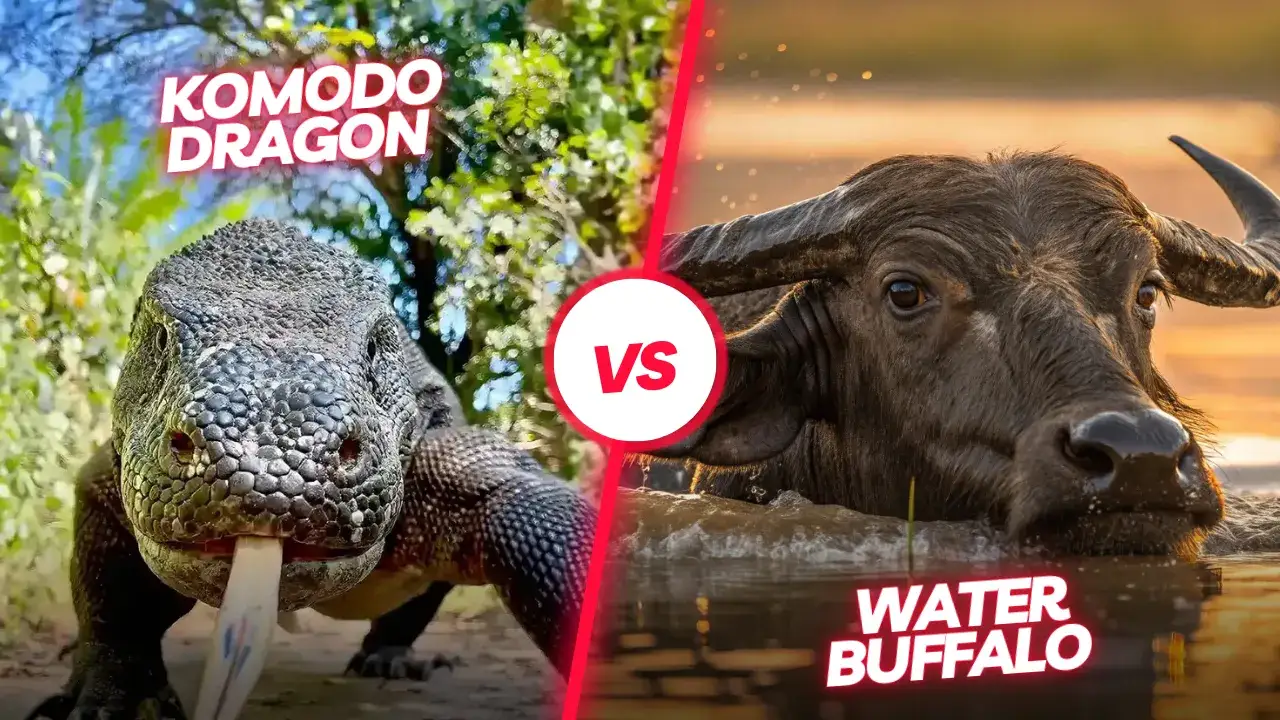
Ever wondered what would happen if an old predator like the Komodo dragon went head to head with a massive herbivore like the water buffalo? Both are from Asia, have unique features and are powerful. For those who love outdoor adventures, tracking a Komodo dragon in its natural habitat—Komodo National Park— is an exciting yet fascinating experience. You might be curious about each creature’s appearance and behavior in the wild, especially if they ever cross paths. So, what really happens when a Komodo dragon meets a water buffalo in real life?
Komodo Dragon: The King of Reptiles
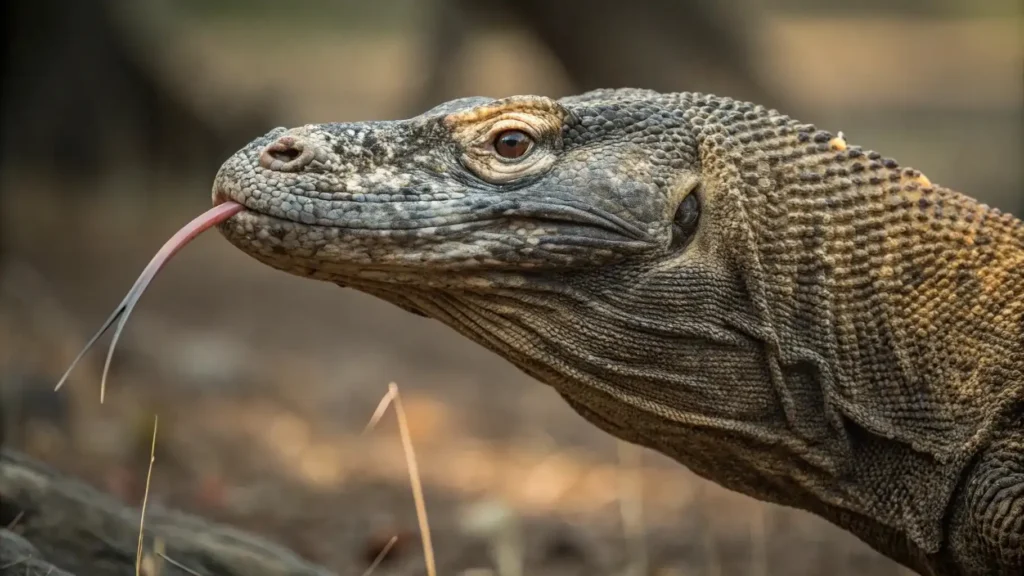
Komodo dragon (Varanus komodoensis) is also called “ora” by locals. It is the largest lizard on earth. It can grow up to 3 meters long and weigh 70 to 90 kg. At first glance, it looks like a reptile from ancient times. Although it moves slowly, a Komodo dragon can run up to 20 km/h for short distances. Its eyes are sharp, its tongue is forked and its saliva is full of deadly bacteria—a essential tool when hunting prey.
Aside from its physical strength, a Komodo dragon has a keen sense of smell thanks to the Jacobson’s organ in the roof of its mouth. When the dragon flicks its tongue, it’s actually “tasting” the air to detect the presence of prey or carrion several kilometers away. That’s why it’s called an opportunistic predator—it doesn’t just hunt live animals but also consumes carcasses. Komodo dragons hunt by ambushing prey, using its sense of smell and stealth to catch unsuspecting animals.
Its natural habitat is concentrated in a few Indonesian islands, particularly in Komodo National Park which includes Komodo Island, Rinca, Gili Motang, Nusa Kode and Padar Island. These giant reptiles prefer savanna-like plains and scrublands with hot temperature, high humidity and coastal ecosystems where they can seek shelter and food. Female Komodo dragons lay their eggs in a self-dug nesting hole or abandoned megapode nests where the eggs incubate for 7-8 months. Although they seem lazy, Komodo dragons are formidable hunters that can take down large animals like Timor deer, wild boar, goats and even horses. But what if a Komodo dragon chooses to attack a water buffalo?
Water Buffalo: The Strong and Resilient Beast
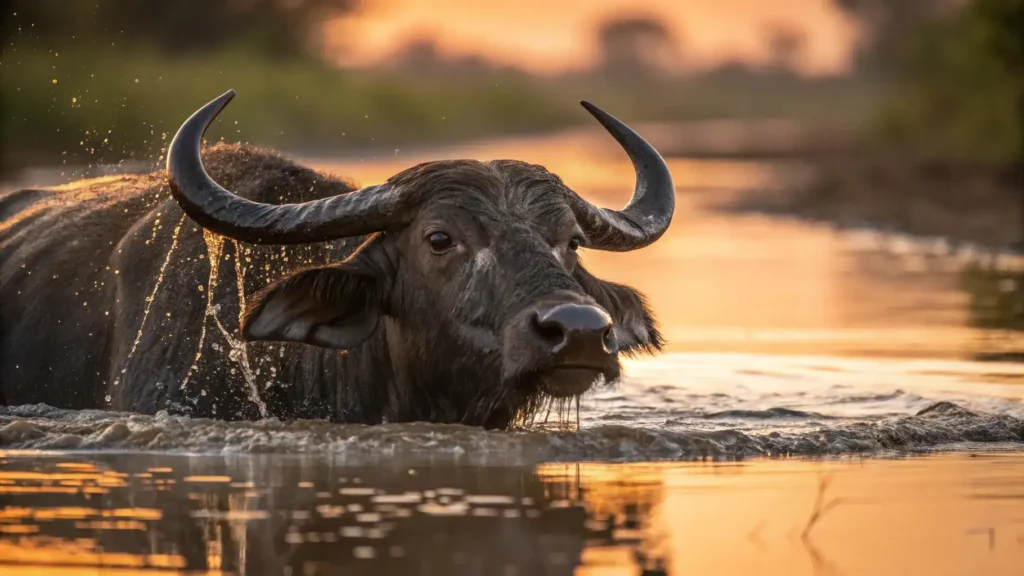
The water buffalo is considered a working animal in many parts of Asia. Its body is big and robust with shoulder height of 1.5 meters and weight of over 600 kg. Its color can range from dark gray to deep brown and has long curved horns that can stretch over a meter in length. As herbivores, its main diet consists of grass, aquatic plants and various leaves.
The name “water buffalo” comes from their habit of wallowing in muddy water to regulate their body temperature and get rid of parasites. They can be found in South and Southeast Asia including Indonesia. Beyond their role in agriculture, water buffalo also has a strong instinct for survival in the wild.
Don’t underestimate the water buffalo’s defensive nature. When threatened, they can counterattack with their sharp horns that can seriously wound a predator. They also often gather in herds for protection.
Komodo Dragon vs Water Buffalo: A Complete Comparison
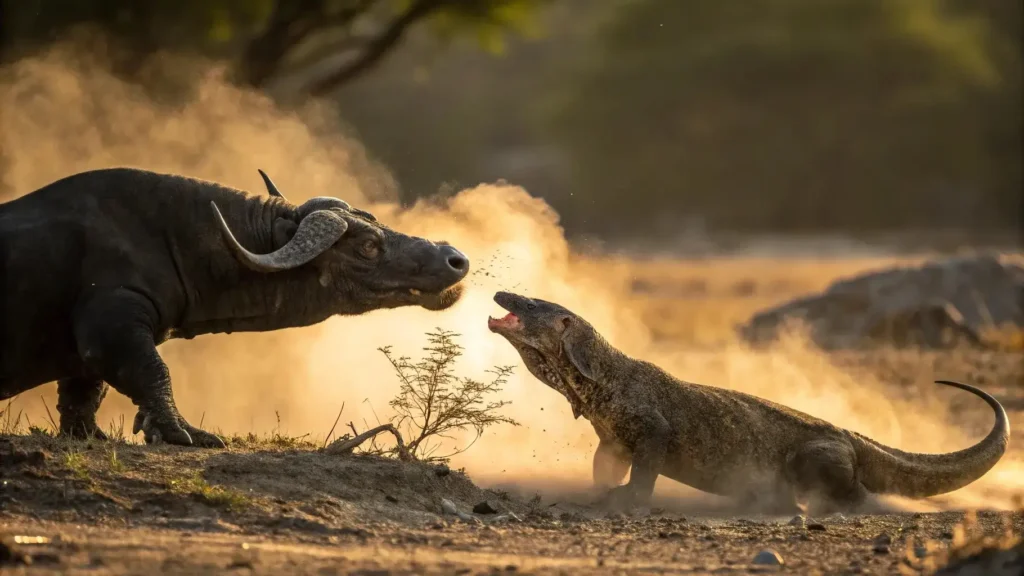
When discussing the topic of “Komodo dragon vs water buffalo” several interesting points come up, from physical traits and size to diet, defense, habitat and adaptation.
| 양상 | 코모도 드래곤 | Water Buffalo |
| Length/Weight | 2–3 m / 70–90 kg | 1.3–1.5 m tall / 400–600 kg |
| 다이어트 | 육식동물 | 초식동물 |
| 주무기 | Venomous bite, claws | Long, curved horns |
| Distribution | Komodo Island & nearby isles | South & Southeast Asia |
| Key Adaptation | Excellent sense of smell (Jacobson’s) | Mud-wallowing to regulate body temperature |
| Defense Behavior | Ambush tactics | Counterattacks in groups |
신체적 특징
The Komodo dragon has a long muscular body supported by four strong legs giving it a low but powerful stance. Its thick scaly skin is usually grayish-brown and blends with dry rocky environment. It has strong jaws and sharp teeth to tear flesh easily. The Komodo as it is also called is an apex predator in its ecosystem. Its powerful claws are for digging, climbing and attacking prey. Beneath its rough exterior lies a highly efficient digestive system that can consume large amounts of raw meat at once.
The water buffalo has a big imposing body with thick muscular neck and broad chest. Its skin is relatively thick and covered with short hair varying in color from dark gray to black. One of its most distinctive feature is its long curved horns that can extend outward and upward in an impressive arc. These horns are for defense and display of dominance among rivals. With strong sturdy legs, the water buffalo can move easily in muddy wetlands and support its massive body weight.
크기
The Komodo dragon is the largest living lizard in the world. It grows between 2 to 3 meters (6.5 to 10 feet) in length and weighs 70 to 90 kilograms (154 to 198 pounds) or even 100 kilograms (220 pounds) for larger individuals. Its long tail makes up a big portion of its body length and helps with balance and agility.
The water buffalo, on the other hand, is much heavier and taller. It stands at an average height of 1.3 to 1.5 meters (4.3 to 5 feet) at the shoulder and weighs between 400 and 600 kilograms (880 to 1,320 pounds) or even 800 kilograms (1,760 pounds) for larger individuals. Its massive size alone can deter potential predators.
식단과 사냥 전략
A Komodo dragon is a carnivore, it feeds only on meat. It’s a hunter and a scavenger, preying on deer, pigs and even large water buffalo. Its hunting strategy is stealth and patience. It hides along trails waiting for unsuspecting prey to pass by before launching a swift ambush. With a powerful bite, it injects venom and harmful bacteria into its victim’s bloodstream, weakening or immobilizing it over time. Once the prey collapses, the Komodo dragon moves in to finish the kill and feast. Komodo dragons sometimes attack humans especially in areas where they coexist with people, showing its presence in their ecosystem.
The water buffalo is a herbivore, it lives on grasses, aquatic plants and leaves. It spends most of its day grazing in wetlands or open fields. Though it doesn’t hunt, it’s not defenseless. If threatened, a water buffalo will not hesitate to use its strength and sharp horns to fight off predators.
방어
The Komodo dragon relies on brute strength, venom and strategy to defend itself. Its sharp claws and powerful jaws can cause serious injury, while its toxic bite can ensure that even a wounded enemy won’t survive long. Though it appears slow, it can run fast when necessary to chase or evade threats.The water buffalo relies on its size, thick skin and horns for defense. If a predator gets too close, it will charge head-on using its horns as deadly weapons. Water buffaloes rarely live alone, they stay in herds and when threatened they group together to deter predators. This collective defense makes them one of the toughest animals for predators like tigers and crocodiles to take down.
서식지 및 분포
The Komodo dragon is found only in a few isolated areas in East Nusa Tenggara, Indonesia including Komodo Island, Rinca Island, Gili Motang and parts of Flores. It thrives in dry savannas, open tropical forests and coastal areas where it can blend in and hunt effectively. Because of its limited range, conservation is key to its survival.
The water buffalo on the other hand has a wider distribution. It is found in several Asian countries including Indonesia, India, Nepal, the Philippines and Thailand. It prefers wetland environments such as swamps, rivers and flooded grasslands where it can graze and cool off in the water. Domesticated water buffaloes are also common in rural areas where they are used for farming and transportation.
생존을 위한 적응
The Komodo dragon has several adaptations to be a top predator. Its highly developed sense of smell made possible by its Jacobson’s organ can detect the scent of dead or injured animals from kilometers away. Its slow metabolism allows it to survive for weeks without food after a big meal. And its powerful bite and venomous saliva ensures that even if prey escapes initially it will likely succumb to infection or weakness making the Komodo dragon an extremely effective hunter. Young Komodo dragons to avoid predators often dwell in trees and exhibit unique behavior such as rolling in feces to repel threats.The water buffalo also has many survival traits. Its thick skin protects it from insect bites and minor wounds. Its large horns are used as a weapon and status symbol among other buffaloes. One of its most important adaptation is wallowing in mud which helps regulate body temperature and keeps its skin free from parasites. Most importantly water buffaloes rely on their herd mentality, as staying in groups greatly reduces their chances of being preyed upon.
These two amazing animals have evolved unique traits to survive in their respective environments. The Komodo dragon, a stealthy and venomous predator, rules the islands of Indonesia while the water buffalo, a massive and resilient herbivore, thrives in the wetlands of Asia.
Komodo Dragon vs Water Buffalo: Who Would Win?
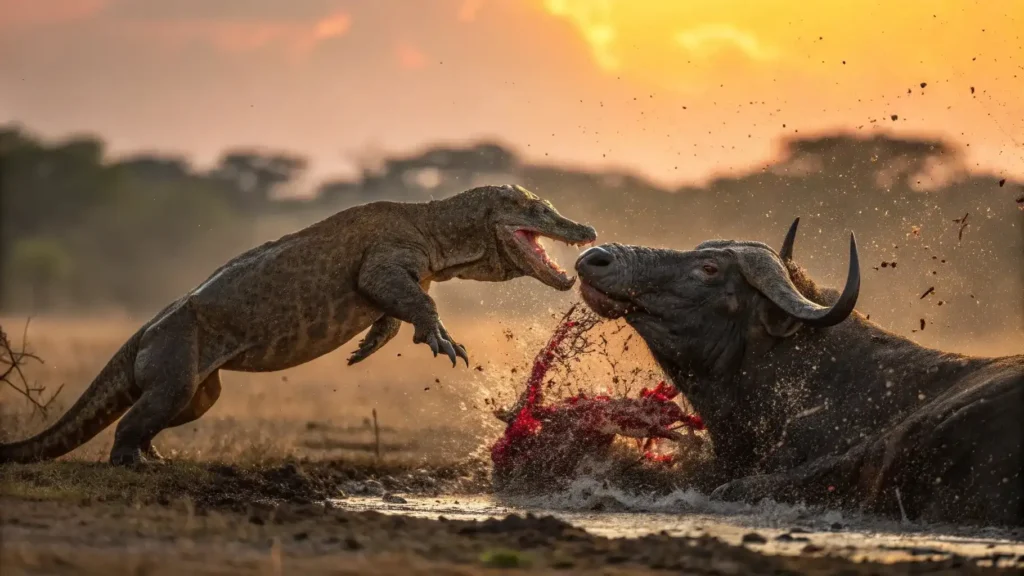
Figuring out the winner in a showdown between a Komodo dragon and a water buffalo isn’t easy. Both animals have their advantages. On one hand a Komodo dragon is smaller than a water buffalo. On the other never underestimate the agility and venomous bite of this ancient reptile. In the reptile world the Komodo dragon’s hunting strategies and venomous bite make it a formidable opponent.
An adult water buffalo is bigger and its horns can be fatal if it hits directly. A Komodo dragon might bite the buffalo’s legs or abdomen then wait for the toxins to take effect. If the bite is successful and the water buffalo can’t run or defend itself—especially if it’s alone from its herd—the buffalo will become weak or seriously infected.While a Komodo dragon’s bite rarely kills immediately the cumulative effect of its bacteria and venom can wear the buffalo down. Komodo dragons often use a “bite and wait” strategy. So if someone asks, “Who would win?” the answer depends on the situation. If the buffalo is with its herd its chances improve. But if a Komodo dragon can bite the buffalo when it’s alone the tables can turn fast.
In the wild these two creatures don’t usually engage in a full on battle like in an arena. But tense encounters can happen especially if a hungry Komodo dragon sees an opportunity.
Witnessing the Komodo Dragon in Komodo National Park
From what we’ve covered “Komodo dragon vs water buffalo” isn’t just about size and strength. Each animal has unique characteristics—from their physical makeup to their behavior and survival strategies. The Komodo dragon has biological weapons like venom and bacteria in its saliva while the water buffalo relies on its massive body, sharp horns and herd dynamics to defend itself. If you’ve seen a water buffalo in real life then it’s time for you to see a Komodo dragon in real life.
If you want to see Komodo dragons in their natural habitat then there’s no better place than Komodo National Park in East Nusa Tenggara. This region has stunning scenery—from white sandy beaches and crystal clear waters to dry savannas where Komodo dragons roam.

For a complete experience—sailing across turquoise seas, trekking through exotic islands and witnessing Komodo dragons up close—join a Komodo Island Tour with Komodo Luxury. A professional team will ensure you have an unforgettable journey, with safety as priority and in-depth knowledge about the area’s wildlife. Don’t miss out on exploring the wild, feeling the thrill of encountering an ancient predator and relaxing on a comfortable tour vessel.
Book now. Click the link to Book a Komodo Island Tour with Komodo Luxury and get ready for an adventure of a lifetime. Seeing a Komodo dragon in person, exploring its habitat and soaking up the raw excitement of nature will be an experience you’ll treasure.